
Interlink Electronics Unfolds Amid Shifting Demand and Supply Dynamics
Q2 2026 filings reveal measured order patterns, supply risk awareness, and solid liquidity underpinning Interlink's sensor component business.
Interlink Electronics’ latest quarterly disclosures highlight stable but modest order intake amid competitive pressures and supply chain uncertainties. The company’s business model balances revenues from standard force and touch sensor sales with higher-margin custom engineering and tooling fees tied to design wins. Despite customer concentration risks and intellectual property vulnerabilities, Interlink maintains a strong liquidity position supporting operational flexibility. Key growth drivers lie in the expanding adoption of human-machine interface technologies and aftermarket service opportunities, though supply constraints could pressure margins ahead.
Latest Quarter Demand Signals Reflect Measured Order Intake during Competitive Pressures
Interlink Electronics’ Q2 2026 filings show relative stability in strategic demand indicators without pronounced growth or contraction. The Form 10-Q filed August 13, 2026 reveals no material changes to the risk factors previously disclosed in the March 2026 annual report, signaling continued cautiousness about market conditions [S2].[S3] While detailed order backlog volume and book-to-bill ratios are not explicitly quantified, narrative evidence suggests incoming orders remain consistent with manufacturing throughput capacity expectations. This stagnant yet stable order cadence implies that customer engagements have not accelerated meaningfully in recent months nor deteriorated sharply, reflecting measured industrial demand during competitive pressures.
In this sector, backlog quality and book-to-bill ratios often presage revenue trajectories. Given Interlink’s sensitivity to OEM purchasing cycles—who provide cancellable purchase orders rather than firm long-term commitments—the observed pattern suggests moderate predictability in near-term production scheduling. Absent a clear ramp-up signal, the company will be dependent on maintaining its design win pipeline and managing customer relationships to sustain output flow.
Sensor Manufacturing Economics: Custom Engineering Fees Anchor Revenue Streams
Interlink Electronics operates on a dual revenue model comprising core sensor product sales—primarily force and touch sensors—and ancillary custom engineering services including design tooling fees essential for customer-specific product integration [S1]. This duality reflects typical industrial hardware manufacturing economics where baseline unit volumes generate foundational revenue but bespoke engineering projects carry higher margin mixes.
Custom designs usually involve upfront engineering fees for prototyping and tooling that stabilize income beyond the volatility of unit sales alone. In practice, Interlink provides product samples followed by iterative testing with customers to tailor sensor performance to exact specifications—an intensive process aimed at securing “design wins,” which represent both pre-production orders and firm commitments from customer engineering or purchasing teams. These wins translate directly into backlog quality critical for volume forecasting.
The importance of this business stream lies in its ability to differentiate Interlink’s offering against commoditized component suppliers by embedding deeper client engagement early in product lifecycles. However, it requires sustained R&D investment, often indicated in increased operating expenses relative to sales.
Industry Value Chain Position: Balancing Technology Rights with Supply Constraints
Interlink situates itself midstream in the industrial hardware value chain supplying sensors integrated by OEMs into complex systems targeting automation, medical equipment, automotive applications, and IoT platforms [S1]. Maintaining developed technology rights and intellectual property safeguards is pivotal given the rapid innovation environment characterized by multi-modal input platforms and printed electronics.
However, sustaining these competitive advantages entails ongoing costs related to legal protection against infringement claims, as well as investments in evolving regulatory compliance—especially given cross-border manufacturing involving facilities in China, California, Scotland, and England as disclosed historically [S1][S6].
Concurrently, supply chain dynamics impose operational leverage limits; Interlink relies on third-party raw material suppliers susceptible to shortages or price volatility that can constrain production capacity utilization or inflate costs unexpectedly [S6]. These dual pressures require balancing capital allocation to protect IP assets while navigating supply bottlenecks that directly impact margin conversion rates.
Design Win Dynamics: Translating Custom Solutions Into Backlog Quality
Interlink’s revenue continuity depends heavily on converting custom engineering collaborations into tangible design wins—a recognized precondition for backlog firmness and forward revenue visibility [S1][S6]. The process involves close co-development with customers to align sensor specifications with end-product requirements.
Variations in success rates for such projects directly affect demand predictability since prolonged development cycles or cancellation risks add uncertainty to production schedules. Given that the company’s customers issue cancellable purchase orders without guaranteed long-term volume minimums, fluctuations in project approval or delays in engineering sign-off can disrupt the order cadence.
This concentration of risk mandates vigilant pipeline tracking; failure to secure consistent design wins may reduce future backlog quality raising vulnerability in Quarter-over-Quarter demand stability.
Margins Under Pressure? Assessing Production Capacity Utilization Amid Supply Bottlenecks
While direct Q2 financial metrics specific to margins were sparse beyond general income statement trends, supply chain references underscore persistent challenges impacting production efficiency [S6]. Industry peers often face similar constraints where elevated raw material prices or delayed delivery extend lead times disrupting lean manufacturing flow.
Such bottlenecks often pressure margins through increased procurement costs or underutilized capacity due to inventory imbalances—a double hit on operational profitability. Monitoring manufacturing yield rates and quality control escapes thus becomes crucial; suboptimal yields augment cost burdens further eroding profitability.
Incremental evidence of margin impact should emerge from subsequent quarterly filings revealing whether supply restoration efforts resolve quickly or exacerbate expense overruns.
Strategic Risks: Customer Concentration and Intellectual Property Vulnerabilities
A standout operating risk is Interlink’s substantial reliance on a concentrated customer base where the top two clients represented roughly 27% of total revenue for the year ended December 31, 2025 (18% plus 9%) [S6]. This concentration heightens exposure; a significant volume reduction or loss of one customer could materially disrupt financial performance absent rapid replacement orders.
Moreover, intellectual property challenges constitute an ongoing threat given the competitive landscape where patent disputes or claims could incur legal costs or limit market access [S1]. Maintaining robust IP defenses while evolving technology offerings is thus vital to safeguarding revenue streams tied closely to proprietary sensor designs and customized solutions.
The fragility linked to these risks necessitates continuous engagement with top clients to preserve relationships alongside vigilance over IP enforcement boundaries.
Growth Catalysts: HMI Innovation Trends and Aftermarket Service Expansion
Growth vectors for Interlink Electronics derive largely from macro trends boosting adoption of advanced human-machine interface (HMI) systems across industrial automation sectors and consumer device markets now expecting seamless gesture-based controls [S1]. Expansion into IoT-connected sensing adds further addressable market breadth benefiting printed electronics solutions enabling thin-film flexible sensors.
Additionally, aftermarket service revenues present opportunities for profit stabilization through maintenance contracts or replacement part sales extending client lifecycle value beyond initial product shipment—a valuable complement reducing dependency on fresh design wins alone.
While relatively less emphasized in the recent filings compared to prior years, these thematic sectors underpin strategic rationale supporting incremental investment in R&D aligning product innovation pipelines with emergent industry requirements.
Key Milestones Ahead: Order Cadence Monitoring and Capacity Deployment Insights
Maintaining operational momentum hinges on demonstrable confirmation of improving order cadence sequentially beyond Q2’s flat pattern coupled with effective capacity scaling aligned with production forecasts—a critical indicator for converting backlog into recognized revenue efficiently [S2][S3]
Another milestone involves tracking new design win conversion rates translating prototype projects into volume shipments that replenish firm order books.
Early signals of supply chain lead-time normalization would also offer margin relief insight bolstering financial outlooks amid ongoing external cost pressures.
Collectively these metrics act as actionable barometers defining short-term execution risk versus growth opportunity balance.
Financial Profile Discussion: Liquidity Strength Supports Operational Flexibility
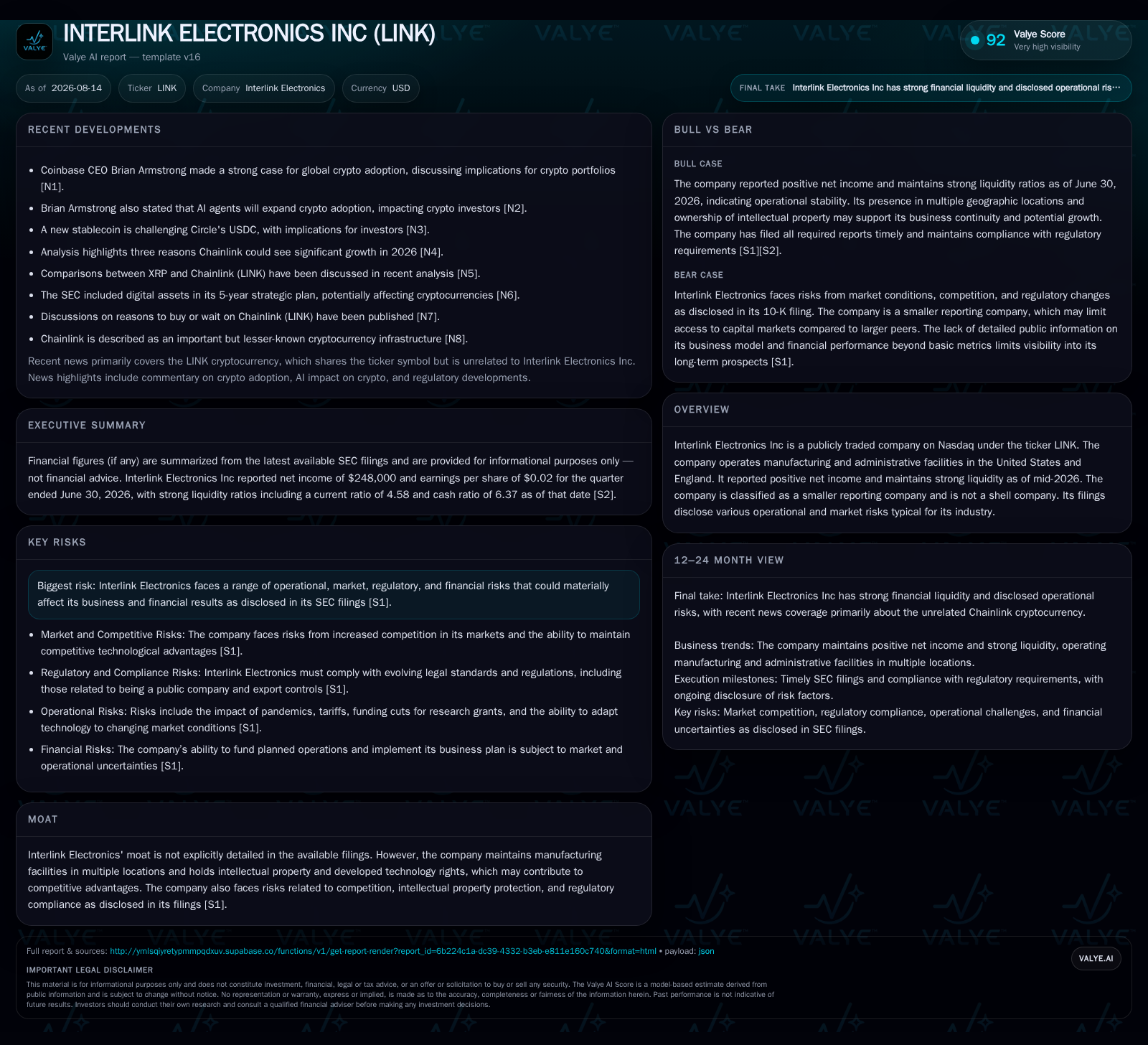
Interlink Electronics displays a solid liquidity foundation as evidenced by $1.83 million cash and equivalents against only $1.32 million current liabilities at June 30, 2026 providing a robust current ratio near 4.58x—well above typical operational thresholds ensuring short-term solvency [F1]. This liquidity position supports necessary working capital requirements alongside funding ongoing R&D outlays crucial for maintaining competitive sensor solutions.
Maintaining cash runway while optimizing capital deployment towards engineering tooling fees linked directly with design win acquisition will be pivotal for sustaining future earnings improvements without compromising balance sheet health.
Disclaimer: This is research-only, informational analysis and not investment advice. It may include AI-generated interpretation and general industry context. Always verify important details using primary sources.

Comments