
Vystar’s Multipronged Innovation Struggle Amid Cash Constraints
The company grapples with liquidity pressures while advancing patented eco-friendly latex and FDA-cleared medical air purifiers in fragmented markets.
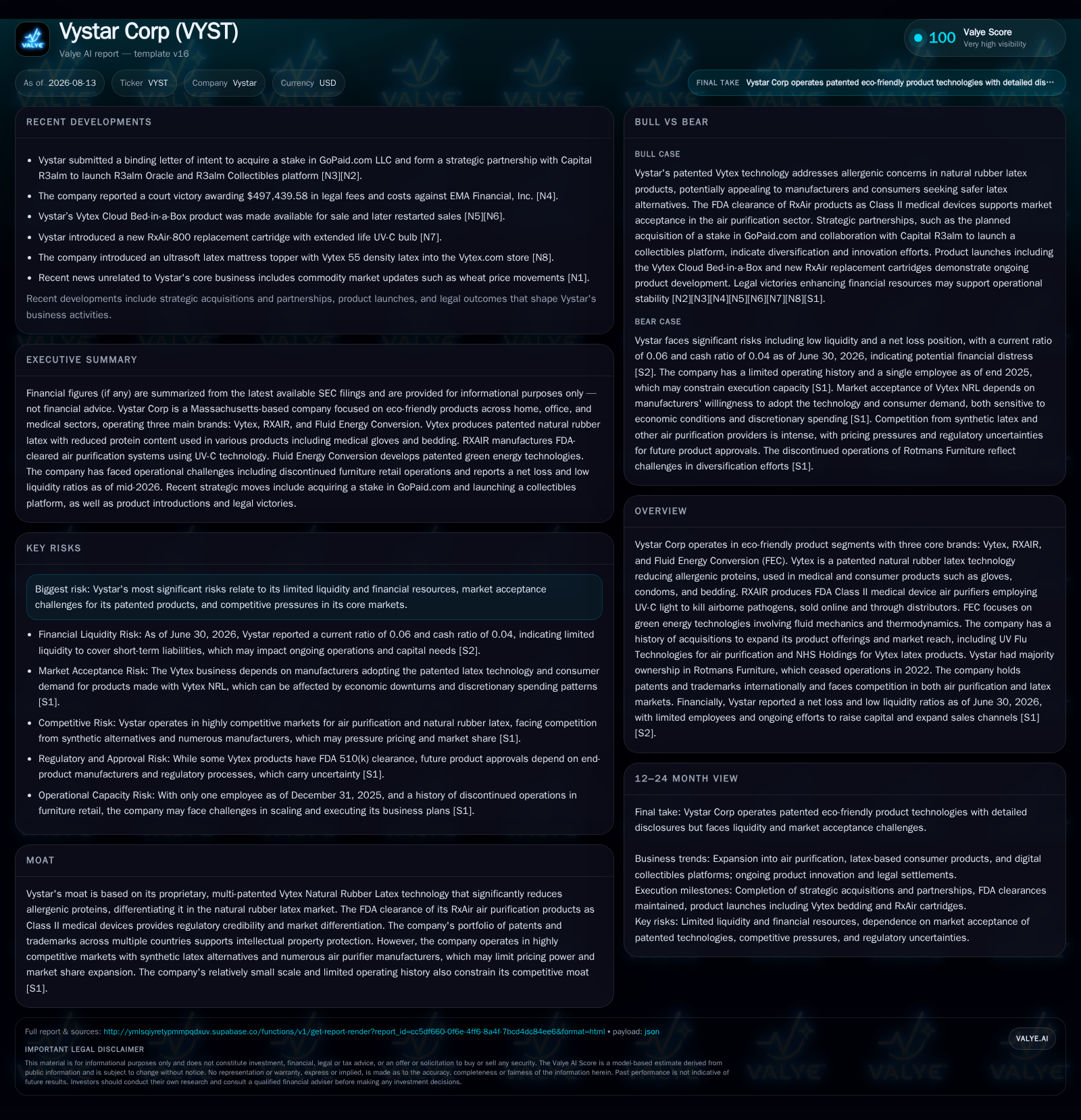
Vystar Corporation’s latest quarterly filing reveals intensifying liquidity challenges amid ongoing efforts to commercialize its proprietary Vytex ultra-low protein natural rubber latex, FDA Class II RxAir air purifiers, and early-stage green energy innovations. Despite a multi-patented technology portfolio providing differentiation in hypoallergenic latex products and regulatory clearance enhancing RxAir's market credibility, the company remains constrained by a cash-strapped balance sheet and complex distribution channels. Market competition, reliance on third-party manufacturing, and operational scale limits continue to temper growth prospects against a backdrop of capital raising needs and execution risks.
The company grants unsecured credit terms to customers without requiring collateral, which combined with an assessed allowance for credit losses shows elevated receivables risk that could impair cash flow reliability [S2]. This risk is compounded by an extremely low current ratio of approximately 0.06 (current assets roughly $490K vs. current liabilities near $7.67 million) at June 30, 2026 [F1], a clear indication of strained short-term liquidity.
This imbalance hampers Vystar’s capacity to finance day-to-day operating requirements such as replenishing inventory or maintaining manufacturing throughput. Borrowings reported are recognized at principal amounts and amortized cost, implying ongoing interest expenses contribute additional strain on liquidity profiles [S2]. Effective working capital management is critical given these operational vulnerabilities.
Proprietary Vytex Latex Technology: Competitive Moat during Synthetic Alternatives
At the core of Vystar’s product suite lies Vytex®, an innovative natural rubber latex (NRL) technology significantly reducing antigenic and total proteins—known allergens responsible for latex sensitivities in users [S1]. Globally multi-patented, Vytex’s ultra-low protein latex offers a differentiated raw material input appealing particularly to the medical sector demanding hypoallergenic protective gear such as surgical gloves and condoms.
However, while Vytex holds intellectual property advantages creating barriers to entry, the natural rubber latex market features entrenched competition from synthetic latex alternatives which often command cost advantages due to scale and raw material sourcing efficiencies. Moreover, consumer trends increasingly favor eco-friendly materials but pricing power remains constrained by the highly fragmented market structure and availability of lower-cost substitutes. Vystar's ability to translate patent strength into sustainable margins depends on scaling manufacturing capacity and securing OEM partnerships that emphasize product quality over price competitiveness.
RxAir's FDA-Cleared Air Purification: Regulatory Safeguard or Growth Bottleneck?
RxAir presents Vystar’s push into the indoor air quality (IAQ) sector with medical-grade air purification devices classified as FDA Class II medical devices—a noteworthy regulatory endorsement signaling compliance with safety and efficacy standards [S1]. This positions RxAir products firmly within healthcare-related air purification markets where sterilization capabilities via UV-C light disinfection differentiate them from standard consumer air purifiers reliant primarily on HEPA filtration.
Nevertheless, the FDA clearance pathway introduces fixed regulatory costs including ongoing compliance and reporting that weigh on operating expenses. Supply chain dependencies also create bottlenecks; RxAir sources its products from non-exclusive third-party manufacturers predominantly outside the U.S., exposing Vystar to risks from tariffs, fluctuating raw material availability, quality control variability, and production delays affecting lead times [S1]. This reliance on overseas contract manufacturing constrains gross margin improvements absent scale economies or vertical integration.
Innovation Pipeline Steeped in Fluid Energy Conversion: Potential but Pre-Revenue?
The Fluid Energy Conversion (FEC) division represents Vystar’s long-term green technology ambition focused on patented applications in fluid mechanics and thermodynamics intended to harness vortex effects and cavitation for energy efficiency gains [S1]. Although promising conceptually as a global green energy technology player, FEC remains largely pre-revenue with commercial viability yet unproven.
Significant R&D expenditures characteristic of deep-technology development raise concerns about capital intensity amid weak core business cash flow. Successful transition from concept patents to scalable product lines capable of generating meaningful sales would require nutritional capital reserves currently lacking. Thus FEC functions more as strategic future optionality than a stable cash generator.
Multi-Brand Distribution Complexity Challenges Scale Economics and Supply Chain Reliability
Vystar operates multiple product lines with distinct route-to-market strategies: Vytex latex licensing/manufacturing relationships cater primarily to industrial and medical customers; RxAir supplies home consumers directly via e-commerce platforms alongside wholesale distributors; FEC remains developmental with limited commercialization [S2][S1]. This multi-channel complexity increases challenges around inventory turnover rates, supply chain coordination, tariff exposure from overseas production sites, and sales channel profitability.
Maintaining adequate stock levels across diverse distribution partners without incurring excessive carrying costs strains limited working capital resources. Tariff impacts on imported components further pressure cost structures. High service requirements for FDA-regulated products like RxAir elevate supply chain reliability sensitivity—disruptions can tangibly impact brand reputation in hospital/consumer segments.
Competitive Environment: Navigating Price, Quality, and Market Penetration in Fragmented Sectors
The markets Vystar operates in are characterized by fragmentation and intense competition. The natural rubber latex space competes not only against established synthetic latex producers capable of large-scale cost-efficient production but also emerging hypoallergenic materials exploring alternative chemistries.
In air purification, numerous OEMs ranging from small startups to multinational firms vie for share through product innovation, pricing strategies, online retail presence, and brand reputation. While Vystar’s patented technologies provide defensible IP moats in both sectors—ultra-low protein NRL or FDA Class II device classification—price sensitivity among end customers curtails margin expansion opportunities.
Market penetration requires scalable marketing investments alongside channel expansion given the highly commoditized nature of many substitute offerings.
Critical Growth Imperatives Center on Channel Expansion and Capital Raising Execution Risks
According to filings through August 2026, Vystar plans capital raises via private placements coupled with targeted expansion of sales partnerships mainly for RxAir products through wholesalers/retailers aiming to bolster revenue inflows needed to sustain operations [S1][S2][S3]. Historical accumulated deficits near $61 million underscore the long haul required before profitability can emerge [S1].
Scaling customer acquisition effectively remains pivotal yet challenging given limited prior operating history combined with capital constraints restricting spending on promotion and inventory buildup. Execution risk lies in balancing growth funding needs with investor appetite amidst macroeconomic uncertainties affecting small-cap public companies.
Liquidity Crunch: Debt Burden Versus Operational Needs Paint Harsh Near-Term Outlook By Latest Filing
Financially strained conditions dominate Vystar’s near-term outlook evidenced by June 2026 consolidated balance sheet metrics showing current liabilities exceeding current assets by more than fifteenfold ($7.67 million vs. ~$0.49 million) resulting in a very weak current ratio near 0.06 [F1]. Borrowings are recognized at principal amounts and amortized cost, implying ongoing interest expenses contribute additional strain on liquidity profiles [S2].
This high leverage reduces operational flexibility inhibiting ability to invest meaningfully in manufacturing scale-out or distribution infrastructure necessary for product lines like Vytex or RxAir poised for commercialization gains. Without successful capital infusion or materially improved cash flow generation—neither guaranteed given market competition—the company faces growing existential funding stress.
Financial Profile Discussion
Despite proprietary technological strengths captured in multi-national patents protecting Vytex natural rubber latex's hypoallergenic properties and regulatory certifications endorsing RxAir’s medical device air purifiers as FDA Class II products offering clinical-grade disinfection guarantees [S1], Vystar's financial disclosures articulate a critical struggle with liquidity management driving overall risk profile.
Limited working capital driven by a minuscule current ratio (~0.06), substantial accumulated deficits exceeding $60 million as of late 2025 [S1], coupled with dependence on unsecured customer credit exposures flagged under accounts receivable policies reveal acute financing challenges triggering operational jeopardy absent prompt capital injections or dramatic revenue ramp-ups from scaled sales channels noted in corporate plans [F1][S2].
Capital structure remains heavily supported by convertible preferred stock issuances evident from recent joint venture activities but these do not obviate underlying cash conversion inefficiencies nor reduce costs tied to third-party overseas manufacturing obligations prominent for RxAir's regulated product line compliance burdening margins further [S2][S3]
Disclaimer: This is research-only, informational analysis and not investment advice. It may include AI-generated interpretation and general industry context. Always verify important details using primary sources.

Comments