
NAPC Defense Advances Tactical Systems with New Contracts and Leadership Shifts
Recent quarterly disclosures highlight NAPC Defense’s contract wins, international expansion, and governance changes amid liquidity challenges.
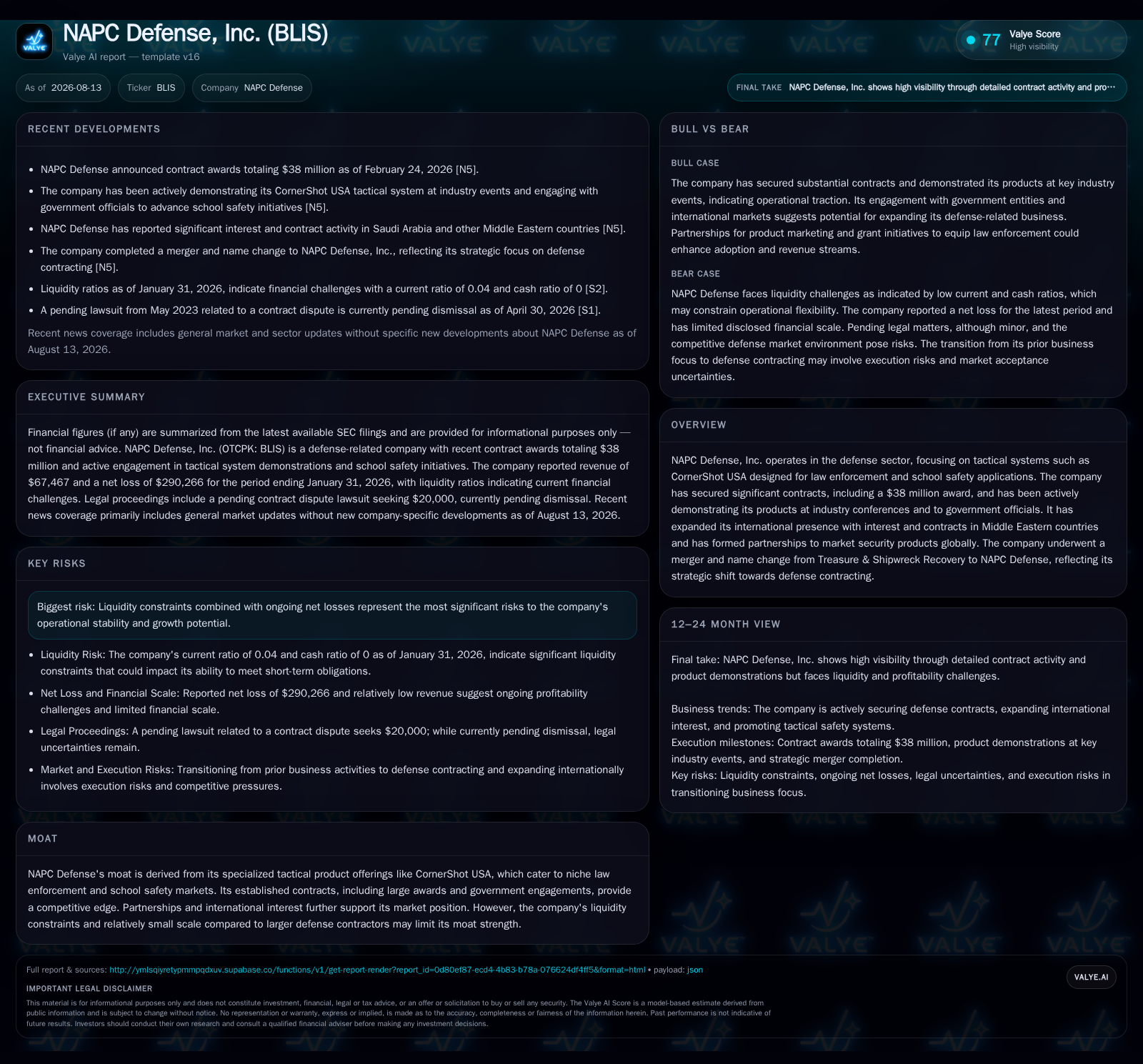
NAPC Defense, Inc. reported meaningful contract awards including a $38 million contract for its CornerShot USA tactical system in the March 2026 quarter, reflecting robust demand in law enforcement and school safety markets. The company’s focus on specialized tactical products and growing international partnerships—especially in the Middle East—underscore strategic market penetration efforts. However, liquidity constraints remain acute, with a very low current ratio exacerbating operational risks alongside ongoing net losses. The June 2026 departure of the Chief Legal Officer adds governance variability amid these challenges. Monitoring backlog conversion, compliance leadership updates, and financing plans will be critical to assessing NAPC Defense’s near-term execution trajectory.
March Quarter Update: Contract Awards and Operational Highlights Define Momentum
In its March 17, 2026 quarterly filing, NAPC Defense disclosed winning significant contracts notably a $38 million award tied to its CornerShot USA tactical system [S2]. This sizable contract underscores sustained government procurement interest in specialized law enforcement equipment that enhances operational safety in high-risk scenarios like school security. CornerShot USA’s position as a core tactical offering ties directly into the company's revenue recognition mechanism—awarded contracts provide well-defined order volume translating into product deliveries over agreed timelines. While detailed backlog metrics were not explicitly stated, securing one large contract of this magnitude suggests meaningful near-term revenue visibility and an elevated order win rate for the quarter [S2].
The company also alluded to continued expenditures in research and development, which is crucial for maintaining product innovation within the defense tactical equipment industry where technological obsolescence is a persistent threat [S1]. Maintaining efficient production capacity utilization remains important to convert booked contracts into deliveries without delays impacting operating margin sustainability.
Leadership Transition's Impact on Compliance and Governance Stability
On June 8, 2026, NAPC Defense announced the immediate termination of its Chief Legal Officer Craig Huffman [S3]. Given the highly regulated nature of defense manufacturing and government contracting—including adherence to regulatory certification standards—this leadership change introduces potential risk around compliance oversight during what appears to be a transition period without an identified successor. For smaller firms like NAPC Defense that are often more vulnerable to disruption from key personnel shifts, this could momentarily affect risk management related to contract execution or licensing.
The company has proactively designed its governance framework with a unique voting control preferred shares structure instituted in October 2025 [S15]. These shares grant the Board concentrated voting power (70% of total shareholder voting rights) specifically on major corporate actions such as amendments to articles of incorporation or mergers. This mechanism likely aims to create stability in board decision-making during times of management turnover or strategic change, providing a safeguard against hostile takeovers or governance fragmentation as the company scales or pursues acquisitions.
Specialized Tactical Products Drive Revenue Through Law Enforcement and School Safety Use Cases
NAPC Defense’s business model centers on designing and selling niche tactical systems primarily to government agencies including law enforcement units tasked with sensitive public safety missions [S1]. CornerShot USA exemplifies this specialization—a product tailored for enhanced firearms deployment with remote viewing capability designed explicitly for scenarios requiring use-of-force precision such as active shooter situations in schools.
Revenue streams depend heavily on successfully winning government contracts via defense procurement processes which emphasize product relevance, demonstrated efficacy (e.g., live demonstrations), regulatory certifications, and competitive pricing. The company’s active participation in industry conferences to demo products strengthens its order win rate by building relationships with procurement officers and validating the system's tactical advantage. Such product quality differentiation supports modest pricing power within this niche segment despite competition from broader portfolio defense contractors.
This specialization contributes fundamentally to NAPC Defense’s moat by creating barriers through technical complexity tailored to specific end-user needs rather than commoditized equipment sales.
International Market Penetration Supported by Partnerships and Product Demonstrations
Beyond domestic contracts, NAPC has advanced efforts to expand its international footprint, notably penetrating Middle Eastern defense markets through partnerships formalized in recent years [S1]. These alliances facilitate entrance into regions with growing security budgets focused on counterterrorism and homeland protection.
International contracts bring both growth opportunities and layered risks: while diversifying customer base beyond U.S.-centric procurement cycles reduces concentration risk, geopolitical volatility in these regions can pose delivery or compliance hurdles. The company’s ability to navigate export regulations and align with foreign military standards will be pivotal for sustained success here. Peer mid-tier tactical manufacturers often leverage such global partnerships as a growth lever complementing domestic contract awards.
Product demonstrations abroad remain integral to securing these deals given differing evaluation standards compared to U.S. Federal acquisitions.
Competitive Positioning: Balancing Niche Innovation Against Scale Challenges in Defense Procurement
Compared against large defense contractors like Lockheed Martin or Raytheon Technologies who offer expansive combat systems portfolios, NAPC Defense competes principally through deep niche innovation focusing on select tactical solutions tailored for law enforcement and school safety applications [F1][S1][S2]. While this narrower scope lends product distinctiveness supporting sustained government interest in specific use cases such as CornerShot USA, it inherently limits overall bargaining power when negotiating pricing or contract terms due to smaller scale.
Financially, NAPC faces pronounced liquidity constraints evidenced by a critically low current ratio (~0.04) stemming from current liabilities far exceeding current assets (over $1.7 million versus $69 thousand) despite relatively nominal total debt ($22K) [F1]. This imbalance constrains operational flexibility essential for inventory buildup or absorbing production delays—common pressure points in defense manufacturing dependent on rigorous delivery timelines.
Operating income remains negative with net losses reported indicating ongoing challenges scaling profitably despite contract inflows [F1]. Such constraints typify risks encountered by mid-tier tactical equipment manufacturers striving for growth amidst dominant incumbents able to leverage broader capital resources.
Growth Drivers: Government Spending Tailwinds and Strategic Expansion Efforts
Demand fundamentals supporting NAPC's growth rest on increasing governmental emphasis on modernizing law enforcement tactical equipment alongside amplified school safety initiatives responding to heightened public security concerns [S1]. Rising defense budgets funnel capital towards securing advanced security solutions fostering an environment conducive for order backlog growth.
NAPC’s increased authorized share count (from 500 million to 2 billion shares) along with designated voting control preferred stock implemented in late 2025 sets a platform facilitating potential future mergers and acquisitions or equity financing tailored towards expanding operational footprint or international reach [S15]. This strategic capital structure flexibility aligns with ambitions to enhance scale capabilities requisite for competing effectively beyond niche segments.
Operational Risks: Liquidity Constraints Threaten Execution Flexibility Amid Ongoing Net Losses
Despite positive momentum in contract awards, NAPC Defense operates under severe financial strain that jeopardizes uninterrupted execution capacity. The company's latest balance sheet depicts current liabilities eclipsing current assets by more than twenty-fold (approximately $1.7 million vs $69 thousand), reflecting a dangerously low current ratio near 0.04 [F1]. Such a situation signals imminent liquidity risks potentially affecting vendor payments, supply chain continuity, or capacity expansion critical for fulfilling larger orders on time.
Persistent net losses compound these pressures — latest reported net income remains significantly negative — further limiting internally generated cash flow availability [F1]. No recent refinancing events have been publicly disclosed suggesting limited immediate alleviation avenues absent new capital raises or asset sales.
Given the reliance on government contracts whose payment timing can vary substantially after delivery completion, maintaining adequate working capital is especially vital for sustaining operations without interruption or damaging supplier relationships.
What Comes Next: Future Contract Milestones, Product Pipeline Developments, and Balance Sheet Watchpoints
Attention should focus closely on subsequent quarterly filings revealing backlog conversion rates from recent sizable orders like the $38 million CornerShot award. Timely order fulfillment coupled with stable production capacity utilization will serve as leading indicators of scaling success.
Further clarity around appointment of new legal/compliance leadership following June’s Chief Legal Officer exit will be significant given regulatory compliance sensitivity impacting future contract eligibility [S3].
Monitoring any capital raising activity or material adjustments to balance-sheet structure will illuminate management’s approach towards mitigating liquidity shortfall while preserving operational agility necessary for sustained bidding competitiveness.
+ Financial Profile Discussion: Current Liquidity Pressure Frames Near-Term Challenges
As of January 31, 2026 balance sheet data indicate extremely constrained liquidity: current assets stand at approximately $69K versus crippling current liabilities surpassing $1.7 million yielding a calculated current ratio of roughly 0.04—an alarmingly low buffer against near-term obligations [F1]. Total debt remains modest at around $23K but near-zero cash reserves (about $346 at early-2019 snapshot) underscore minimal cash cushion available for ongoing operations absent rapid revenue inflows or financing measures [F1].
Operating income continues negative trajectory with reported net losses signaling ongoing challenges converting contract wins into profitable cash flow generation [F1]. Such financial positioning underlines acute execution risk; any delays in milestone payments or cost overruns may amplify liquidity pressure potentially constraining production capacity utilization critical for fulfilling growing order volumes.
This precarious balance situates NAPC Defense at significant risk juncture typical among mid-tier tactical equipment providers reliant on intermittent large government contracts without diversified funding sources ordinarily available at larger peers.
Disclaimer: This analysis is based solely on publicly filed SEC documents up to August 2026 and credible industry framing related to defense tactical equipment firms similar to NAPC Defense. It does not constitute investment advice or research views regarding securities of any kind.
Disclaimer: This is research-only, informational analysis and not investment advice. It may include AI-generated interpretation and general industry context. Always verify important details using primary sources.

Comments