
STARRY SEA ACQUISITION CORP Strives to Complete Business Combination Amid Trust Account and Liquidity Constraints
The blank check company continues seeking a business combination, leveraging its experienced management team and capital structure while facing time and redemption risks.
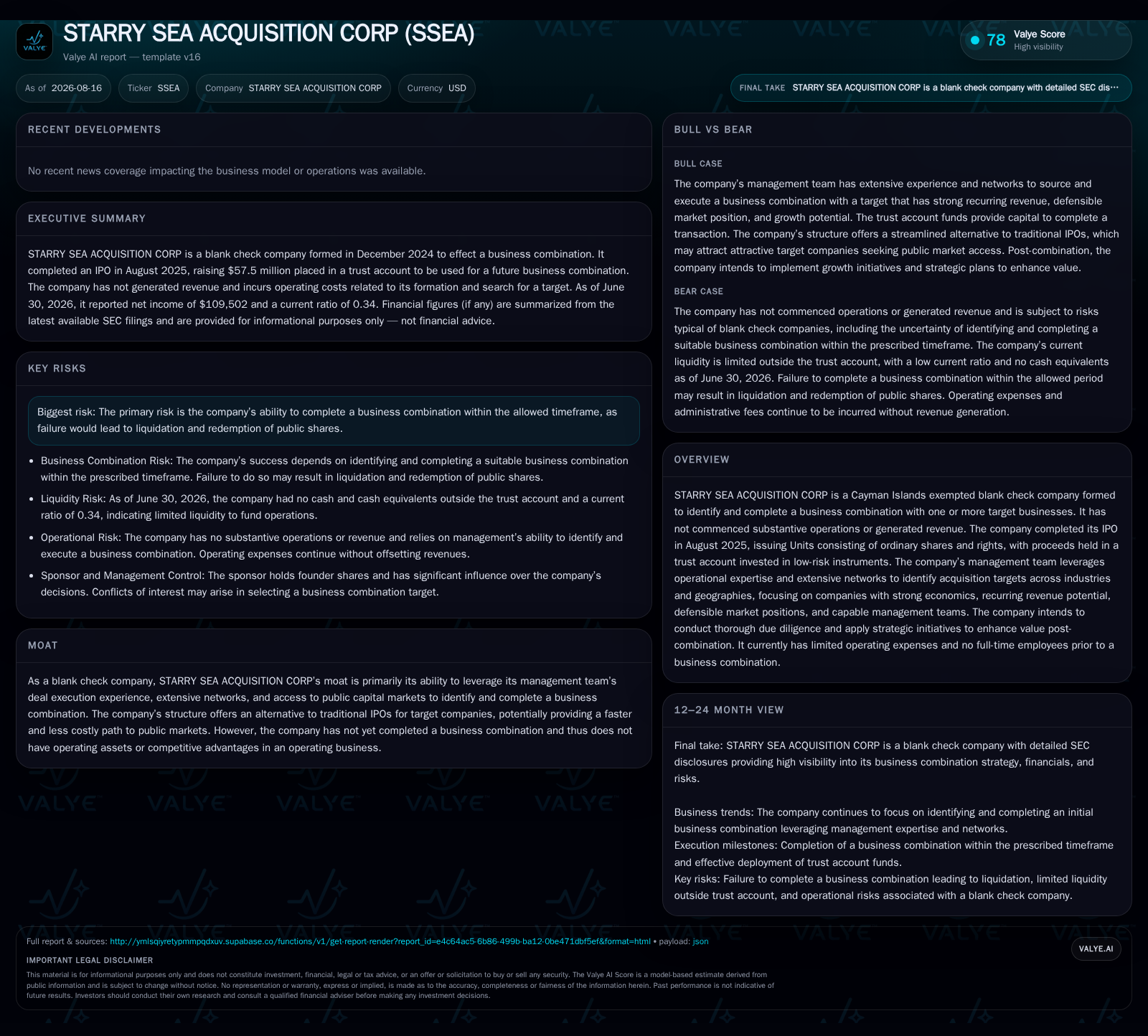
STARRY SEA ACQUISITION CORP (SSEA) operates as a Cayman Islands exempted blank check company formed in late 2024 to identify and complete a business combination with one or more target businesses. The company raised approximately $57.5 million in its August 2025 IPO, placing funds in a trust account invested conservatively. As of mid-2026, it maintains minimal operating activity and no revenues prior to an acquisition. Management’s focus is on sourcing target companies with strong cash flow, defensible market positions, and capable leadership but faces execution risks including the mandate to complete a deal within 15 months or face liquidation. The recent expiration of its exclusivity on a previously proposed deal underscores ongoing challenges in deal-making momentum. Financially, the SPAC holds limited current assets outside the trust account with ongoing operating expenses that require careful management to preserve capital for the de-SPAC transaction.
Recent Operating Update
STARRY SEA ACQUISITION CORP (SSEA) filed its latest quarterly report on August 14, 2026, reaffirming its status as a blank check company with no substantive operations or revenue generation since inception. The company remains actively pursuing a business combination but has yet to consummate a deal following the expiration of exclusivity pertaining to negotiations with Forever Young International Limited in early 2026 [S2][S26]. This development underscores persistent challenges in closing agreements within the finite window imposed by SPAC regulations.
The absence of any definitive acquisition agreement necessitates careful capital stewardship as the company approaches its mandatory deadline to complete a business combination within 15 months post-IPO (August 2025), or else face involuntary liquidation and return of remaining funds to public shareholders [S3]. The latest disclosures provide no indication of new binding commitments but emphasize continued due diligence efforts.
Business Model Specifics
As a Special Purpose Acquisition Company (SPAC), SSEA’s core business model centers on raising capital through an initial public offering (IPO) to finance an acquisition or merger with one or more private companies. Units issued at IPO comprised ordinary shares paired with detachable rights exercisable upon consummation of a business combination. The $57.5 million gross proceeds from the IPO and concurrent private placement were secured in a U.S.-regulated trust account invested predominantly in low-risk government securities or equivalent money-market instruments with maturities capped at 185 days [S1][S3][S10]
Operating expenses incurred pre-business-combination consist primarily of professional fees—accounting, legal, advisory—as well as costs related to compliance with public company regulations and due diligence activities targeting prospective acquisitions. The sponsor purchased founder shares at nominal cost which represent significant equity participation post-merger but have no economic value absent completion of the de-SPAC transaction [S1][S11].
Revenue generation only commences after completing the business combination when the acquired company transitions into the public markets via merger with SSEA’s publicly listed shell entity. Until that event, net income consists solely of interest earned on trust account balances offset by operating expenses.
Industry Structure and Competitive Position
SPACs like SSEA operate as financial intermediaries upstream from operating businesses seeking public listings. Their role is to offer private companies an alternative path to going public that can be more expedient and less costly relative to traditional IPOs. The value proposition lies heavily in management’s ability to identify suitable targets possessing stable cash flows, competitive moats such as proprietary technology or brand strength, opportunities for capital-driven growth expansion, and seasoned management teams incentivized to drive shareholder value.
Key competitors include other SPAC sponsors who may possess larger scale or broader networks (e.g., Pershing Square Tontine Holdings), traditional investment banks underwriting classic IPOs, private equity investors engaging in buyouts with alternative exit strategies, and PIPE investors providing capital during de-SPAC transactions.
In comparison, SSEA’s strategic strengths rest chiefly on its management team’s deal execution experience and ability to leverage networks across industries and geographies. However, the lack of any consummated acquisition thus far places SSEA among many SPACs confronting intensified market skepticism over their ability to complete deals timely amid heightened regulatory scrutiny.
Growth Drivers
Growth catalysts for SSEA hinge fundamentally on successful identification and merger with an appropriate target business within the allotted time frame. Favorable market conditions including robust investor appetite for alternative public listing vehicles sustain this opportunity set.
Additional leverage may come from securing PIPE financing post-announcement of a definitive merger agreement which can expand deal size capacity and signal institutional confidence [S8][S21]. Regulatory frameworks remain accommodative albeit increasingly vigilant—particularly regarding cross-border transactions involving China-based entities where compliance risk has elevated substantially due to cybersecurity review requirements and anti-monopolistic enforcement
Moreover, the rising demand among private businesses for quicker access to liquid public markets propels SPAC issuance momentum generally. Management alignment via equity rollover participation ensures committed partnership fostering focused synergy creation post-combination.
Risks and Watchpoints
The primary risk involves non-completion of any qualifying business combination before the mandated deadline approximately August 2026 (15 months post-IPO closing) [S3][S11]. Failure triggers corporate dissolution and redemption of public shares at approximately $10 per share plus accrued interest held in trust accounts leading to loss of sponsor equity investments and reputational damage
Shareholder redemption rights introduce dilution uncertainty — large-scale redemptions reduce available merger capital potentially compromising deal economics or necessitating additional financing rounds which add complexity and cost.
Regulatory risks are especially salient when targeting Chinese operating companies. Requirements such as cybersecurity reviews for network platform operators processing data of over one million users create barriers that could delay or prevent transaction approvals [S8][S21]. Continued evolution in PRC policies regarding overseas listings also inject operational uncertainties that must be monitored closely.
Operating expense overruns ahead of deal closure can further strain limited non-trust liquidity pools critical for administrative functioning during this pre-revenue phase.
What To Watch Next
Key milestones include announcements confirming definitive agreements or termination thereof beyond previous efforts like Forever Young International Limited whose exclusivity expired without deal closure [S26][S19]. Progress indicators also encompass updates on PIPE financing commitments as well as shareholder voting outcomes once proposals arise.
Indicator metrics such as trust account balance stability (not diminished by redemptions), magnitude of operating expenses relative to cash outside trust accounts (~$80K current assets vs ~$238K current liabilities reported mid-2026), overall working capital trends particularly heading into final months permitted under SPAC rules serve as critical barometers [F1]
Monitoring management commentary around pipeline quality—number of evaluated targets—and regulatory developments affecting cross-border deals will be pivotal in assessing near-term execution prospects.
Disclaimer: This is research-only, informational analysis and not investment advice. It may include AI-generated interpretation and general industry context. Always verify important details using primary sources.

Comments