
Mercator Acquisition Corp. 2026 Q2: SPAC Status Maintained with No Business Combination and Limited Liquidity
As of Q2 2026, Mercator Acquisition Corp. remains a SPAC without an operating business, facing liquidity constraints and ongoing net losses.
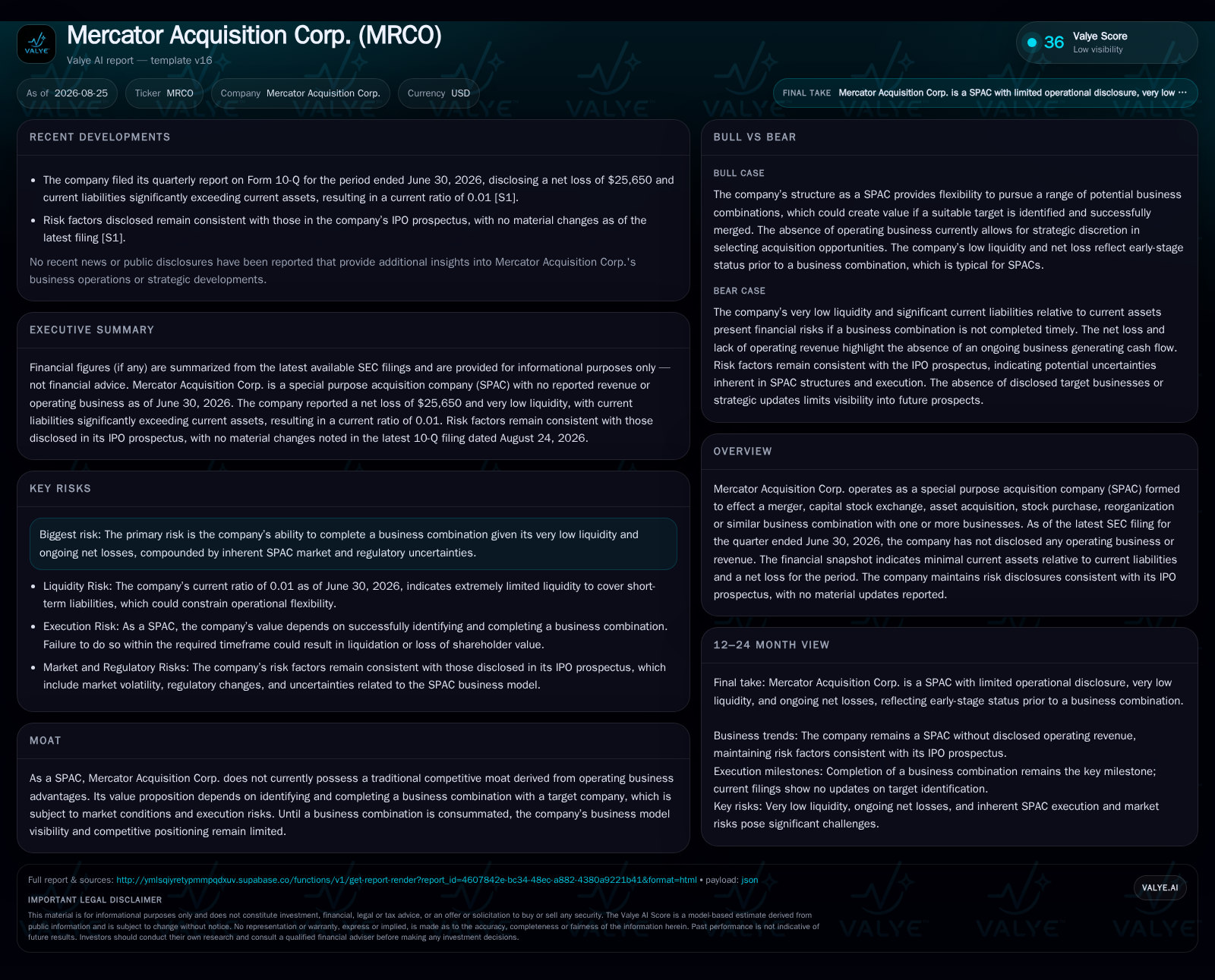
Mercator Acquisition Corp. continues its status as a special purpose acquisition company (SPAC) without disclosing any operating business or revenue as of the second quarter of 2026. The company reported limited liquidity and ongoing net losses, which heighten the risk of failing to complete a business combination within the required timeframe. Risk factors remain unchanged from the IPO prospectus, underscoring the persistent uncertainties inherent in the SPAC business model. Investors should monitor announcements related to business combination agreements, liquidity changes, and potential SPAC expiration decisions.
Financial Position and Liquidity Constraints
The latest quarterly filing reveals that Mercator Acquisition Corp. holds limited current assets relative to its current liabilities and reported a net loss for the period ended June 30, 2026 [S2]. These financial conditions indicate constrained working capital and reduced financial flexibility. The ongoing net losses imply negative operating cash flow, which further limits the company’s ability to sustain operations without additional capital or transaction proceeds. This constrained liquidity environment increases the risk that Mercator Acquisition Corp. may face challenges in executing or closing a business combination, especially if market conditions deteriorate or if additional financing cannot be secured.
Business Model and Investment Thesis
As a SPAC, Mercator Acquisition Corp. raises capital through an initial public offering by selling units consisting of one Class A ordinary share and one-half of one redeemable warrant. Investors purchase these units with the expectation that the company will complete a business combination with a private operating company, thereby taking that company public without a traditional IPO. Until such a transaction occurs, Mercator Acquisition Corp. generates no revenue or operating profits [S2]. The company’s value and investor returns depend entirely on management’s ability to identify a suitable target, negotiate favorable terms, and complete the merger within the allotted timeframe. The absence of an operating business means there are no traditional competitive advantages or cash flow drivers; instead, the investment case rests on execution risk and market conditions.
Risk Factors and Market Context
Risk disclosures in the Q2 2026 filing remain consistent with those outlined in the company’s IPO prospectus, with no material updates reported [S2]. This stability suggests that no new mitigating factors or emerging risks have altered the baseline uncertainties inherent in SPAC transactions. Key risks include the possibility of failing to complete a business combination within the mandated timeframe, market volatility impacting investor appetite for SPAC units, regulatory changes affecting SPAC structures, and dilution risks from warrant exercises or sponsor promote arrangements. These factors collectively maintain the execution and market risks that investors must consider when evaluating Mercator Acquisition Corp.
Scenario Analysis
One plausible base scenario is that Mercator Acquisition Corp. completes a business combination within the SPAC timeframe, transitioning to an operating company and eventually generating revenue. This outcome would require sufficient liquidity to support deal execution, favorable market conditions for SPAC transactions, and identification of a suitable acquisition target. Confirmation would come from announcements of definitive business combination agreements, improved liquidity or financing arrangements, and subsequent filings disclosing operating business post-combination.
Conversely, a bear scenario involves the company failing to complete a business combination due to liquidity constraints and adverse market conditions, potentially leading to liquidation or a return of funds to investors. This scenario is supported by the company’s limited liquidity and ongoing net losses, which reduce financial flexibility. Confirmation would include disclosures of liquidation plans, failure to extend the SPAC timeframe, or absence of deal announcements as deadlines approach.
Conclusion and Watchpoints
Mercator Acquisition Corp.’s lack of operating business and revenue as of Q2 2026 means its valuation and investor returns are fully dependent on successfully completing a business combination [S2]. The company’s limited liquidity and ongoing net losses heighten the risk that it may be unable to sustain operations or close a transaction within the required timeframe. Investors should closely monitor future SEC filings for any announcements regarding definitive business combination agreements, changes in liquidity or financing arrangements, updates to risk factors, and decisions related to SPAC expiration or extension. These developments will be critical indicators of the company’s ability to transition from a SPAC shell to an operating public company.

Comments