
CalEthos Advances Onsite Natural Gas-Powered Data Center Campus Amid Early-Stage Development and Capital Intensity
The company progresses its master-planned data center campus with integrated onsite natural gas power, targeting hyperscale users to bypass grid delays.
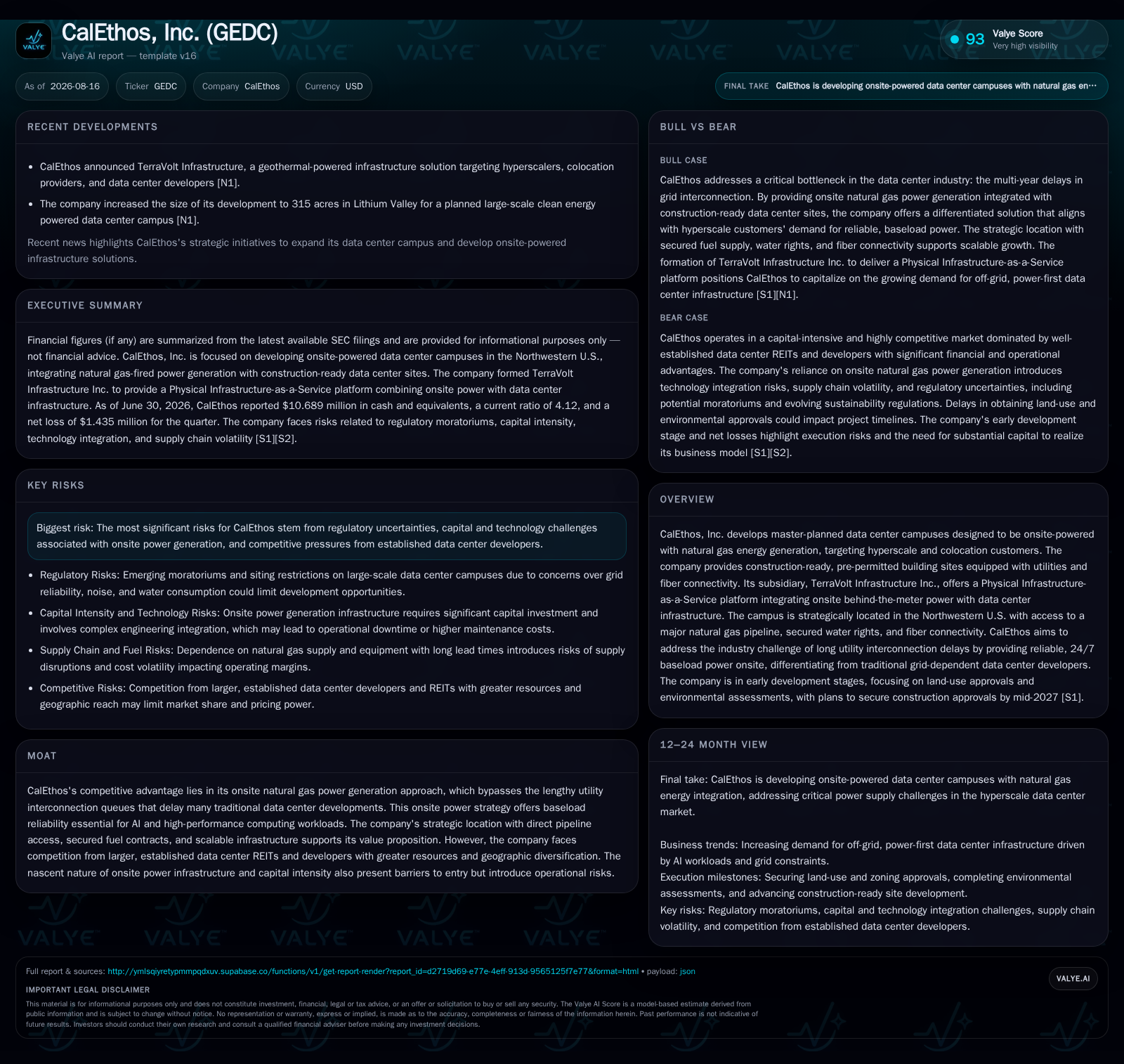
CalEthos, Inc., now renamed TerraVolt Holdings, is developing a master-planned data center campus designed with onsite natural gas-powered energy generation to supply baseload power directly at the site. This approach addresses a critical bottleneck in data center infrastructure: utility interconnection delays. The company remains in early development phases with no revenue yet, focusing on securing regulatory approvals, finalizing fuel supply contracts, and establishing joint ventures for land development. Key industry growth drivers such as AI workloads and cloud expansion underpin the strategic rationale, but substantial capital requirements and regulatory risks remain significant headwinds.
Recent Operating Update
CalEthos, Inc., which officially changed its corporate name to TerraVolt Holdings, Inc. in July 2026 to align with its strategic focus on integrated onsite power solutions for data centers [S15][S16], remains firmly in an early-stage development phase as of its latest quarterly filing ending June 30, 2026. The company has not yet generated any top-line revenue [F1] but continues progressing key foundational milestones essential to delivering its master-planned data center campus concept. This includes executing critical natural gas supply contracts and negotiating joint ventures for land development aimed at creating multiple scalable building lots fully equipped with utilities and fiber connectivity [S1][S24].
Business Model and Strategic Offering
CalEthos targets the upstream segment of the data center infrastructure value chain by developing "construction-ready" building sites that are pre-permitted and backed by fully integrated utility services including high-voltage onsite-generated natural gas power [S1]. Unlike typical data center developments that rely heavily on lengthy utility interconnection queues—often causing project delays of months or years—the company’s model aims to provide hyperscalers, colocation operators, and cloud service providers with immediate access to reliable 24/7 baseload power tethered directly onsite with fiber connectivity.
The centerpiece is its Physical Infrastructure-as-a-Service (PIaaS) platform operated through its subsidiary TerraVolt Infrastructure Inc., integrating behind-the-meter natural gas-fired power plants with fiber optics and utility infrastructure on campus [S1][S24]. The firm monetizes primarily through selling or leasing these pre-permitted, powered parcels to large-scale digital economy customers who require scalable footprints that can rapidly ramp alongside increasing computational demands.
This design caters specifically to hyperscale cloud providers aggressively expanding AI and high-performance computing capacity where continuous uptime and power stability are vital. Offering baseload onsite power mitigates operational risks related to grid fluctuations or outages—a meaningful competitive moat compared to peers dependent on traditional electrical grids.
Industry Structure and Competitive Position
The data center infrastructure development industry is undergoing a profound supercycle driven by AI workload scaling projected to represent half of all server loads by 2030 [S1]. Global capacity must nearly double from approximately 103 GW to over 200 GW within four years. Key industry players include large publicly traded REITs such as Equinix, Digital Realty, CyrusOne along with emerging dedicated onsite power technology firms like Bloom Energy.
While CalEthos operates at an upstream development phase focused on land and infrastructure provision rather than direct facility operation or IT hardware management, the integration of onsite natural gas-fired generation is a distinctive positioning. Its physical proximity to a major Northwest Pipeline natural gas source enables competitive energy procurement economics backed by formal long-term fuel contracts negotiated under stringent Letter Agreements involving reservation fees exceeding $3.8 million plus multi-million-dollar letter of credit commitments demonstrating financial discipline on fuel security [S24][S25]
Despite this differentiation, CalEthos faces competition from larger incumbents who benefit from economies of scale, geographic breadth, diversified funding sources, and established customer relationships. The capital intensity of developing both physical campuses and standalone onsite generation plants also creates high barriers to entry but exposes CalEthos to considerable execution risk absent proven large-scale operational history in onsite power generation for hyperscale applications.
Growth Drivers
Fundamental market drivers favor CalEthos’s thesis: The rapid expansion of cloud computing fueled by AI supercharging compute loads requires facilities capable of delivering constant high-capacity baseload power locally. Traditional reliance on interconnected electrical grids has repeatedly created bottlenecks due to regulatory delays and limited grid reliability especially where renewable integration creates intermittency challenges.
CalEthos’s approach addresses these pain points via direct pipeline-sourced natural gas plants providing dispatchable onsite baseload energy—a model anticipated to gain traction amid hyperscalers’ growing preference for resilient infrastructure architectures. Additionally, growth in enterprise adoption of colocation services further expands demand for flexible footprint availability on pre-permitted scalable lots supported by comprehensive fiber connectivity.
The firm’s joint venture strategy facilitating phased parcel sales allows staged capital deployment aligned with demand growth while sharing economic returns with landowners—potentially enhancing scalability without full upfront balance-sheet strain [S11][S19]
Risks and Growth Constraints
Critical risks surround regulatory uncertainties inherent in large-scale infrastructure permitting for both energy generation and data center construction. Delays or failures obtaining approvals could materially impede project timelines.
Capital intensity remains a persistent challenge highlighted by the company’s continued operating losses (-$6.5 million net income reported for FY2025) coupled with reliance on external debt/equity financing exemplified by a recent $15 million loan secured from a related-party trust with attached warrants indicating costlier funding terms at this stage [F1][S12][S24]
Technology risk also looms given the relative novelty of deploying behind-the-meter natural gas-powered platforms at scale within master-planned campuses compared to established grid-dependent models followed by larger REITs.
Additionally, competitive pressure from incumbents equipped with extensive geographic footprints could constrain pricing or negotiation leverage over customer tenancy agreements once built out. Exposure to fluctuations in natural gas prices or contract renegotiations could affect operational cost structures.
What To Watch Next
Investor focus should track progress against pivotal milestones such as finalization of joint venture agreements for Phase 1 campus parcels including definitive sale or lease transactions that would trigger material proceeds sharing per existing Letter Agreements [S11][S19]. Advances toward state/local permitting signoffs enabling construction commencement will also be key demand drivers.
Equally important are updates related to execution against the natural gas purchase agreement framework including delivery period finalization set between now and early 2028-2030 windows delineated in contract covenants [S24][S25]. Monitoring capital raise activities or partnerships that alleviate balance sheet constraints will be critical given the high burn rate inherent in early-stage development.
Finally, evidence of prospective customer engagement such as conditional tenancy letters or preliminary off-take agreements—even if not publicized—would provide meaningful validation of market acceptance for CalEthos’s unique integrated infrastructure offering.
Financial Profile Discussion
As of June 30, 2026, CalEthos held approximately $10.7 million in cash and equivalents against current liabilities near $2.6 million reflecting a robust current ratio above 4x that offers short-term liquidity comfort during ongoing capital-intensive development activities [F1]. Total debt reported is negligible at roughly $11 thousand based on last available measure ending March 2025 indicating limited third-party leverage at this point; however, the company has raised a $15 million promissory note facility concurrently issuing stock warrants as partial compensation emphasizing dependence on related-party financing sources for near-term cash needs [S12][S24].
Operating losses continue reflecting R&D and pre-revenue status typical for greenfield infrastructure developers focusing heavily on permitting, engineering design, contractual groundwork, and initial capital expenditures before production-level activity begins. Playbook comparisons to established peers like Digital Realty show substantial upfront capex ramp phases but also eventual scale benefits post-commissioning absent here yet.
Longer term value creation depends heavily on successful asset monetization through either sale or triple-net leases of developed powered sites combined with operational efficiencies realized through proprietary onsite generation technology deployment.
Disclaimer: This analysis is provided solely for informational purposes without any investment advice or research view. It is based strictly on disclosed filings as cited herein at their respective dates and general industry knowledge without any speculative assumptions about future company performance beyond stated facts.
Disclaimer: This is research-only, informational analysis and not investment advice. It may include AI-generated interpretation and general industry context. Always verify important details using primary sources.

Comments