
THUNDER MOUNTAIN GOLD Reflects Exploration and Capital Challenges in Latest Quarter
Thunder Mountain Gold's August 2026 quarterly report highlights sustained exploration losses, insider debt settlement via equity issuance, and ongoing regulatory and capital market headwinds impacting advancement of its polymetallic South Mountain project.
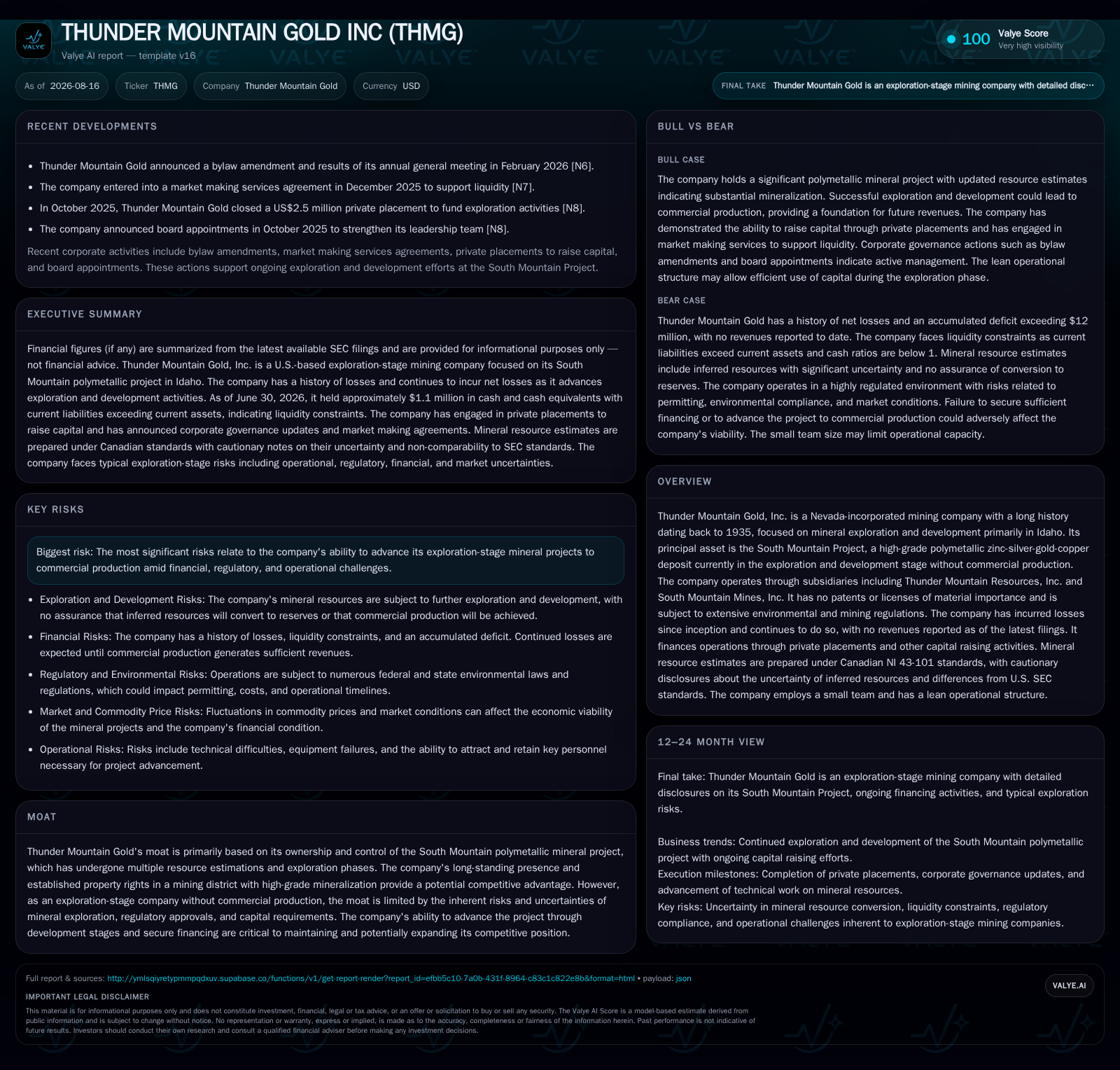
Thunder Mountain Gold remains focused on advancing its South Mountain polymetallic project through exploration and resource delineation but faces persistent capital constraints and regulatory bottlenecks. The company reported no commercial production or revenues in Q2 2026, with cash of approximately $1.1 million against significant net debt exceeding $36 million. Recent equity issuance to settle insider debt underscores reliance on related-party financing amid challenging market conditions. Progress toward feasibility studies and permitting approvals will be critical near-term milestones to mitigate inherent exploration risks.
August Quarterly Update: Exploration Stage Pressures Amid Tight Capital
Thunder Mountain Gold’s August 14, 2026 Form 10-Q reveals the financial strain typical of exploration-stage mining companies without commercial production. The company reported no revenues during the quarter or year-to-date period; accumulated losses exceeded $12.2 million as of June 30, 2026 [S2][F1]. Cash reserves stood at roughly $1.1 million against total debt of approximately $37.3 million, resulting in net debt near $36.1 million and a current ratio of only 0.73 — signaling limited liquidity headroom absent new capital inflows [F1].
A significant recent development was the board-approved issuance of up to 1,578,036 common shares at CAD$1.00 (approximately US$0.70) per share to settle about US$1.1 million in outstanding compensation payable primarily to the CEO and certain former service providers [S3]. This related-party transaction complies with Canadian MI 61-101 exemptions since insider participation does not exceed 25% of market capitalization; however, it underscores the company’s reliance on equity issuance from internal stakeholders rather than broad market financing during challenging capital markets [S3][S1].
South Mountain Project: Polymetallic Resource Definition Without Production
Thunder Mountain’s flagship asset is the South Mountain Project located in Idaho — a polymetallic deposit containing zinc, silver, gold, and copper mineralization. Resource estimates comply with Canadian NI 43-101 standards encompassing measured, indicated, and inferred categories but do not yet include mineral reserves or commercial mining operations [S1].
As an upstream explorer focused on resource delineation rather than production, the company’s value proposition hinges on converting inferred resources into higher-confidence categories through expanded drilling programs and advancing toward feasibility studies that establish economic viability. Without progressing beyond resource estimation phases supported by metallurgical testing and environmental baseline work, project valuation remains speculative.
Regulatory Environment: Permitting Bottlenecks Impact Timing
Regulatory compliance constitutes a key operational challenge for Thunder Mountain. Its projects are subject to federal and state environmental regulations covering land use permits, water quality controls, habitat conservation measures, waste management requirements, and reclamation obligations [S1]. The absence of recent permitting milestones suggests ongoing delays that can extend development timelines materially.
Moreover, securities regulations impose a four-month hold period on shares issued under the recent debt settlement due to TSX Venture Exchange policies plus applicable Canadian securities laws [S3], temporarily limiting liquidity despite fresh equity infusion.
Capital Strategy: Dilutive Equity Financing Amid Market Constraints
With continued negative operating cash flows driven by exploration drilling costs, administrative expenses, lease payments, and compliance outlays — Thunder Mountain depends heavily on episodic capital raises primarily through private placements and related-party transactions as demonstrated by the recent insider share issuance for debt settlement [S3][S1]. These financings are dilutive but necessary to sustain ongoing exploration activities.
Management acknowledges difficult broader capital market conditions limiting access to public offerings or affordable debt instruments [S1]. Consequently, balancing shareholder dilution against urgent funding needs remains a central strategic priority.
Risks: Geological Uncertainty Meets Financial Fragility
Thunder Mountain operates within a high-risk framework combining geological uncertainty inherent in early-stage polymetallic deposits with financial fragility reflected in persistent losses and substantial accumulated deficits [S2]. The conversion of mineral resources—especially inferred categories—into economically mineable reserves depends on successful drilling outcomes confirming ore grade continuity.
Environmental permitting risks add regulatory uncertainty capable of stalling project development if additional studies or restrictions are imposed. Operational risks such as equipment failures or title disputes further compound execution challenges typical for junior mining firms [S1][S2]. Dilution risk from frequent equity raises also weighs on investor returns.
Growth Drivers: Resource Expansion and Commodity Price Sensitivity
Potential value inflection points include expanding measured and indicated mineral resource volumes through successful drilling campaigns alongside advancing feasibility studies that quantify project economics including capital intensity and operating costs.
Commodity price trends for zinc and copper (base metals) combined with gold and silver (precious metals) provide upside potential by enhancing project margins once commercial production is achieved. Industry demand driven by electrification infrastructure (copper), renewable energy technologies (silver), and industrial applications underpins medium- to long-term metal price support.
Financial Profile Discussion: Liquidity Constraints Evident at Quarter-End
At June 30, 2026, Thunder Mountain held approximately $1.1 million in cash against total liabilities including debt exceeding $37 million—resulting in elevated leverage reflective of funding primarily sourced through seller-financed notes or accrued obligations rather than operating cash flow [F1][S2]
Ongoing losses have expanded accumulated deficits beyond $12 million with no immediate prospect for profitable operations until commercial production commences or significant property sales occur [S3][F1]. The recent internal debt settlement via share issuance eases near-term payment pressures but transfers dilution burdens onto shareholders while highlighting limited access to diversified funding sources outside related parties.
This financial profile contrasts sharply with producing peers such as Hecla Mining Company that generate positive free cash flow supporting organic growth; instead Thunder Mountain typifies junior explorers reliant on continual external investor support throughout lengthy resource development cycles.
In summary, Thunder Mountain Gold exemplifies early-stage mining companies facing exploration uncertainties amplified by strained liquidity and regulatory hurdles delaying progress toward production viability. Near-term monitoring should focus on drilling results that enhance resource confidence levels alongside any permitting advancements that reduce timeline risks. Equally important will be the company’s ability to secure non-dilutive or less dilutive financing alternatives improving financial stability.
This analysis incorporates information from publicly filed company documents as of August 2026 combined with industry context; it does not constitute investment advice.
Disclaimer: This is research-only, informational analysis and not investment advice. It may include AI-generated interpretation and general industry context. Always verify important details using primary sources.

Comments