
Sensus Healthcare Advances Non-Invasive Cancer Treatment Amid Expanding Services and Financial Constraints
Sensus Healthcare leverages proprietary low-energy X-ray technology with new software solutions and a revenue-share model to grow device adoption.
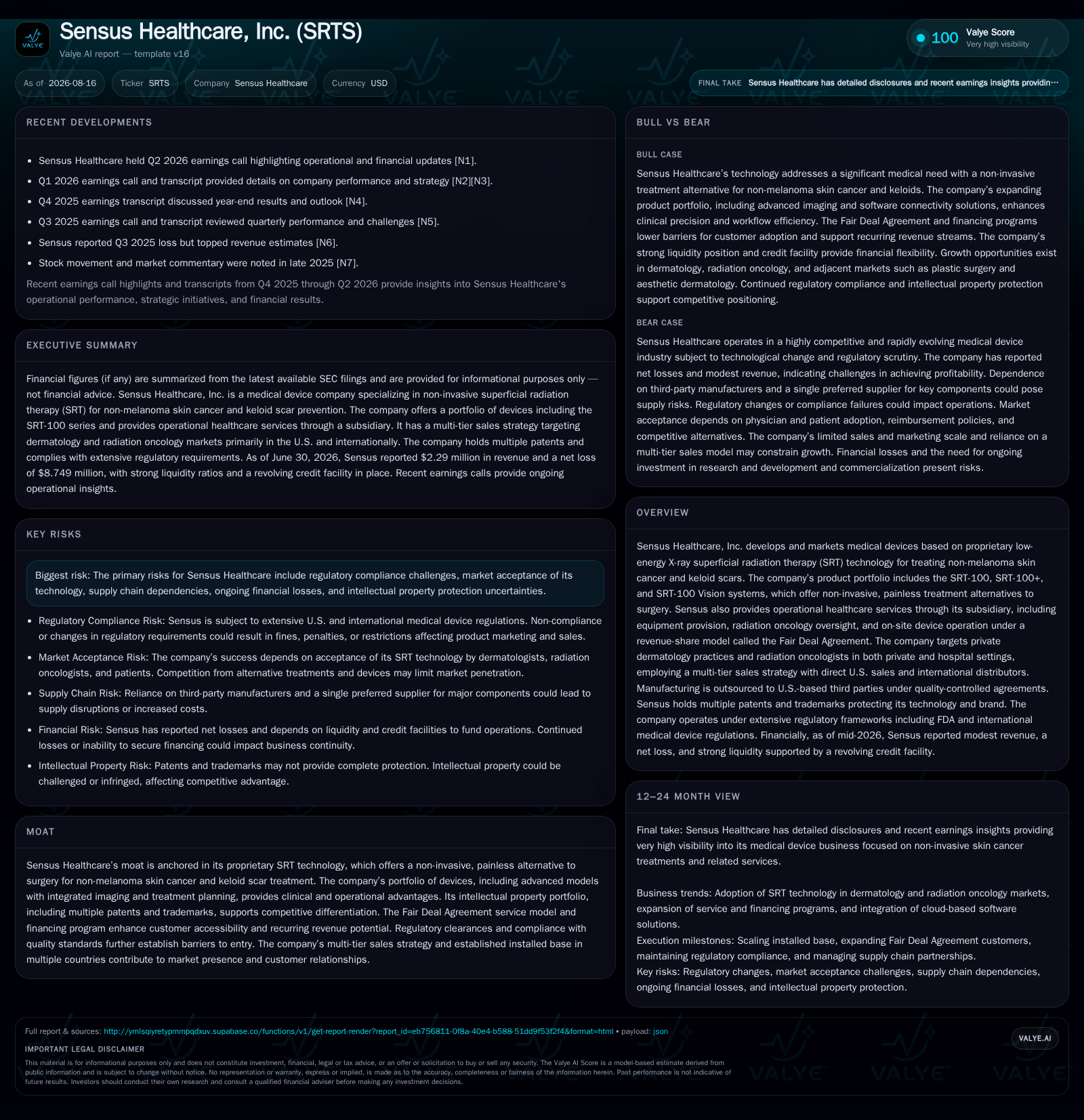
In Q2 2026, Sensus Healthcare continued its focus on non-invasive treatment for non-melanoma skin cancer using patented superficial radiation therapy (SRT) technology. The company reported ongoing investment in expanding its installed base and service offerings through the Fair Deal Agreement and launched complementary financial services and cloud-based software to enhance operational efficiency. While these initiatives deepen customer engagement and diversify revenue streams, Sensus remains challenged by its operating losses and must navigate regulatory and reimbursement dynamics. Near-term growth depends on execution of sales strategies, device utilization improvements, and successful penetration of both U.S. and international dermatology markets.
Recent Operating Update
Sensus Healthcare's latest quarterly filing from August 14, 2026, reaffirms its strategic emphasis on expanding the commercial footprint of its proprietary superficial radiation therapy (SRT) devices designed for treating non-melanoma skin cancers (NMSC) and keloids through a non-invasive approach [S2][S3]. The company reinforced its multi-pronged commercial strategy combining direct device sales with a novel recurring revenue model branded the Fair Deal Agreement. This approach bundles equipment provision with operational services such as radiation oncology oversight and onsite technologists to manage treatments.
Launching in February 2026, the Fair Deal Agreement is pivotal in reducing upfront cost barriers by replacing traditional outright purchases with a revenue-sharing structure tied to reimbursements from payors across private dermatology practices and hospital settings [S1]. This model is complemented by the introduction of Sensus Healthcare Financial Services which broadens customer accessibility by offering flexible financing options via third-party banks targeting outright purchase or leasing routes—thus addressing common leasing-related sales friction prevalent among medical providers.
Notably, the recent rollout of Sensus Link – a cloud-enabled point-of-care software tool integrated into their SRT-100 devices – introduces workflow enhancements including automated treatment documentation, improved operational intelligence, and treatment planning capabilities previously only available on higher-end image-guided radiation platforms [S1][S22]. Such software connectivity solutions represent an important evolution in marrying hardware with digital healthcare delivery trends that can improve device utilization rates and customer retention.
Manufacturing operations remain outsourced primarily within the United States under contract with RbM Services LLC, supplemented since 2025 by Kollpak LLC for special projects [S1][S18]. Establishing multi-supplier relationships aims to mitigate supply chain constraints risks while allowing agility in scaling production should demand accelerate dramatically—a crucial consideration given the industry's typical lead times for specialized component sourcing
Business Model Overview
At its core, Sensus Healthcare generates revenues through a combination of medical device sales (primarily the SRT-100 family comprising SRT-100, SRT-100+, and SRT-100 Vision models), consumables like disposable shielding components used during treatments, and service contracts under revenue-share programs that entail oversight responsibilities including radiation safety compliance and dedicated technologist provision [S1]. The business targets healthcare providers specializing in dermatology as well as radiation oncologists working in diverse clinical settings.
The company's patented low-energy photon X-ray technology offers a clinically effective alternative to surgical excision for certain skin cancers that are cosmetically or functionally challenging to remove surgically—such as lesions near critical facial features where scarring or grafting would normally be required [S1]. This distinct therapeutic proposition allows dermatologists to retain patient care under their roof rather than referring out while offering radiation oncologists a less capital-intensive option compared to large-scale linear accelerators.
Revenue mechanics hinge on device sales price or recurring reimbursements for treatments under Fair Deal Agreements. Growth variables include increasing installed base numbers, device utilization rates driven by patient volumes treated per system per period, expansion of service agreement customers adopting the turnkey offering, consumable usage linked proportionately with treatments delivered, and effective management of leasing/financing uptake impacting average contract size [S1].[F1]
Industry Structure & Competitive Position
Medical devices in superficial radiation therapy operate within a competitive landscape balancing efficacy, patient experience, regulatory compliance, reimbursement status, and cost efficiency versus established treatment modalities. Compared to conventional surgery or linear accelerator radiotherapy providers such as Varian Medical Systems or Accuray Incorporated (which offer higher-risk or more complex irradiations), Sensus positions itself with a light-weight Class II medical device cleared through FDA’s 510(k) pathway necessitating specialized quality controls but affording streamlined regulatory timelines [S21][S25].
This sector values intellectual property portfolios heavily due to high R&D costs coupled with clinical validation demands; Sensus' multiple patents underpin barriers against commoditization. Its emerging installed base nearing a thousand units worldwide is respectable scale among niche oncology devices though smaller than diversified radiation oncology equipment manufacturers. The array of service delivery models incorporating operational staff supervision differentiates it from pure capital equipment providers by embedding recurring revenue potential tied directly to patient throughput.
The company competes indirectly with dermatological lasers (some offered historically but limited since recent years) and alternative non-invasive modalities aimed at aesthetic or lesion treatments but lacking the same clinical indication breadth or reimbursement support. Peer companies like Cutera Inc., focused on broader dermatology aesthetic devices, underscore distinct strategic differences between tumor-focused oncology apparatus versus general aesthetics equipment.
Growth Drivers
Several structural tailwinds underpin demand for Sensus’ technology: globally rising skin cancer incidence—especially NMSC—drives clinical need; patients increasingly favor less invasive outpatient procedures that avoid anesthesia complications or visible scarring; recent CPT reimbursement code introductions effective January 2026 enhance payer recognition supporting economic viability; software tools like Sensus Link allow clinicians streamlined workflows potentially impacting utilization positively; broadening geographic penetration via international distributors expands addressable market scope; financing programs reduce acquisition cost barriers facilitating faster decision cycles among independent practices [S1]
The Fair Deal Agreement model’s success will likely correlate closely with measurable KPIs such as number of active agreements signed, contracted revenue share percentages realized against reimbursement collections, technologist uptime efficiency metrics, patient volumes treated per site per month (indirectly indicating device productivity), customer retention rates post initial term renewal periods, and overall installed base growth velocity.
Risks & Watchpoints
Key risks include delays or revocations in regulatory clearances which could impair marketing efforts given stringent FDA class II controls requiring compliance with special controls including post-market surveillance [S21]. Market adoption remains dependent on convincing traditionally surgical-oriented dermatologists or oncologists wary of changing practice patterns—a challenge compounded by physician training requirements detailed under the Fair Deal program.
The manufacturing outsourcing model exposes operations to supplier capacity fluctuations or quality issues despite established quality control regimes; though the addition of a second supplier mitigates concentration risk somewhat [S18]. Additionally, cybersecurity vulnerabilities inherent to connected medical devices necessitate ongoing investment in governance overseen at board level—a failure could materially damage reputation or invite regulatory penalties [S1].
Financial sustainability also poses challenges; operating losses exceeded $10 million as recently reported forcing tight cash flow management despite healthy liquidity positions currently at $15.2 million cash equivalents as of June 30, 2026 [F1]. Shifts in reimbursement policy by CMS or private payors may adversely affect pricing power while competitive advancements could pressure market share gains.
What To Watch Next
Progress milestones include quarterly updates on installed device counts beyond the last disclosed ~955 units across 21 countries as foundational market penetration benchmarks; tracking new Fair Deal Agreement signings provides insight into recurring revenue build-out; usage rates per installed system especially under new CPT codes will reveal clinical acceptance levels; adoption trajectory for Sensus Link among customers indicating successful software value-adds enhancing stickiness; possible regulatory announcements related to new product approvals or audits affecting compliance status; progress metrics from financial services uptake shedding light on easing sales funnel friction points; any shifts in R&D expense guidance portending pipeline innovation potential.
Investor attention should monitor upcoming quarterly results for top-line growth dynamics relative to operating expenses reflecting scalability prospects along with management commentary translating industry trends into executable strategy refinements highlighted during earnings calls alongside specific KPIs identified above [N1][S3]. Regulatory filings about cybersecurity governance committee formation could signal strengthening risk management preparedness reflective of growing connected-device portfolio complexity.
Financial Profile Discussion
As per the companyfacts data aligned with Q2 2026 filings,[F1] Sensus Healthcare maintains $15.2 million in cash and equivalents at quarter-end supporting operational runway amidst ongoing investments in product enhancement and service expansion initiatives.
Despite this balance sheet strength at period end June 30th, trailing twelve-month operating results through December 31st disclose an operating loss totaling over $10 million highlighting persistent pressure before achieving profitability thresholds.[F1] The net loss figure exceeding $7.7 million underscores continuing investment priorities in sales infrastructure development, R&D expenditure (although expected to decline from prior fiscal years), commercialization activities including Fair Deal rollout costs as well as compliance expenditures mandated under evolving FDA regulations.[F1][S25][S27]
Capital allocation focuses heavily on growth enablers: augmenting installed base network supported by financing facilitation programs alongside SaaS-inflected cloud solution deployment aimed at elevating value extraction per device asset. Maintaining discipline in SG&A spending without compromising market reach remains critical given small scale relative to larger oncologic device peers.[F1]
In summary, while profitable margins remain elusive amid early commercial stage positioning within specialized radiation therapy markets, Sensus’s balance sheet resilience combined with expanded product-service ecosystem constructs provides a platform on which it can pursue incremental scale economies should medical adoption accelerate substantively underpinned by favorable reimbursement landscapes.
This analysis synthesizes publicly filed financial disclosures along with industry sector context relevant to medical technology companies specializing in superficial radiation therapy applications as of mid-2026. It refrains from forecasting future performance or making investment research views consistent with internal Valye News editorial standards.
Disclaimer: This is research-only, informational analysis and not investment advice. It may include AI-generated interpretation and general industry context. Always verify important details using primary sources.

Comments