
Capital Structure and Deal Timing Pressure Shape QDRO Acquisition’s SPAC Path
QDRO Acquisition Corp., a newly listed SPAC, holds $200 million in trust and faces a narrow window to secure a business combination amid typical redemption dynamics.
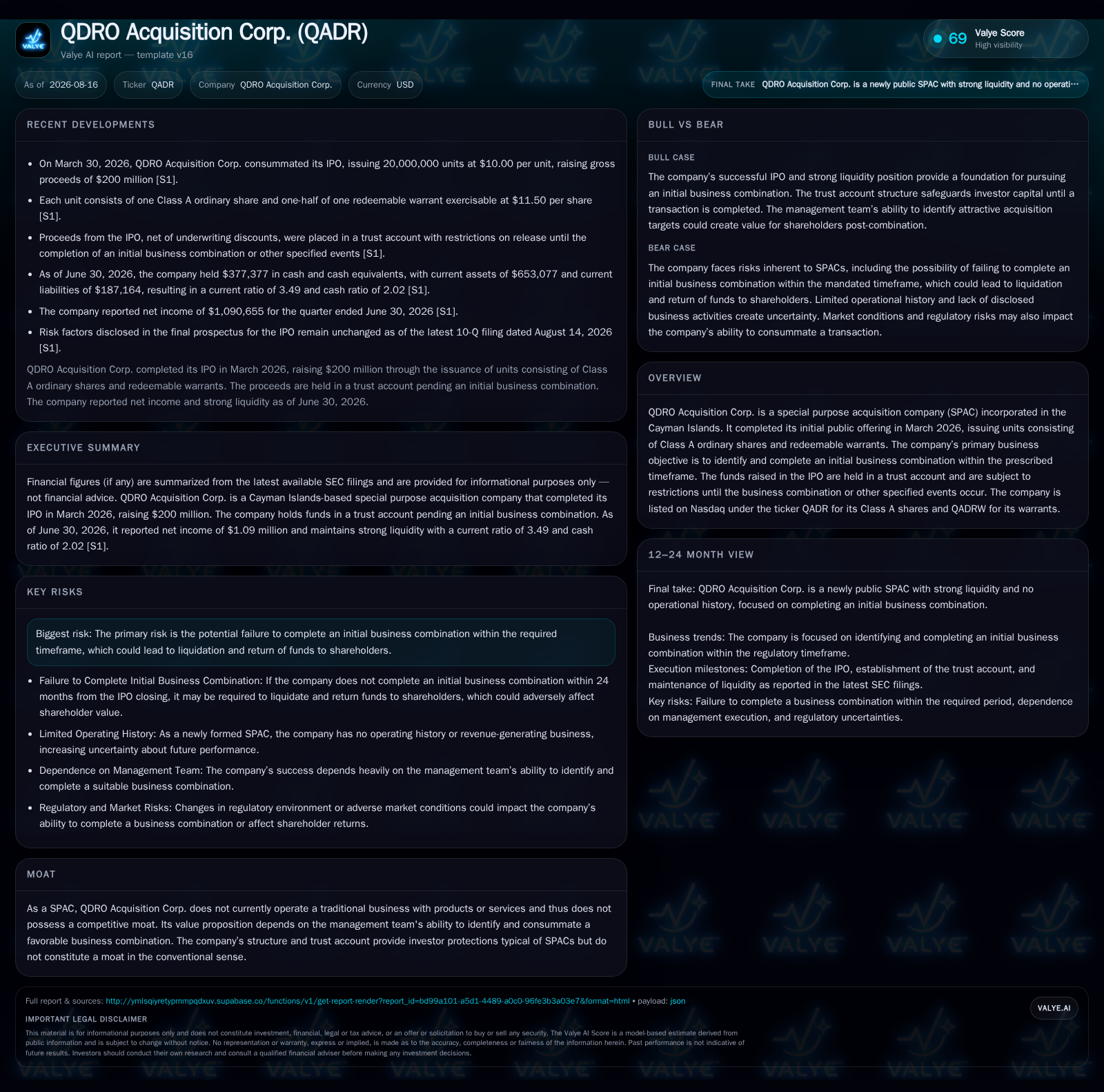
QDRO Acquisition Corp. completed its IPO in March 2026, raising $200 million by issuing units comprising Class A ordinary shares and redeemable warrants. The company holds its proceeds in a trust account to be deployed upon completing a qualifying business combination within roughly two years or face liquidation. Its latest 10-Q filing confirms no change in risk factors but underscores the urgency of deal execution given limited operating expenditures and robust liquidity. As a pure shell entity, QADR’s future value hinges entirely on management's ability to source attractive merger candidates before redemption pressures intensify. Sponsor incentives and typical SPAC mechanics shape capital structure and shareholder protections, while market appetite for alternative public listing routes remains key to deal pipeline prospects.
Latest Quarterly Filing Highlights Operational Stability Amid Deal-Timing Pressure
QDRO Acquisition Corp.’s August 14, 2026 10-Q filing reconfirms that there have been no material changes in risk factors since the IPO prospectus [S2]. This underscores the enduring central risk facing all SPACs: executing an initial business combination within the prescribed timeframe to avoid liquidation.
Financially, the company reported cash and cash equivalents of approximately $377 thousand as of June 30, 2026 [F1]. This cash primarily supports administrative functions separate from the substantial IPO proceeds held in trust. Current assets totaled about $653 thousand against current liabilities of roughly $187 thousand, resulting in a healthy current ratio of approximately 3.49 [F1]. This liquidity position ensures adequate runway for corporate overhead expenses as QADR pursues its de-SPAC transaction.
Operating income remains negative but minimal (around -$700K), reflecting expected corporate overhead without operating revenues [F1]. The positive net income figure exceeding $1 million is largely driven by non-operating items such as interest income on cash equivalents [F1], indicative of conservative capital management pre-combination.
Capital Structure: Units, Warrants, and Trust Account Mechanics Protect Investor Capital
In its March 2026 IPO closing, QADR issued approximately 20 million units at $10 each for total gross proceeds near $200 million [S3], [S8]. Each unit consists of one Class A ordinary share paired with half a redeemable warrant exercisable at $11.50 per share [S8]. This structure balances investor downside protection—via redemption rights prior to combination—with upside participation through warrants upon successful merger completion.
Additionally, QADR issued six million private placement warrants to its sponsor and underwriter at $1 each for gross proceeds of $6 million [S12]. These private placement warrants provide management with promote-like incentives aligned to post-merger value creation.
The full gross proceeds less underwriting fees (approximately $12 million) were placed into a U.S.-based trust account administered by Continental Stock Transfer & Trust Company acting as trustee [S8]. Access to these funds is tightly restricted; only limited annual withdrawals capped at $100 thousand plus tax payments outside this cap are permitted for working capital needs. The principal remains protected until either completion of an initial business combination or mandatory liquidation after two years if no deal is consummated [S8]. Shareholders maintain redemption rights throughout this period allowing them to reclaim their pro-rata share from the trust before any merger closes.
Industry Context: Value Hinges on Sponsor Quality and Deal Pipeline Amid SPAC Lifecycle Risks
As a typical SPAC without operating revenues or assets aside from trust funds, QADR’s intrinsic value depends entirely on the sponsor’s ability to identify and close attractive business combinations efficiently. Unlike traditional operating companies where financial history informs valuation, SPAC market value largely reflects confidence in management’s sourcing capabilities and pipeline quality.
Peers such as Pershing Square Tontine Holdings exemplify how sponsor reputation materially influences outcomes by facilitating access to high-quality targets and favorable deal terms. While QADR’s sponsor arrangements—including private placement warrants—follow standard industry conventions [S12], public disclosures have yet to reveal detailed management track records or sector focus compared to specialized SPAC vehicles.
This absence of operational history necessitates close monitoring of forthcoming deal announcements—the primary validation point—and subsequent shareholder redemption behavior which signals investor approval or skepticism toward proposed transactions.
Growth Drivers: Market Appetite for Alternative Listing Routes Supports Deal Potential
The broader capital markets environment continues to favor SPACs offering expedited paths to public markets relative to traditional IPOs that involve lengthier regulatory processes and greater market volatility exposure. Regulatory clarity surrounding de-SPAC transactions has improved investor confidence recently.
While QADR has not disclosed target sectors or candidates—a common practice prior to formal announcements—the structural appeal lies in leveraging efficient capital deployment combined with PIPE financings that strengthen valuations during mergers.
Key Risks: Time Constraints, Redemption Dynamics, Dilution Exposure, and Regulatory Scrutiny
A fundamental risk facing QADR—and all SPACs—is failure to complete an initial business combination within approximately two years post-IPO (~24 months), triggering mandatory liquidation that returns invested funds minus expenses [S2].
Redemption rights empower shareholders to exit investments if they disapprove proposed deals or prefer capital return without exposure; however, elevated redemptions reduce cash available for transaction financing and may complicate negotiations with prospective targets.
Dilution risks arise from warrant exercises post-merger which can pressure stock price appreciation if not mitigated through underwriting agreements or PIPE structures. Regulatory scrutiny around disclosure transparency and valuation practices continues evolving under SEC oversight.
Potential conflicts between sponsors—who benefit from promote economics—and public investors may influence deal terms including redemption conditions or warrant treatment [S2]. Furthermore, ongoing negative operating costs highlight the need for careful expense control relative to administrative allowances funded outside the trust account.
Watchpoints Ahead: Deal Announcements, Redemption Rates, Sponsor Warrant Activity, Timeline Amendments
Investors should closely follow near-term catalysts such as formal announcement of initial business combinations which typically trigger heightened trading volumes alongside shareholder redemption election periods.
Subsequent voting outcomes will clarify investor sentiment levels directly affecting secondary market liquidity post-announcement.
Sponsor warrant exercise patterns may also indicate confidence in closing transactions successfully. Any extensions or amendments modifying deadlines for completing business combinations will be critical signals regarding execution challenges or strategic pivots requiring scrutiny.
To date (August 2026), no such developments have been publicly disclosed; thus maintaining vigilance alongside patience remains prudent until material progress beyond shell status emerges [S16]
Financial Profile Discussion: Conservative Capital Management Ensures Runway Pre-Deal
The core capital base secured within the trust exceeds $200 million net underwriting fees providing substantial firepower for acquisition financing [S8]. However direct cash held outside this restricted fund remains modest ($377K) per June quarter-end data reflecting primarily administrative working capital rather than transactional liquidity [F1].
Current assets notably exceed current liabilities (current ratio ~3.49), underscoring prudent short-term balance sheet stewardship supporting necessary legal compliance and corporate functions without endangering principal held in trust accounts [F1]
Operating losses remain limited (-$699K) consistent with expected pre-deal corporate overhead focused on professional services such as legal counsel related to proxy solicitations or SEC filings rather than generating operational revenues [F1].
Overall, QDRO Acquisition exemplifies an early-stage SPAC maintaining conservative financial discipline while depending critically on timely deal origination and sustaining shareholder engagement essential for progression beyond its shell company phase.
This analysis strictly reflects publicly available SEC filings through August 14, 2026. It avoids speculation regarding specific acquisition targets or timing beyond documented facts and established industry frameworks relevant for assessing QDRO Acquisition Corp.’s position as an active but pre-deal SPAC preparing for its de-SPAC transition.
Disclaimer: This is research-only, informational analysis and not investment advice. It may include AI-generated interpretation and general industry context. Always verify important details using primary sources.

Comments