
GPU-Enhanced SaaS Growth and Liquidity Risks Shape Global-Smart.Tech Outlook
Global-Smart.Tech's latest quarter highlights its consultative GPU-driven cloud rendering SaaS amid severe liquidity constraints and governance moves.
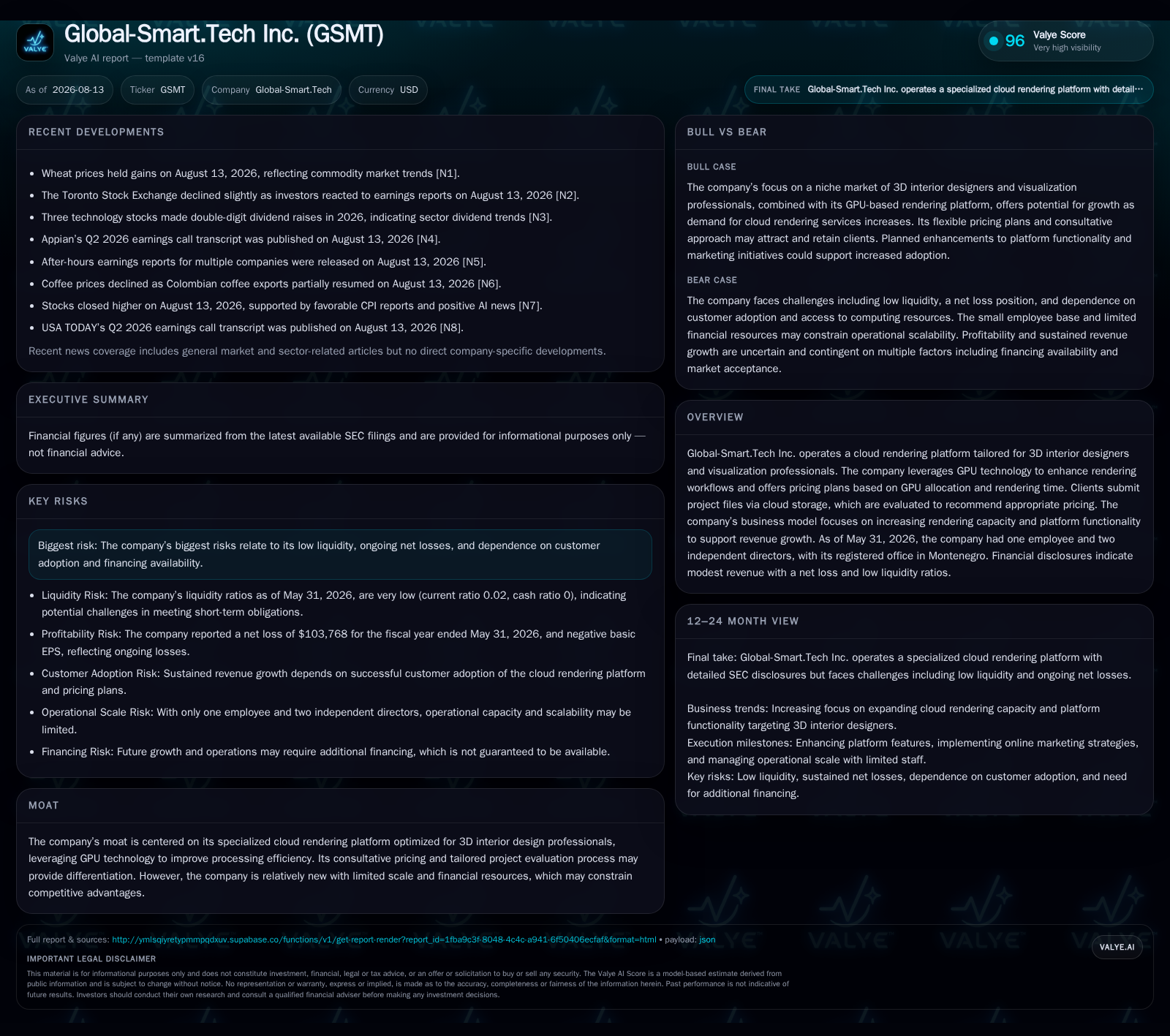
Global-Smart.Tech Inc. operates a specialized cloud rendering platform targeting 3D interior designers, monetizing through tiered GPU usage-based pricing tied to project complexity. The April 2026 quarter revealed ongoing operating losses and minimal cash reserves, while a mid-June equity share cancellation reduced outstanding shares by nearly half, signaling active capital structure management. Despite a well-differentiated consultative pricing approach and potential in a growing cloud rendering market, the company faces significant risks from low liquidity and scalability limitations. Key metrics like GPU hours consumed and platform utilization remain undisclosed but will be critical to monitor alongside marketing effectiveness as the firm pursues growth.
April Q1 Operating Update: Platform Usage and Capital Structure Shifts
Global-Smart.Tech’s April 2026 quarterly filing revealed continued modest revenue generation at approximately $79,156 paired with a net loss of about $103,768 for the period ending May 31, 2026 [F1][S2]. These figures highlight an early-stage SaaS struggling to scale revenue adequate to cover fixed platform costs and development expenses. Critically, the balance sheet shows exceptionally low liquidity with current assets of just $9,181 against current liabilities nearing $460,000, yielding a current ratio around 0.02—a stark indicator of near-term solvency risk if additional capital is not secured [F1].
Shortly after this filing, management executed a voluntary cancellation of 3 million common shares—reducing total shares outstanding from roughly 6.13 million to just over 3.13 million—effectively halving the shareholder base through an internal capital contribution without cash inflow or dilution impact on residual investors [S3]. This unusual governance move points to strategic capital structure rebalancing aimed at possibly streamlining control or preparing for future financing rounds under altered equity conditions.
Together these developments frame Global-Smart.Tech as a company aggressively managing its constrained financial runway while working to prove out demand traction for its unique cloud rendering offering.
'Consultative Pricing' Business Model Tied to GPU Tiers for Project Complexity
Global-Smart.Tech deploys a tailored cloud rendering SaaS where customers—primarily focused on 3D interior designers—initiate engagement through online contact forms submitting project files via external cloud storage links [S1][S9]. The company’s specialists then perform comprehensive project evaluations examining file data density, scene complexity, and required rendering parameters before recommending pricing plans based on allocated GPU counts (10, 25, or 40 GPUs) with minimum rendering time thresholds typically starting at five hours.
This consultative pricing scheme differs from commoditized pay-as-you-go models seen broadly in public cloud providers by emphasizing upfront project-specific assessment to optimize compute resource use efficiently while ensuring transparent cost structures aligned with technical demands. By matching GPU allocation tightly to project complexity, Global-Smart.Tech aims to improve compute resource management and platform utilization rate—critical operational KPIs that influence both margins and customer satisfaction in compute-intensive workflows.
Revenue accrual depends significantly on how well the firm can grow active user projects that fit these GPU usage tiers and extend average rendering times—a function directly correlated with project complexity mix among their niche professional clientele segment.
Competitive Context: Specialized SaaS Peers Versus Large Cloud Providers
Within the broader cloud rendering ecosystem, Global-Smart.Tech occupies a specialist SaaS niche focusing on graphic-intensive workflows for design professionals rather than mass-market compute instances offered by hyperscalers like AWS or Azure GPU offerings. Peers such as Chaos Group’s V-Ray Cloud and Autodesk’s cloud rendering services offer similarly consultative or integrated platforms emphasizing ease-of-use and sophisticated pricing models tied closely to project demands.
While GSMT’s platform functionality revolves around detailed project assessment enabling bespoke GPU resource allocation—a potential differentiator—its very limited scale (one employee plus two independent directors), tight financial position, and undeveloped marketing presence hamper its ability to compete effectively against larger firms with more extensive infrastructure partnerships and broader customer outreach capacity.
In this comparison group context, maintaining competitiveness requires both efficient platform scalability (minimizing idle GPU time) and accelerating client acquisition velocity without disproportionate CAC outlays.
Demand Catalysts: Adoption Trends in Niche Professional Visualization Markets
Demand dynamics favor Global-Smart.Tech’s business focus given an industry-wide shift away from costly local hardware toward flexible, on-demand cloud rendering solutions supporting freelancers and small studios increasingly engaged in high-fidelity visualizations [S1]. The escalating complexity of contemporary projects mandates more substantial GPU workloads extending average rendering times and driving up platform utilization rates—all favorable for consumption-based SaaS models like GSMT’s.
Moreover, ongoing expansion of remote-work environments expands the target market of interior designers and visualization professionals reliant on accessible cloud services integrating seamlessly with their existing design toolsets via standard cloud storage file transfers.
The effectiveness of planned online marketing initiatives will be critical in scaling user acquisition cost-effectively while capturing emerging demand growth fueled by these structural technology adoption trends.
"Threat Vectors": Liquidity Crisis, Scalability Barriers, and Market Competition
Subjecting GSMT’s operations to scrutiny reveals acute risks undermining growth prospects. The balance sheet evidences dangerously low liquidity (current ratio ~0.02), leaving minimal buffer against unforeseen operational disruptions or investment needs [F1]. Combined with continuing net losses exceeding $100k quarterly puts significant pressure on cash burn sustainability absent fresh financing.
Capital intensity is high due to ongoing requirements for GPU infrastructure capacity expansion essential for scaling platform utilization without quality degradation—a typical pain point within GPU-cloud SaaS industries where hardware refresh cycles and energy costs weigh heavily. Furthermore, competitive pressures from large public clouds offering commodity-priced GPUs create downward pricing pressure threatening margin compression unless GSMT achieves scale advantages or superior efficiency through its consultative model.
Also pertinent are extended B2B sales cycles characteristic of professional design segments potentially slowing adoption velocity. Finally, reliance on third-party cloud infrastructure introduces counterparty risk regarding service availability and cost volatility impacting both operational stability and pricing strategies.
"Next Checkpoints": Platform Enhancement Milestones and Adoption Indicators
Looking ahead, several key performance indicators will be pivotal gauges validating Global-Smart.Tech’s strategic path. Enhancements expanding platform functionality—such as improved integration with leading design tools or automation of project complexity assessments—could materially boost user experience and reduce onboarding friction [S1][S9].
Demand-side metrics warrant close monitoring including number of active projects/users processed per period, aggregate GPU hours consumed indicating true scaling of rendering workloads, trends in average revenue per user reflecting pricing power or upsell success, and customer acquisition cost evolution signaling marketing efficiency.
Tracking these KPIs in coming quarters will clarify whether usage-based revenue generation can sustainably offset infrastructure costs while progressing toward breakeven levels amid intense financial constraints.
Financial Profile Discussion
As of May 31, 2026—the latest reported fiscal period—the company posted total revenue of approximately $79k contrasted against operating losses close to $104k highlighting persistent unprofitability amidst ramping expenses [F1]. Cash balances stood critically low at only $81 limiting operational flexibility; this combined with current liabilities near half a million dollars results in an extremely negative current liquidity ratio (~0.02) underscoring acute need for external funding or operating improvements [F1].
This financial picture exposes existential risk absent effective capital raising or rapid operational scaling. Investors should monitor announcements related to financing events or meaningful margin pathway developments carefully given the likelihood of ongoing cash burn outpacing incoming revenue until broader adoption milestones are met.
This analysis integrates all verifiable disclosures and situates Global-Smart.Tech within the evolving landscape of cloud rendering SaaS platforms serving specialized professional visualization markets. While the company demonstrates a conceptually attractive usage-based consultative pricing model leveraging GPU allocations attuned to project complexity, material execution risks relating primarily to liquidity stress and competitive scale disadvantages remain substantial as it seeks wider market traction.
Disclaimer: This is research-only, informational analysis and not investment advice. It may include AI-generated interpretation and general industry context. Always verify important details using primary sources.

Comments