
Shimmick Corp Faces Execution Challenges While Expanding Water Infrastructure Backlog
Shimmick’s latest quarterly results reveal operational headwinds amid a strategic backlog expansion focused on water and critical infrastructure projects.
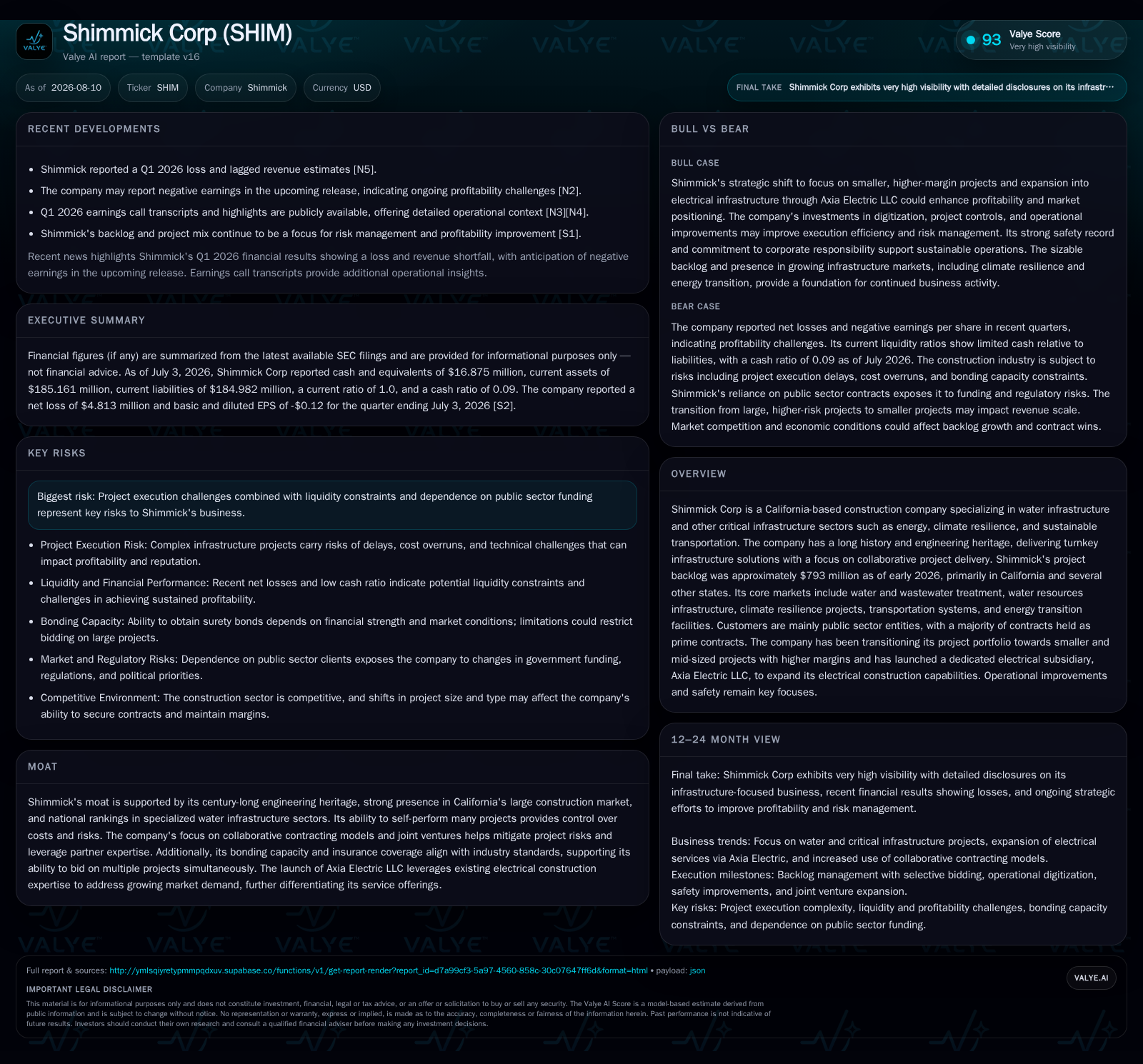
In its Q2 2026 report, Shimmick Corp disclosed a second-quarter loss and revenue miss, highlighting ongoing execution risks despite growth in its project backlog primarily centered in California and adjacent states. The company is pursuing a strategic pivot towards smaller, higher-margin infrastructure projects and expanding its electrical construction capabilities through Axia Electric LLC. Structural industry drivers such as aging water infrastructure, climate resilience demand, and increased public-sector funding underpin the company’s growth prospects, but fixed-price contracts, cost inflation, and public funding dependency remain key risks. Close attention to backlog conversion timing and project margin trends will be crucial to assessing Shimmick's operational progress ahead.
Recent Operating Update
Shimmick Corporation reported financial results for the second quarter ended July 3, 2026, disclosing a net loss that missed consensus revenue expectations [S2][N1]. The quarter highlighted persistent challenges in project execution amid ongoing inflationary pressures impacting costs on fixed-price contracts. Despite these near-term earnings concerns, the company emphasized continued strategic efforts to expand its project backlog — which stood at approximately $793 million as of early 2026 — predominantly within California along with selected projects in Tennessee, Texas, Wyoming, Idaho, Hawaii, and Washington [S1][S26]. This backlog consists mainly of prime contracts with public sector clients across water infrastructure and other critical sectors.
Business Model
Shimmick specializes in turnkey construction solutions focusing on water infrastructure (including treatment plants and resource systems), alongside energy transition facilities, climate resilience projects, and sustainable transportation systems [S1]. The company operates primarily as a prime contractor for public agencies such as municipal water districts and transit authorities with roughly 96% of the backlog being direct contracts rather than subcontracting engagements [S22].
Revenue is recognized using an input method based on percentage completion tied to incurred costs relative to total expected costs for each contract. This method inherently carries volatility risk — cost overruns or design errors can materially affect profitability in any given period [S24][S25]. Project economics are sensitive to scope changes as well as claims arising from materials or regulatory compliance issues. Maintaining control over subcontractors is vital given potential knock-on impacts on schedule adherence and cost escalation.
A notable component of Shimmick's model is its emphasis on self-performance of key work scopes — particularly electrical construction — which enables tighter cost controls and mitigates reliance on third-party subcontractors. This capability has been formalized under the newly launched Axia Electric LLC subsidiary that targets specialized electrical work including low- and medium-voltage power distribution tailored for energy transition projects (e.g., electric vehicle fleet infrastructure) [S26]. This initiative leverages over two decades of experience while aiming to capture higher-margin opportunities in technology-driven segments.
The firm's growing adoption of collaborative contracting methods marks a strategic shift away from purely fixed-price contracts toward partnership-based models that allow broader client-contractor cooperation throughout design and construction phases. These models provide greater transparency with open-book pricing arrangements during preconstruction services phases and better aligned incentives aimed at reducing cost overruns and schedule delays [S12]. While still representing a minority share today, Shimmick intends to increase this portfolio segment to improve overall risk management.
Industry Structure & Competitive Position
Shimmick operates within the capital-intensive U.S. construction and infrastructure services industry characterized by heavy public sector participation. The overall market includes water treatment plants, dams, transportation systems, energy facilities, flood control structures, among others.
California represents the company's core market — one of the largest construction markets nationally — supported by state-driven infrastructure funding which complements federal investments targeting climate resilience and clean water initiatives. This geographic focus affords scale advantages but also concentrates regulatory compliance complexity.
Peers typically include large general contractors with diversified portfolios such as Kiewit or Granite Construction; specialized players focused on water infrastructure; engineering firms providing design-build services; and various joint venture partners utilized for complex projects. Shimmick’s century-long engineering heritage combined with strong ENR national rankings (#8 in dams/reservoirs; #11 in water treatment/desalination) underscores a solid market reputation within its niche sectors [S1].
Growth Drivers
Critical secular trends underpinning Shimmick’s addressable market include:
- Aging national water infrastructure requiring rehabilitation or replacement.
- Heightened attention on climate change effects bolstering demand for resilient flood control systems.
- Energy transition efforts fostering new electrical infrastructure installations (e.g., EV charging stations).
- Expansion of sustainable transportation networks requiring upgrades or new constructions.
- Increased government funding via federal stimulus packages focusing on environment-friendly infrastructure development.
The launch of Axia Electric represents capitalizing on the energy transition theme by integrating electrical solutions within broader civil engineering offerings [S26]. The strategic pivot from very large-scale projects toward smaller/mid-sized contracts supports ambitions for improved profitability profiles via lower risk exposure [S26]. Furthermore, collaborative contracting adoption aims to safeguard margins by distributing risk more evenly between client and contractor.
Risks & Watchpoints
Project execution risks loom large due to reliance on fixed-price contracts susceptible to unanticipated cost inflation or design complications leading to cost overruns or liquidated damages claims. Material adverse events such as natural disasters can disrupt operations abruptly [S24]. Subcontractor supply chain reliability is another vulnerability given its influence on timeliness and expense controls.
Public sector funding dependency means shifts in government investment priorities or economic downturns could curtail project pipelines causing cancellations or scope reductions impacting backlog realization rates [S24][S25]. Revenue recognition subjectivity inherent in input methods implies quarterly earnings may fluctuate significantly based on changing project completion estimates.
Liquidity constraints warrant monitoring despite currently balanced working capital metrics — with a current ratio near parity— since prolonged operating losses or delayed receivables could tighten cash flow availability pressing debt covenants under credit agreements [F1]. Commodity price swings also potentially affect material costs feeding into project budgets negatively.
Legal/regulatory compliance failures including under the False Claims Act represent lingering reputational risks tied to government contracts enforcement norms [S24]. Finally, any unsuccessful execution of recent strategy shifts or overextension into new service lines like Axia Electric could strain resources if not managed prudently.
What To Watch Next
Key milestones that indicate progression include:
- Quarterly updates on backlog conversion rates into recognized revenue confirming sustainable work progression.
- Changes in gross margin reflecting success managing increased input costs or collaboration contract effectiveness.
- New awards booked signaling pipeline health amid selective bidding discipline.
- Safety incident rates maintaining low levels ensuring uninterrupted site operations.
- Financial statement disclosures around working capital cycles mitigating risk of liquidity shortfalls.
- Integration success of Axia Electric reflected through incremental electrical project wins or margin expansion.
- Updates related to any material claims or litigation resolving uncertainty over potential financial impact.
Consistent delivery against these operational KPIs will affirm whether Shimmick’s strategic shift towards balanced risk portfolios backed by collaborative contracting delivers tangible improvements beyond earlier execution setbacks.
Financial Profile Discussion
Working capital management involving timely collections on receivables plus disciplined subcontractor payments will be critical as revenues ramp up from backlog execution phases transitioning into later quarters [F1][S2]
This analysis reflects information current as of August 2026 based upon available SEC filings and regulatory disclosures. It is intended solely for informational purposes without investment research views.
Disclaimer: This is research-only, informational analysis and not investment advice. It may include AI-generated interpretation and general industry context. Always verify important details using primary sources.

Comments