
Douglas Elliman’s Luxury Brokerage Defends Margin Amid Market Cyclicality
Douglas Elliman sustains premium brokerage margins and growth focus through technology integration and ancillary services despite a challenging market environment.
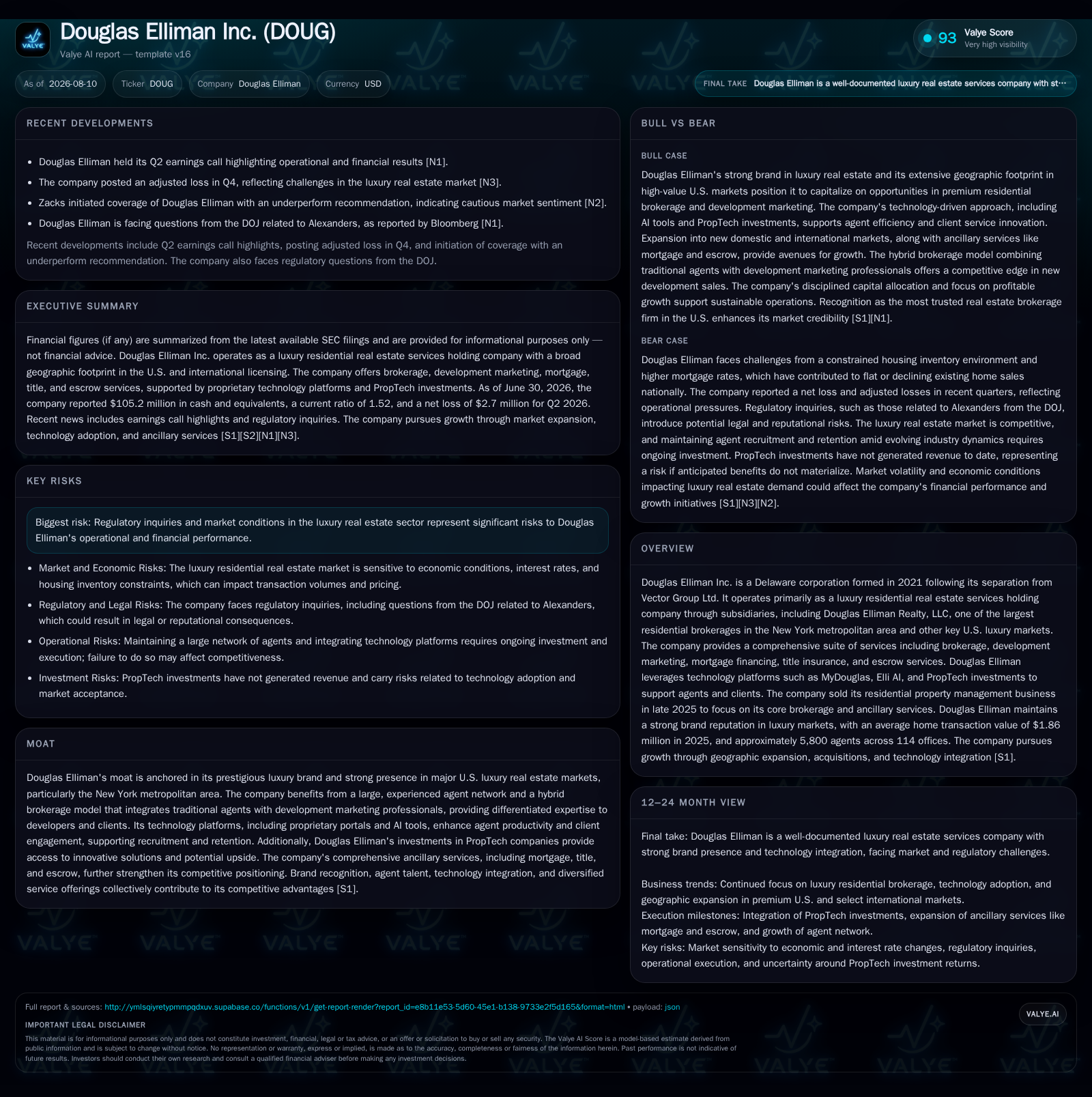
In Q2 2026, Douglas Elliman demonstrated resilience in its core luxury residential brokerage business amid ongoing market cyclicality, with average home transaction values holding steady near $1.86 million, supporting stable brokerage commissions. The company leverages its well-established brand in key U.S. luxury markets alongside technology platforms like MyDouglas and Elli AI to enhance agent productivity and client experience, differentiating itself from peers. Growth strategies emphasize expansion of development marketing and ancillary offerings—including mortgage financing, title insurance, and escrow services—which add revenue diversification and margin leverage. Regulatory and macroeconomic risks remain salient but are balanced by Douglas Elliman's focused luxury market positioning and asset-light model.
Q2 Operating Trends Signal Resilience in Luxury Transactions during Market Cycles
Douglas Elliman’s latest quarterly filing for Q2 2026 evidences operational durability despite the cyclical challenges typical in the residential real estate market. The company maintained an average home transaction value close to $1.86 million—a figure substantially higher than many competitors—anchoring gross commission income at robust levels even as fluctuations in closed transaction volume occur during broader market softness [S2][N1]. This premium average sale price is critical; it supports elevated per-transaction fees that help sustain margins during periods when transaction counts may fall due to macroeconomic pressures such as rising interest rates or tight housing supply.
The slight cyclicality in transaction volumes observed is not unexpected given recent year-over-year declines in existing home sales nationally since 2021. Yet Douglas Elliman’s strong foothold in luxury metropolitan markets mitigates these effects because luxury homebuyers tend to be less sensitive to standard economic cycles compared with entry-level or mid-market buyers [S1]. The maintenance of commission revenues despite a softening industry backdrop signals durable pricing power inherent to Douglas Elliman’s brand.
Douglas Elliman’s Brokerage Model Anchored in High-Value Transaction Economics
At its core, Douglas Elliman generates the majority of its revenue through brokerage commissions on residential real estate transactions primarily located in high-barrier-to-entry luxury markets such as New York City metro area (including the Hamptons), Florida, California, Texas, and selected East Coast cities [S1]. The company’s agent network comprises approximately 5,800 licensed agents organized chiefly around principal agents who command local market knowledge and client relationships—key assets for converting listings into closed deals.
This geography-specific focus on affluent urban hubs supplies two intertwined advantages: first, higher average transaction values that scale fee income materially; second, sustained demand volatility buffering because luxury buyers’ purchasing decisions are influenced by factors such as international capital flows and wealth concentration rather than purely domestic economic cycles [S22]. Notably, Douglas Elliman’s hybrid model pairs traditional residential broker agents with the Development Marketing division (DEDM), which focuses on new project sales. This amalgamation diversifies revenue streams within brokerage commissions while leveraging cross-functional agent expertise.
Compared to peers like Compass Inc. or Realogy Holdings Corp., which also compete in similar high-end markets but with differing technology investment profiles or scale advantages, Douglas Elliman prioritizes deep market penetration coupled with sharp brand prestige that supports superior pricing power per sale [S22]. This dynamic is reflected in its consistently above-average transaction values relative to broader full-service brokerages
Technology-Powered Agent Productivity: A Differentiator in Competitive Luxury Markets
Douglas Elliman’s investment in proprietary digital infrastructure significantly enhances its agents’ productivity and client engagement capabilities. Platforms such as MyDouglas provide cloud-based SaaS portals enabling brokers to manage workflow on any device with integrated AI-driven dashboards that streamline deal processing and client communications [S17]. Elli AI supplements these efforts with data analytics designed to refine agent targeting and listing optimization.
These technologies reduce administrative friction and deepen customer relationship management efficacy—both crucial in attracting high-caliber agents amid fierce talent competition in real estate services. Moreover, sustained enhancements to agent tools aid recruitment retention by reinforcing broker earnings potential through efficiency gains.
While technologically driven brokerages like Redfin or eXp World Holdings pursue scalability via platform-centric operations, Douglas Elliman blends tech adoption with traditional brand-driven brokerage expertise. This balance allows it to maintain personalized service required at the luxury segment while harnessing innovation benefits—a potentially durable moat given industry disruption trends yet unproven among prestige brokerages [S22].
Expanding Footprint Through Development Marketing and Integrated Ancillary Services
Beyond core brokerage commissions, Douglas Elliman leverages development marketing as a growth vector through DEDM, a specialized division servicing new real estate developments with a team of about 88 professionals who provide sales, leasing, marketing research and design tailored for developers across major U.S. markets [S22]. By bridging deep market intelligence with targeted developer relationships via a hybrid agent model, DEDM generates fee-based revenue streams relatively less tied to individual sale closings.
Complementing this is the company’s strategic emphasis on ancillary services encompassing mortgage financing (via alliance with Associated Mortgage Bankers), title insurance, escrow services, notary work, staging, security, renovation facilitation among others [S1][S22]. These offerings extend monetization over broader parts of the property life cycle beyond transactional point commissions and improve client retention through bundled service delivery.
The sale of its property management business in late 2025 signaled increased focus on expanding these high-margin ancillary verticals alongside brokerage expansion [S25]. This integrated model enhances profitability leverage especially during market softness when volume-dependent income streams face pressure.
Macroeconomic & Regulatory Risks Shadow Growth but Luxury Brand Moat Endures
Douglas Elliman faces material risks from adverse regulatory developments stemming from antitrust litigation affecting industry-wide commission structures. Following significant settlements—including a $7.75 million payment into escrow plus contingent future payments—the company contends with ongoing appeals that inject uncertainty around future liability and potential operational changes required under injunctions or regulatory reforms [S4][S5][S9][S26]
Additionally, macroeconomic headwinds related to rising mortgage rates increasingly affect housing affordability even in affluent segments where demand has traditionally been more resilient. Tightening credit availability could moderate new transaction volumes or lengthen time properties remain listed.
These regulatory and economic factors underscore unavoidable cyclicality intrinsic to residential real estate services yet Douglas Elliman’s concentrated exposure to luxury markets—marked by more price-inelastic buyers—and investment-backed technology adoption partially insulate its operations from extreme volatility [S1][S26].
What to Watch: Milestones for Transaction Volume, Technology Uptake, and Regulatory Outcomes
Key near-term performance indicators will include monitoring quarterly closed transactions alongside maintaining or growing the average transaction value benchmark near $1.86 million. Sustained or accelerating adoption of advanced tools like MyDouglas portal features across agents will signal continued productivity enhancements supporting margins.
Progress on clarifying outcomes related to antitrust settlement appeals remains pivotal since adverse rulings could necessitate structural adjustment impacting commission revenues. Additionally, expansion updates within development marketing and ancillary offerings will reveal if diversified fee streams successfully offset general brokerage cyclicality [S2][N1].
Financial Profile Discussion: Strong Liquidity with Asset-Light Capital Structure Supports Strategic Flexibility
As of June 30, 2026, Douglas Elliman held approximately $105 million in cash and equivalents against current liabilities near $105 million—yielding a healthy current ratio of 1.52—and reported no outstanding debt as per the latest data available through year-end 2022 balance sheets [F1]. This robust liquidity combined with a zero-debt stance reflects prudent capital management aligned with an asset-light operational model focused on commissions rather than capital-intensive holdings.
This analysis incorporates the most recent SEC filings alongside broader industry insights into residential real estate brokerage dynamics focusing on luxury markets. It emphasizes how Douglas Elliman balances traditional high-touch brokerage economics with digital innovation while navigating evolving regulatory landscapes typical of this highly cyclical yet opportunity-rich sector.
Disclaimer: This document is for informational purposes only without any investment research view or financial advice.
Disclaimer: This is research-only, informational analysis and not investment advice. It may include AI-generated interpretation and general industry context. Always verify important details using primary sources.

Comments