
CSB Bancorp Leverages Regional Focus and Diversified Services Amid Interest Rate Pressures
CSB Bancorp’s Q2 2026 highlights emphasize asset quality vigilance and investment portfolio adjustments in a competitive Ohio banking landscape.
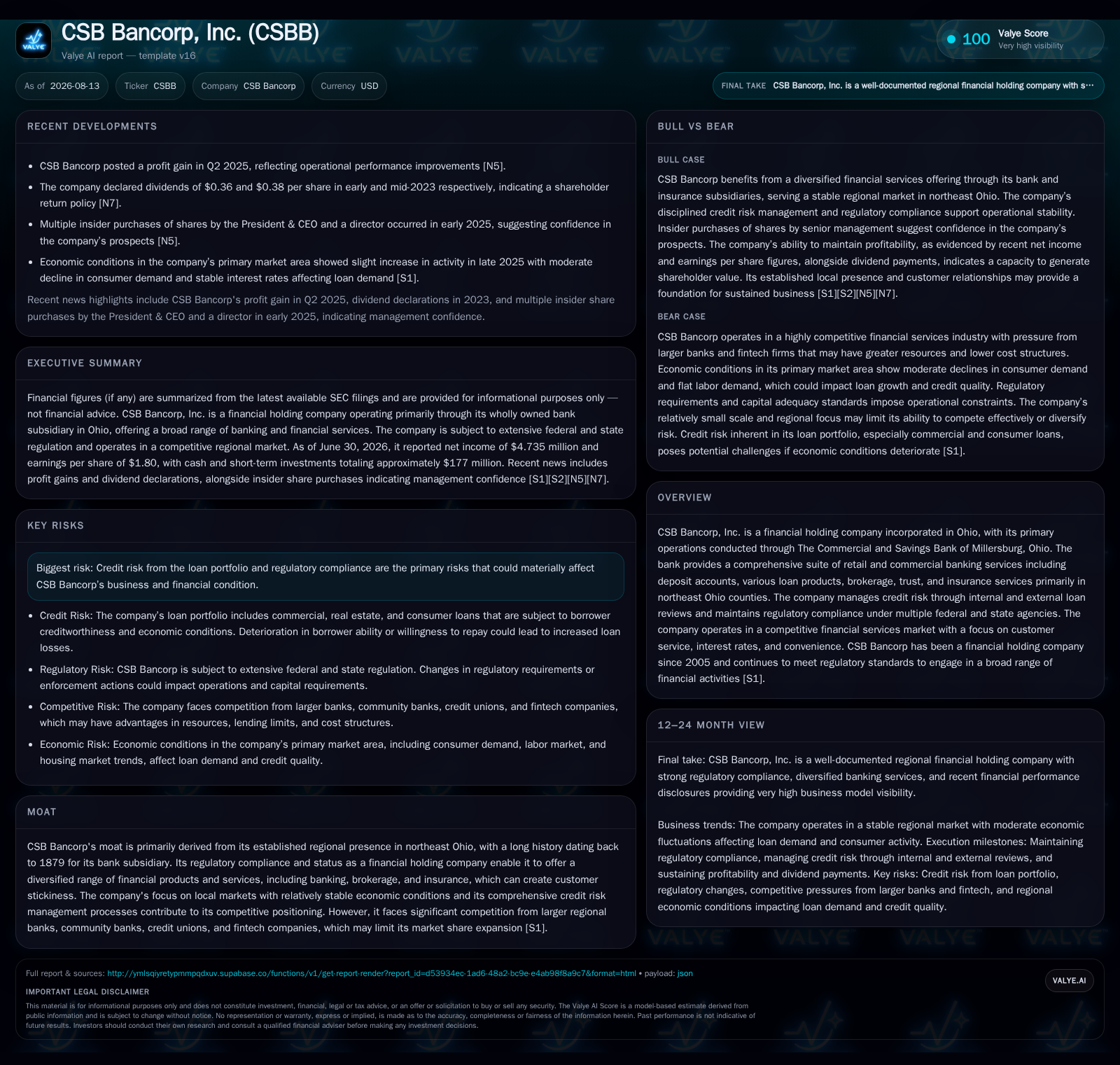
CSB Bancorp, Inc., a financial holding company centered on The Commercial and Savings Bank of Millersburg, reported in its Q2 2026 filing a persistent unrealized loss in its securities portfolio largely due to rising interest rates. Despite this, management asserts confidence in full recovery of those investments’ carrying costs. The company’s revenue stream remains anchored in traditional net interest margin dynamics common to regional banks, supported by diversification through brokerage and insurance offerings. Operating within the Northeast Ohio regional market, CSB faces competitive constraints from larger banks and fintech disruptors but benefits from deep local relationships and prudent credit risk management. Monitoring credit quality and interest rate impacts on net interest margin will be key performance indicators going forward.
Recent Operating Update
In the latest Q2 2026 quarter ending June 30, CSB Bancorp disclosed that it holds 96 securities in an unrealized loss position largely due to rising interest rates impacting fixed-rate debt instruments [S2]. Notably, 76 of these have been continuously impaired for over a year. The company performs rigorous quarterly impairment assessments and management expresses confidence these unrealized losses are temporary with full cost recovery anticipated. The unrealized losses concentrate within U.S. Treasury securities and agency bonds totaling approximately $96 million of available-for-sale (AFS) securities [S2]. This signals pressure on the bank's fixed income portfolio from current rate volatility but also underscores disciplined monitoring practices.
Additionally, CSB’s quarterly statements reaffirm consolidation of its financials with its wholly owned subsidiaries — The Commercial and Savings Bank and CSB Investment Services — reflecting integrated operations focused on retail/commercial banking plus brokerage/insurance services [S2]. No audit was conducted on these condensed financials given their interim nature.
Business Model Analysis
CSB Bancorp functions as a financially regulated holding company under the Bank Holding Company Act with primary banking activities conducted through its Ohio-chartered bank subsidiary dating back to 1879 [S1]. The bank caters predominantly to retail customers and small-to-medium businesses across several northeast Ohio counties. Its product suite includes deposit accounts (checking/savings), commercial loans (term loans, operating lines), consumer loans (installment, mortgages), as well as brokerage, trust services, and insurance offerings handled via licensed subsidiaries [S1].
The core revenue driver is net interest income derived from the difference between interest earned on loans/security investments versus interest paid on deposits. This classic regional banking model depends heavily on maintaining a healthy net interest margin (NIM), which itself fluctuates against prevailing short- and long-term interest rates. Loan volumes and deposit balances directly influence top-line growth prospects.
Fee-based income supplements earnings through brokerage commissions, trust fees, and insurance premiums which collectively improve revenue diversification and customer stickiness. This multi-product approach helps mitigate cyclicality inherent to lending-dependent models but still faces competition-induced margin pressure.
CSB actively manages credit risk via comprehensive internal/external loan reviews that classify loans according to risk profiles such as performing, special mention, substandard, or nonperforming status. Customers receive personalized service emphasizing local relationships while loan underwriting integrates cash flow analysis especially for commercial clients requiring guarantors or collateral backing [S1][S16]
Industry Structure & Competitive Positioning
Operating within the regional banking segment focused on northeast Ohio gives CSB advantages stemming from entrenched local presence dating back over a century plus regulatory compliance standing enabling diverse financial activities [S1]. The market itself is fragmentary yet intensely competitive; players range from large regional banks like Fifth Third Bancorp or KeyCorp to community banks specializing locally and rapidly growing fintech lenders challenging legacy deposit/lending models.
While CSB benefits from established brand recognition and trusted customer relationships building retention benefits, its scale limits ability to expand aggressively compared to these larger peers who enjoy broader geographic reach and technology investments. Moreover, credit unions introduce pricing competition for retail deposits due to their tax advantages.
Fintechs attacking consumer lending or payment processing raise structural risks of disintermediation but currently have limited footholds in commercial banking segments relevant to CSB’s strengths.
Growth Drivers
Several structural factors underpin potential growth trajectories for CSB:
- Local economic stability: Northeast Ohio’s reasonably diverse economy supports steady small business activity fueling commercial loan demand; demographic trends sustain retail banking needs.
- Interest rate cycles: Elevated rates can compress investment portfolio valuations but simultaneously enhance lending yield spreads if passed on effectively reducing pressure on net interest margins.
- Loan/deposit expansion: Growing deposit bases provide liquidity for increased loan production boosting net interest income while cross-selling insurance/trust products enhances fee income streams.
- Product diversification: Offering brokerage/trust services opens noninterest revenues reducing earnings volatility tied solely to deposit spreads.
- Regulatory compliance: Maintaining capital ratios above Basel III minimums ensures capacity for growth without capital raising drag [S11][S12]
Risks & Watchpoints
Principal risks remain:
- Credit risk retention: Deterioration in borrower repayment capacity amid macroeconomic headwinds could increase nonperforming loans or force reserve build-ups impairing net income.
- Interest rate risk exposure: Rising rates challenge fixed income securities valuations causing unrealized losses impacting shareholder equity volatility despite currently being viewed as temporary [S2].
- Competitive pressures: Larger regional banks wield scale economies affecting pricing; fintech entrants alter dynamics especially in consumer lending segments.
- Regulatory adherence: Compliance failures or shifting frameworks by Federal Reserve or Ohio authorities can impose operational costs or restrict business lines.
- Local economy sensitivity: Any regional economic downturn would impair deposit inflows and loan demand concurrently straining asset quality.
Monitoring loan loss provisions alongside nonperforming loan ratios will be critical early warning signals. Additionally, tracking composition shifts in securities portfolios will indicate how effectively management is positioning against ongoing rate fluctuations.
What to Watch Next
Upcoming milestones include:
- Quarterly updates highlighting changes in credit metrics such as special mention or substandard loans relative to performing loans.
- Securities portfolio revaluation reflecting interest rate trajectory adjustments possibly altering unrealized loss magnitudes or triggering realized impairments.
- Deposit growth rates signaling customer retention strength amid competitive field.
- Fee income trends evaluating success of product cross-selling efforts outside pure lending margins.
- Regulatory announcements influencing permissible activities or capital requirements potentially affecting strategic flexibility.
Revenue sensitivity to net interest margin expansion or compression will remain paramount given CSB’s lending-centric profit dependence. Improving cost efficiencies relative to peers could also serve as a lever for profitability enhancement amidst margin headwinds.
Financial Profile Discussion
As of its latest filings for the fiscal year ending December 31, 2025, CSB Bancorp maintains modest debt levels with total debt approximating $917 thousand against cash & equivalents exceeding $37 million yielding an estimated net cash position [F1]. This conservative leverage profile buffers liquidity risks allowing operational agility.
While precise quarterly profitability figures are limited in these excerpts, reported net income stood at about $13.4 million at the end of calendar 2025 suggesting profitable operations consistent with mid-sized regional bank norms [F1]. Capital adequacy aligns with Basel III standards mandated for smaller banking organizations ensuring sufficient loss absorption capacity without undue capital raising constraints [S11][S12].
Investment portfolio fair value fluctuations linked to interest rate trends generate balance sheet volatility but with no immediate credit loss provisions recorded on held-to-maturity securities indicating manageable risk exposure currently [S2]. Continued emphasis on disciplined credit underwriting reduces expected downside deviations beyond cyclical variability common within regional banking peer groups.
This analysis synthesizes CSB Bancorp’s SEC disclosures through August 2026 combined with sector knowledge surrounding regional community banking dynamics focusing on net interest margin dependence and credit risk oversight. It refrains from making price or investment guidance while offering observational insights into operational merits relative to competitive industry structures and evolving macroeconomic conditions.
Disclaimer: This is research-only, informational analysis and not investment advice. It may include AI-generated interpretation and general industry context. Always verify important details using primary sources.

Comments