
Kun Peng International’s Revenue Mix Shifts Reflect Strained Operational and Regulatory Challenges
Recent quarterly disclosures reveal Kun Peng International’s struggles to stabilize revenue amid subsidiary shutdowns, regulatory constraints, and liquidity pressures.
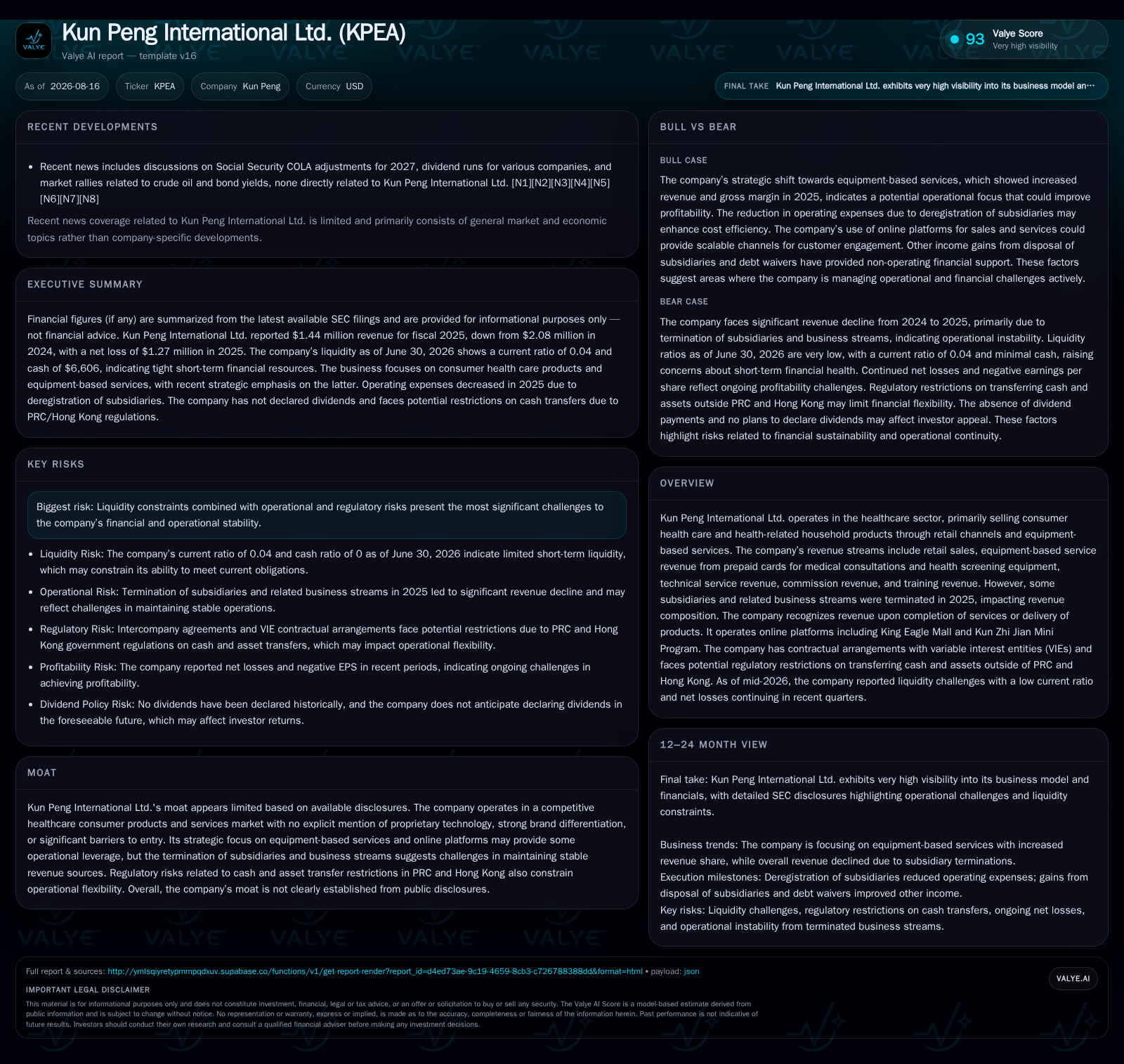
Kun Peng International Ltd. operates in the competitive healthcare consumer products and services retail industry primarily through online platforms and health screening equipment services. Its latest quarterly report highlights ongoing challenges including termination of subsidiaries, which has materially altered its revenue composition, and regulatory restrictions complicating cash flows from China-based variable interest entities (VIEs). The company combines direct retail sales with equipment service revenues, relying on prepaid cards and technical support fees, but faces headwinds due to diminished gross margins and operational leverage constraints. Liquidity appears stressed given a current ratio near 0.04 and negative operating income, underscoring risks from regulatory environments, VIE structures, and cash transfer limitations that weigh on its financial flexibility.
Recent Operating Update
The company continues operating primarily via its online platforms King Eagle Mall and Kun Zhi Jian Mini Program ([S8]), targeting consumers demanding both healthcare consumer products and health-related household goods through convenient digital channels.
Business Model
Kun Peng International functions predominantly as a healthcare consumer products retailer integrated with complementary equipment-based service offerings. The company’s monetization includes direct retail product sales to consumers via online platforms alongside equipment services such as health screenings deployed through prepaid cards—consumers prepay for usage credits that unlock access to medical consultations or diagnostic procedures facilitated by Kun Peng’s partnership network.
This hybrid model entails multiple revenue streams: retail sales capturing nominal gross margins typical of consumer goods; equipment-based service revenues representing recurring income underpinned by prepaid card activation fees; plus ancillary streams like technical services commissions and training revenues previously sourced from subsidiaries now terminated ([S10]).
Revenue recognition follows fulfillment or completion milestones—product delivery for retail goods or completion of service engagements for equipment-based offerings ([S1]). This approach aligns cash inflows with operational KPIs such as prepaid card activation rates, service utilization metrics, online platform traffic-to-conversion ratios, and average transaction values.
The company operates through complex regional structures involving a U.S.-based holding entity controlling subsidiaries across Hong Kong and mainland China via VIE contractual arrangements ([S8],[S21],[S28]). The VIE structure enables control over mainland Chinese operations without direct equity ownership but introduces enforcement uncertainties inherent in PRC regulatory frameworks.
Industry Structure and Competitive Position
Kun Peng International operates within the broadly defined healthcare consumer products and retail services industry in China—a market characterized by intense competition from established mass retailers such as Watsons-style chains offering health-related household goods alongside emerging digital native platforms delivering online health services like diagnostics or telemedicine.
Competition spans social e-commerce models (e.g., Pinduoduo), dominant marketplaces (Taobao, JD.com), and niche health platforms providing vertically integrated consultation plus product delivery. Kun Peng’s competitive position is constrained by limited brand differentiation despite cultivating expertise drawn from multinational corporate veterans within King Eagle (China) subsidiaries ([S11]).
Its dual focus on consumer goods retail combined with equipment-based service delivery attempts to capture wallet share across health-conscious consumers seeking convenience paired with preventive screening. However, no proprietary technology or pricing power is evidenced in disclosures; margin contraction hints at elevated pricing pressure amid economic headwinds ([S10]). Moreover, regulatory risk surrounding VIE enforceability limits strategic flexibility compared with fully owned peers.
Growth Drivers
Key growth levers for Kun Peng International center on scaling engagement with its digital health platforms—King Eagle Mall and Kun Zhi Jian Mini Program—to increase prepaid card activations driving recurring equipment-based service revenue. Rising consumer health awareness coupled with adoption of home- or community-based diagnostics supports this trend.
Expanding middle-class incomes in China fuel demand for convenient healthcare solutions accessible online or via device-enabled screenings aligning well with Kun Peng’s value proposition. Furthermore, regulatory shifts encouraging private sector participation in healthcare retail could unlock opportunities pending compliance enhancements ().
Operationally, driving higher utilization rates on prepaid cards offers more predictable recurring revenues that can improve gross margin stability relative to volatile retail sales channels. Enhancing online platform user experience may raise conversion rates while optimizing customer acquisition cost metrics impacts profitability positively.
Recent subsidiary additions such as Kun Pin Hui (Shandong), which commenced operations in April 2024 focusing on healthcare product sales in an expanding geographic market segment ([S20]), also represent pockets for incremental growth if integration executes efficiently.
Risks and Watchpoints
Several interwoven risks loom over Kun Peng’s prospective recovery trajectory:
- Regulatory Risk: The reliance on VIE contractual governance exposes it to enforcement ambiguity amid tightening PRC oversight of U.S.-listed Chinese companies.
Monitoring indicators such as prepaid card usage ramp-up rates adjusted for churn levels alongside evolving compliance disclosures related to PRC regulations will clarify resilience.
What to Watch Next
Investors seeking insight into Kun Peng International’s developmental arc should prioritize several upcoming milestones:
- Quarterly updates detailing prepaid card activation trends providing visibility into recurring revenue momentum.
- Reports of any regulatory developments impacting VIE contract enforceability or cross-border capital flows could serve as catalysts for reassessing structural risk exposure.
- Progress updates on integrating newer subsidiaries like Kun Pin Hui (Shandong) shedding light on geographic/segment expansion success.
- Changes in operating expense profile signaling efficiency improvements post-subsidiary termination decisions.
- Disclosures regarding platform user metrics including traffic growth versus conversion efficacy highlighting competitive customer acquisition progress.
- Any announcements concerning refinancing plans addressing liquidity gaps measurable against near-term maturing obligations.
Financial Profile Discussion
As of June 30, 2026, companyfacts [F1] shows Kun Peng International holds cash and equivalents of approximately $6.6 million. Net debt is estimated at approximately $42.5 million based on available data ([F1]).
These financial constraints underscore the urgency for faster growth realization from recurring equipment-based services plus tighter cost management complemented by prudent liquidity preservation amid ongoing political and regulatory uncertainties impacting operations primarily based in mainland China through the VIE arrangement ([S21], [S22], [S28]).
This analysis is prepared independently for informational purposes using publicly filed SEC documents without investment advice or research views. Readers should consider all disclosed risks before drawing conclusions concerning Kun Peng International Ltd.’s financial stability or operational outlook.
Disclaimer: This is research-only, informational analysis and not investment advice. It may include AI-generated interpretation and general industry context. Always verify important details using primary sources.

Comments