
CTS CORP 2026 Q2: Diversified End-Market Exposure Supports Revenue Stability
CTS Corporation's broad sales mix across transportation, industrial, medical, and aerospace sectors underpins revenue resilience amid cyclicality.
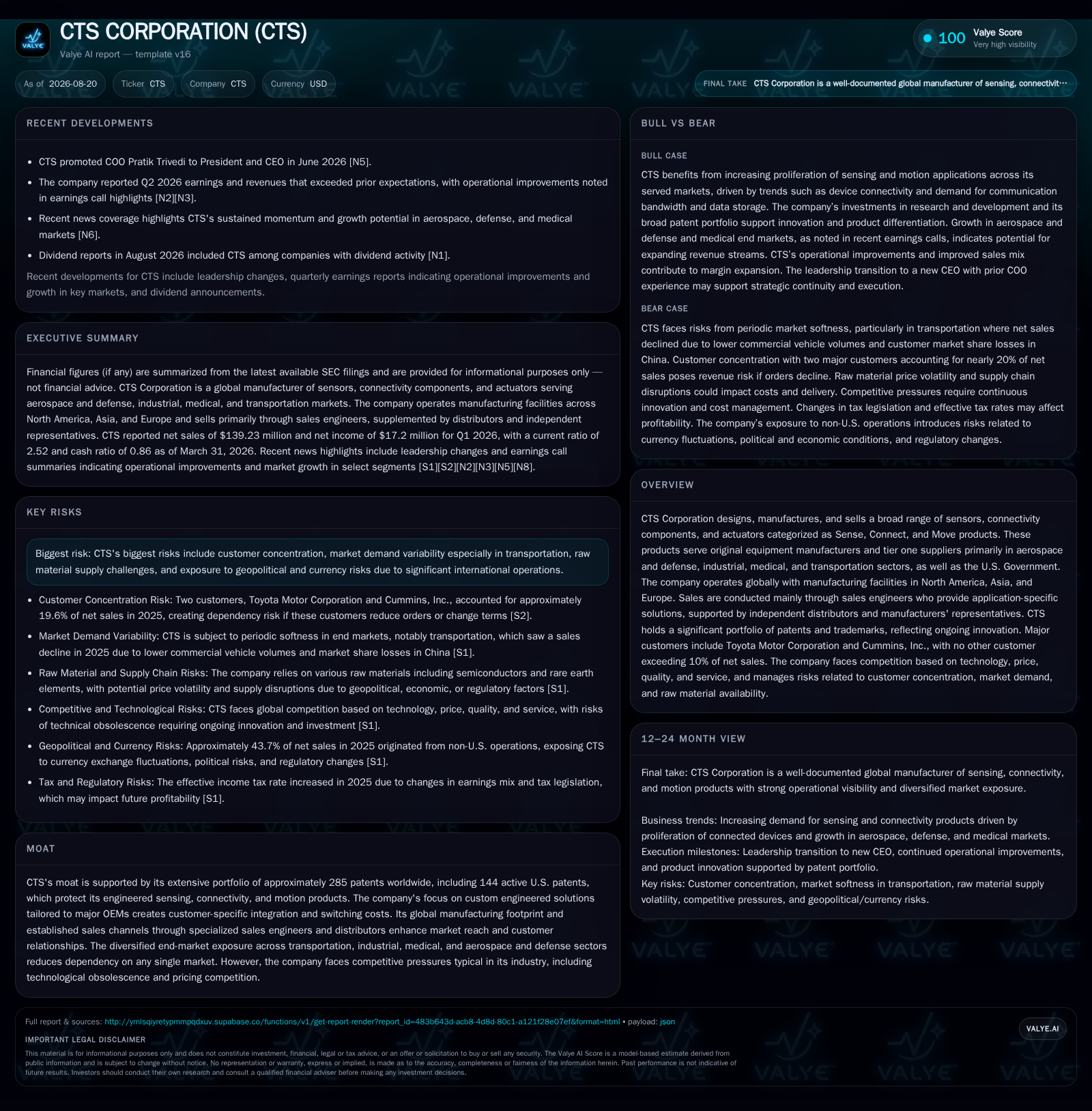
CTS Corporation maintains a diversified end-market exposure with transportation accounting for 43%, industrial 26%, medical 16%, and aerospace & defense 15% of sales as of 2025, supporting revenue stability amid sector-specific cyclicality. The company replaced its prior $400 million revolving credit facility with a new five-year unsecured $300 million facility in November 2025, extending maturity to 2030 and modifying covenants to enhance financial flexibility. CTS is also evaluating the future impact of ASU 2025-06 on internal-use software accounting. These developments collectively support CTS's operational resilience and liquidity management in 2026.
Business Model and Market Diversification
CTS Corporation operates as a global manufacturer of engineered sensors, connectivity components, and actuators, supplying original equipment manufacturers (OEMs), tier one suppliers, distributors, and the U.S. Government. Its products are categorized into three main groups: Sense, Connect, and Move. Sense products provide critical inputs to electronic systems, Connect products enable synchronization between systems, and Move products facilitate precise motion control. These offerings serve diverse end markets including aerospace & defense, industrial, medical, transportation, and government sectors [S1].
The company's manufacturing footprint spans North America, Europe, and Asia, enabling it to serve multinational customers efficiently. Sales and marketing efforts leverage both direct sales engineers and independent manufacturers' representatives, enhancing market penetration and customer support [S1]. CTS's broad patent portfolio and custom engineered solutions help create switching costs, supporting competitive positioning in these specialized markets.
CTS's diversified end-market exposure is a key strength in its business model. In 2025, transportation accounted for 43% of consolidated net sales, industrial 26%, medical 16%, and aerospace & defense 15% [S1]. This diversification reduces dependency risk on any single sector and supports revenue resilience amid sector-specific cyclicality. For example, while transportation sales declined by 6.6% in 2025 due to lower commercial vehicle volumes and customer market share losses in China, growth in aerospace & defense and medical markets helped offset this weakness [S1]. No single customer accounts for more than 10% of net sales, further mitigating concentration risk [S1].
New Revolving Credit Facility and Financial Flexibility
On November 24, 2025, CTS entered into a new unsecured revolving credit facility with a total availability of $300 million, replacing its prior $400 million facility that was set to expire in December 2026 [S2]. The new facility extends the maturity date to November 24, 2030, providing CTS with longer-term funding certainty. Additionally, the financial and non-financial covenants were modified to offer the company increased flexibility in managing its operations and capital structure [S2].
As of June 30, 2026, CTS had $243.5 million available under this revolving credit facility, subject to covenant restrictions [S2]. While the nominal credit availability decreased from $400 million to $300 million, the extension in maturity and relaxed covenants enhance CTS's financial flexibility, which is critical for a capital-intensive manufacturer operating in cyclical markets. The longer maturity reduces refinancing risk and provides a stable liquidity base to support working capital needs and moderate growth investments [S2].
CTS is also evaluating the impact of adopting ASU 2025-06, which relates to accounting for internal-use software and is effective for fiscal years beginning after December 15, 2027, with early adoption permitted [S2]. The diversified sales mix mitigates revenue volatility by spreading demand risk across transportation, industrial, medical, and aerospace & defense sectors, each with distinct economic drivers and cyclicality patterns [S1]. This structural diversification complements the enhanced liquidity and covenant flexibility provided by the new credit facility, reducing refinancing risk and supporting steady cash flow management [S2].
CTS's liquidity position as of the latest quarter includes $243.5 million available under the revolving credit facility, which is unsecured and subject to covenant restrictions [S2]. This availability, combined with the extended maturity to 2030, provides CTS with a solid financial foundation to manage operational needs and potential market fluctuations. The modified covenants offer additional operational flexibility, which is particularly valuable given the cyclical nature of some of CTS's key end markets.
Analytical Conclusions and Scenarios
The replacement of the prior $400 million credit facility with a $300 million facility maturing in 2030, coupled with modified covenants, improves CTS's financial flexibility despite the lower nominal credit line [S2]. This longer-term funding certainty is important for managing liquidity and operational needs in a capital-intensive manufacturing environment subject to cyclical demand fluctuations. The extended maturity reduces refinancing risk, while the relaxed covenants provide CTS with greater latitude to navigate market uncertainties and invest in growth opportunities.
CTS's diversified end-market exposure across transportation, industrial, medical, and aerospace & defense sectors supports revenue stability and reduces dependency risk, which complements its financial flexibility from the new credit facility.
The base scenario envisions CTS maintaining stable operations supported by this diversification and sufficient liquidity from the revolving credit facility to fund working capital and moderate growth investments. This scenario assumes no significant deterioration in end-market demand and stable credit market conditions [S1][S2]. Confirmation would come from stable liquidity ratios and consistent or growing sales in diversified markets.
Conversely, a bear scenario would involve end-market weakness, particularly in transportation, which accounts for a significant sales segment [S1]. Evidence for this would include declining sales and margins or increased borrowings nearing credit limits. Liquidity and covenant compliance under the revolving credit facility, which had $243.5 million available as of June 30, 2026, warrant close observation to assess financial flexibility [S2]. Additionally, the impact and timing of ASU 2025-06 adoption on CTS's internal-use software capitalization should be tracked for potential effects on financial reporting and capital allocation.
Overall, CTS's diversified business model, together with its new revolving credit facility that extends maturity and modifies covenants, could provide the company with financial flexibility to manage sector cyclicality and operational challenges in 2026 and beyond, assuming no significant adverse changes in market conditions or credit availability.

Comments