
Biotricity Inc. 2026 Q2: Expanding Cardiac Monitoring Footprint Amid Liquidity Constraints
Biotricity broadens its FDA-cleared cardiac monitoring device reach across 35 states while facing significant liquidity challenges in Q2 2026.
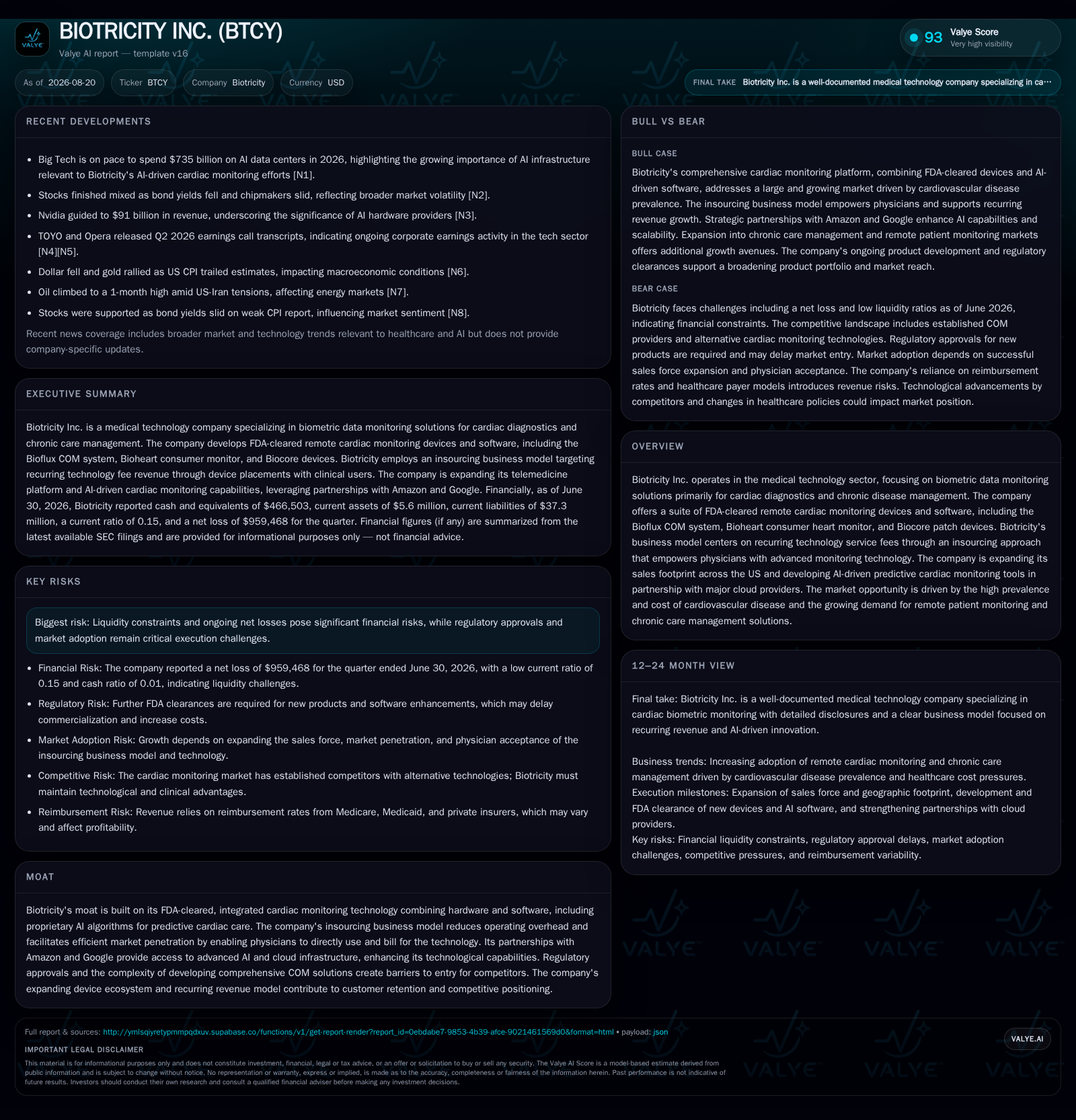
In its Q2 2026 filing, Biotricity Inc. reports ongoing expansion of its FDA-cleared cardiac monitoring devices and sales footprint across 35 states, leveraging an insourcing business model to generate recurring technology service fees. The company has developed a device ecosystem including Bioflux COM, Bioheart, and Biocore Pro, and is advancing AI-driven predictive monitoring tools via partnerships with major cloud providers. However, Biotricity faces severe liquidity constraints, with a current ratio of 0.15 and cash of approximately $466K against $37.3 million in current liabilities, raising concerns about its ability to sustain operations and fund growth without additional capital. The key question remains whether the company’s operational progress can overcome these financial challenges to achieve scalable profitability.
Operating Update and Product Expansion
Biotricity Inc.'s Q2 2026 10-Q filing highlights continued progress in expanding its cardiac monitoring device ecosystem and geographic sales footprint [S1][S2]. The company now commercializes FDA-cleared devices including the Bioflux COM technology, Bioheart consumer heart monitors, and its flagship Biocore Pro cellular device across 35 states in the U.S. This expansion represents a broadening of the company’s addressable market within the cardiac outpatient monitoring segment, which is driven by the high prevalence of cardiovascular disease. Biotricity’s product portfolio targets diagnostic and post-diagnostic cardiac monitoring needs, with devices designed for both physician use and direct-to-consumer applications.
The company’s sales efforts leverage an insourcing business model that empowers physicians and healthcare providers to directly use and bill for Biotricity’s technology [S1]. This approach generates recurring technology service fees while reducing Biotricity’s operating overhead, enabling more efficient market penetration. The model also facilitates cross-selling opportunities within existing customer clinics and hospital networks, expanding potential revenue streams.
In addition to hardware commercialization, Biotricity is advancing AI-driven predictive cardiac monitoring tools developed in partnership with major cloud providers Amazon and Google. These tools aim to enhance clinical value and product differentiation by enabling predictive analytics and improved patient outcomes, which could drive adoption and competitive positioning in the remote patient monitoring market [S1].
Business Model and Competitive Positioning
Biotricity operates within the medical device and remote patient monitoring industry, focusing on FDA-cleared cardiac monitoring devices integrated with proprietary software and AI capabilities. Its insourcing business model is a key differentiator, reducing vendor overhead by enabling physicians, hospitals, clinics, and Independent Diagnostic Testing Facilities (IDTFs) to directly use and bill for its technology. This structure supports recurring technology service fees, which are critical for margin expansion and cash flow generation as device adoption scales.
The company’s device ecosystem—comprising Bioflux COM, Bioheart, and Biocore Pro—addresses a broad spectrum of cardiac monitoring needs, from diagnostic ambulatory monitoring to consumer self-management. FDA clearance of these devices establishes regulatory barriers to entry and supports reimbursement pathways essential for commercial success. The integration of AI-driven predictive analytics further enhances the competitive moat by potentially improving clinical outcomes and offering differentiated product features [S1].
However, Biotricity faces competitive challenges related to market adoption rates among physicians and healthcare providers, reimbursement uncertainties, and the need to continuously innovate technology offerings. As of June 30, 2026, the company reported current assets of approximately $5.6 million against current liabilities of $37.3 million, resulting in a current ratio of 0.15 [F1]. This indicates significant liquidity stress and limited short-term financial flexibility.
Cash and cash equivalents were approximately $466,000 at quarter-end, a level that is low relative to the company’s operating needs and liabilities [F1][S2]. The negative working capital position highlights the risk that Biotricity may face challenges in sustaining operations and funding growth initiatives without securing additional financing.
The company continues to incur net losses and has not yet achieved sustained profitability, reflecting ongoing investments in research and development, commercialization, and sales expansion [S1][S2]. Margin data for the latest quarter is not explicitly disclosed, but the recurring technology service fee model suggests potential for margin improvement as adoption scales and operating overhead is controlled.
Risks and Scenario Analysis
Biotricity’s near-term outlook is shaped by the interplay of its operational expansion and financial constraints. One possible bullish scenario is that the company successfully leverages its FDA-cleared device ecosystem and insourcing model to rapidly increase adoption and recurring service fees. This could drive scalable revenue growth and margin expansion, enabling the company to overcome liquidity challenges through improved operational cash flow [S1][S2]. This scenario would delay profitability but maintain operational continuity, contingent on access to capital markets or debt financing and controlled operating expenses. Evidence supporting this would be announcements of financing transactions and stable but modest revenue growth.
The bearish scenario involves worsening liquidity constraints combined with failure to achieve sufficient market adoption or regulatory approvals for new products [F1][S1]. This could lead to operational cutbacks and potential restructuring. Indicators would include negative cash flow trends, regulatory setbacks, and inability to raise additional capital.
Conclusion and Watchpoints
Biotricity’s expansion of its FDA-cleared cardiac monitoring devices and sales footprint across 35 states enhances its addressable market and recurring revenue potential, which are critical for scaling the business and moving toward profitability [S1][S2]. The insourcing business model supports recurring technology service fees and reduces operating overhead, providing a pathway to margin improvement as adoption grows.
However, the company’s severe liquidity constraints, reflected in a current ratio of 0.15 and low cash balances, pose significant risks to sustaining operations and funding growth without additional capital [F1][S2]. Monitoring liquidity metrics, quarterly revenue and margin trends, adoption rates of AI-driven predictive tools, and capital raising activities will be essential to assessing Biotricity’s progress toward scalable profitability.

Comments