
JAB Acquisition Corp I Advances Trading Flexibility and Maintains Strong Liquidity Ahead of Business Combination
Recent SEC filings highlight JAB Acquisition Corp I’s updated trading structure and robust liquidity positioning as it prepares to pursue its initial business combination.
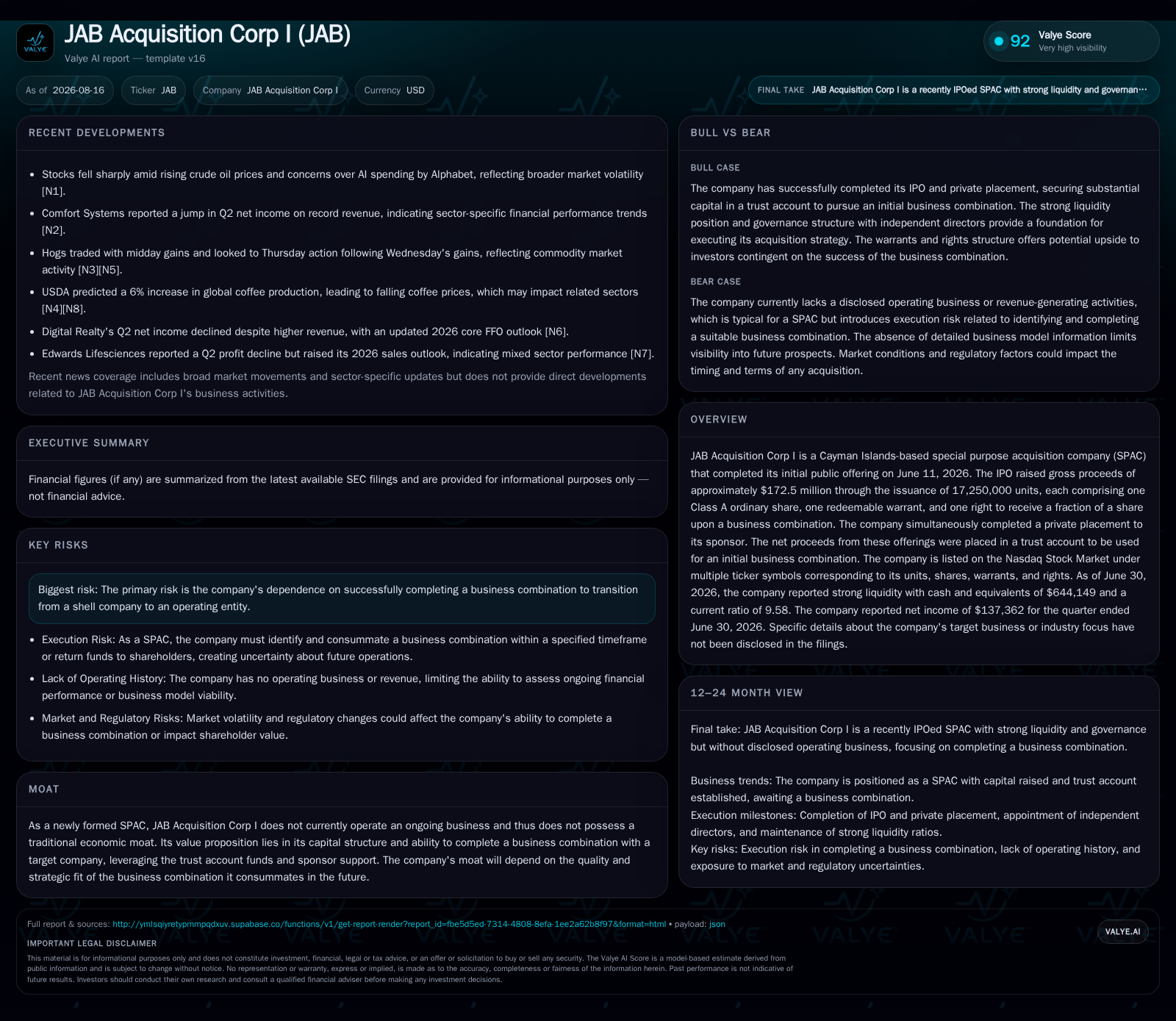
JAB Acquisition Corp I completed its IPO in June 2026, raising approximately $172.5 million through issuance of units combining Class A shares, warrants, and rights. On August 4, 2026, the company enabled separate trading of these components, enhancing investor choice and market efficiency ahead of a potential de-SPAC transaction. With cash and equivalents around $644K and a current ratio near 9.6 as of June 30, 2026, JAB maintains a solid liquidity base typical for SPACs at this stage. Execution risk centers on completing a qualifying business combination within the regulatory timeframe while managing dilution from convertible instruments.
Recent Operating Update: Separate Trading of Units’ Components Enhances Market Dynamics
JAB Acquisition Corp I announced on August 4, 2026 that holders may elect to separately trade the Class A ordinary shares, redeemable warrants, and rights underlying their previously bundled units effective August 5th [S3][S8]. Prior to this change, these components traded only together as units under the symbol "JABRU." By decoupling these securities—shares (ticker: JAB), warrants (JABRW), and rights (JABRR)—investors gain flexibility to select exposures aligned with their risk-return preferences tied to the eventual business combination.
This structural evolution can improve market liquidity by catering to distinct investor appetites: some may seek direct equity participation while others prefer leveraged upside through warrants or fractional ownership via rights. Enhanced granularity also aids price discovery across these instruments ahead of a de-SPAC transaction and may influence redemption behavior by allowing shareholders to evaluate component values separately.
Monitoring trading volumes and pricing behavior across separated securities will provide insight into investor sentiment and confidence as the company progresses toward identifying a business combination.
Capital Structure: Multi-Instrument Units Support Strategic Flexibility but Imply Dilution Considerations
The June 2026 IPO raised approximately $172.5 million gross proceeds through issuance of 17.25 million units priced at $10 each [S10][S15]. Each unit consists of one Class A ordinary share with par value $0.0001, one redeemable warrant exercisable at $11.50 per share subject to adjustment, and one right entitling holders to receive one-fourth fractional shares upon consummation of an initial business combination.
This layered composition is typical among SPACs providing investors with direct equity claims post-merger alongside optionality via warrants that can enhance upside exposure at a premium strike price. The rights component further entitles holders to fractional ownership benefits upon deal closing.
Simultaneously, a private placement was completed with the sponsor acquiring 260,000 units for $2.6 million at the same unit price [S10][S7]. These Private Units generally carry transfer restrictions until de-SPAC completion but serve to align sponsor incentives closely with public shareholders during deal sourcing and execution phases.
While such structures enable strategic flexibility for capital formation and investor choice, they inherently introduce dilution risk when warrants convert into shares post-transaction—a fundamental consideration for assessing ownership concentration after merger completion.
Liquidity Position: Strong Trust Account Metrics Reflect Capital Preservation Focus
As of June 30, 2026, JAB reported cash and cash equivalents totaling approximately $644K with current assets above $865K against current liabilities near $90K resulting in an exceptional current ratio of roughly 9.58 [F1]. This robust liquidity position reflects prudent management of IPO proceeds held securely in trust pending an initial business combination.
Minimal total debt reported near $49K as of March 31 further emphasizes low leverage risk pre-deal [F1]. While net income was modestly positive at about $137K for the period ending June 30, this is typical since SPACs do not generate operating profits before acquiring an operating company.
Preserving capital within the trust account is critical to maintaining shareholder protection against operating expenses prior to de-SPAC completion and ensuring availability of funds in case deal timelines extend or transactions fail.
Competitive Positioning: Mid-Sized SPAC Navigates Crowded Sponsor Landscape
With gross proceeds around $172.5 million augmented by a sponsor private placement of $2.6 million, JAB fits within a moderate capital scale among mid-tier SPACs competing for attractive private acquisition targets.
Its ability to successfully complete a business combination hinges on the sponsor team’s track record and sourcing capabilities amid intense competition from other SPAC vehicles and traditional IPO routes seeking similar targets.
Though specific details on JAB’s management pedigree remain undisclosed publicly at this stage, sponsor reputation historically correlates strongly with higher deal completion rates and favorable valuation terms given their intermediary role bridging private companies with public capital markets.
Growth Drivers: Favorable Market Trends Support Alternative Listing Routes
SPACs like JAB benefit from sustained investor interest in streamlined pathways for taking private companies public outside conventional IPO mechanisms. This demand is reinforced by episodic volatility in public equity markets that can impede traditional listings.
Additional growth factors include innovations in deal structuring attracting institutional PIPE investments that supplement transaction financing after announcement along with regulatory environments facilitating smoother approvals for de-SPAC deals.
Despite no identified acquisition targets disclosed thus far by JAB itself, prevailing industry momentum suggests reasonable optimism regarding transaction pipeline development enabling transition into active operating status.
Risks & Watchpoints: Execution Timelines and Redemption Impact Investor Returns
A core risk inherent in SPAC structures applies equally to JAB — failure to consummate a qualifying business combination within roughly two years post-IPO triggers liquidation or refunding obligations limiting shareholder upside beyond returned capital less expenses [S2].
Investor redemption rights present additional uncertainty as elevated redemptions following merger announcements diminish available capital for closing deals potentially forcing renegotiations or cancellations detrimental to shareholder value.
Dilution remains a watchpoint since warrant exercises increase outstanding share count post-transaction thereby diluting earnings per share metrics relevant once operational performance commences.
Ongoing regulatory scrutiny around SPAC transactions could introduce compliance complexities or timeline delays impacting execution risk further.
What Investors Should Monitor Next
Key milestones include any formal announcements regarding targeted mergers or acquisitions where valuation terms and financing arrangements become clearer. Tracking trading volumes across separated shares versus warrants/rights will shed light on market confidence levels given newly available investment choices.
Subsequent regulatory filings detailing agreements or shareholder approval solicitations will enhance visibility on timing feasibility relative to mandated deadlines.
Together these indicators will shape investor sentiment while highlighting the company’s operational execution capabilities amidst competitive pressures characteristic of mid-sized SPACs today.
Disclaimer: This is research-only, informational analysis and not investment advice. It may include AI-generated interpretation and general industry context. Always verify important details using primary sources.

Comments