
Riverview Bancorp Navigates Interest Rate and Credit Pressures with Steady Regional Banking Focus
Riverview Bancorp sustains its traditional regional banking model in the Pacific Northwest, balancing net interest income generation with prudent risk management amid evolving economic conditions.
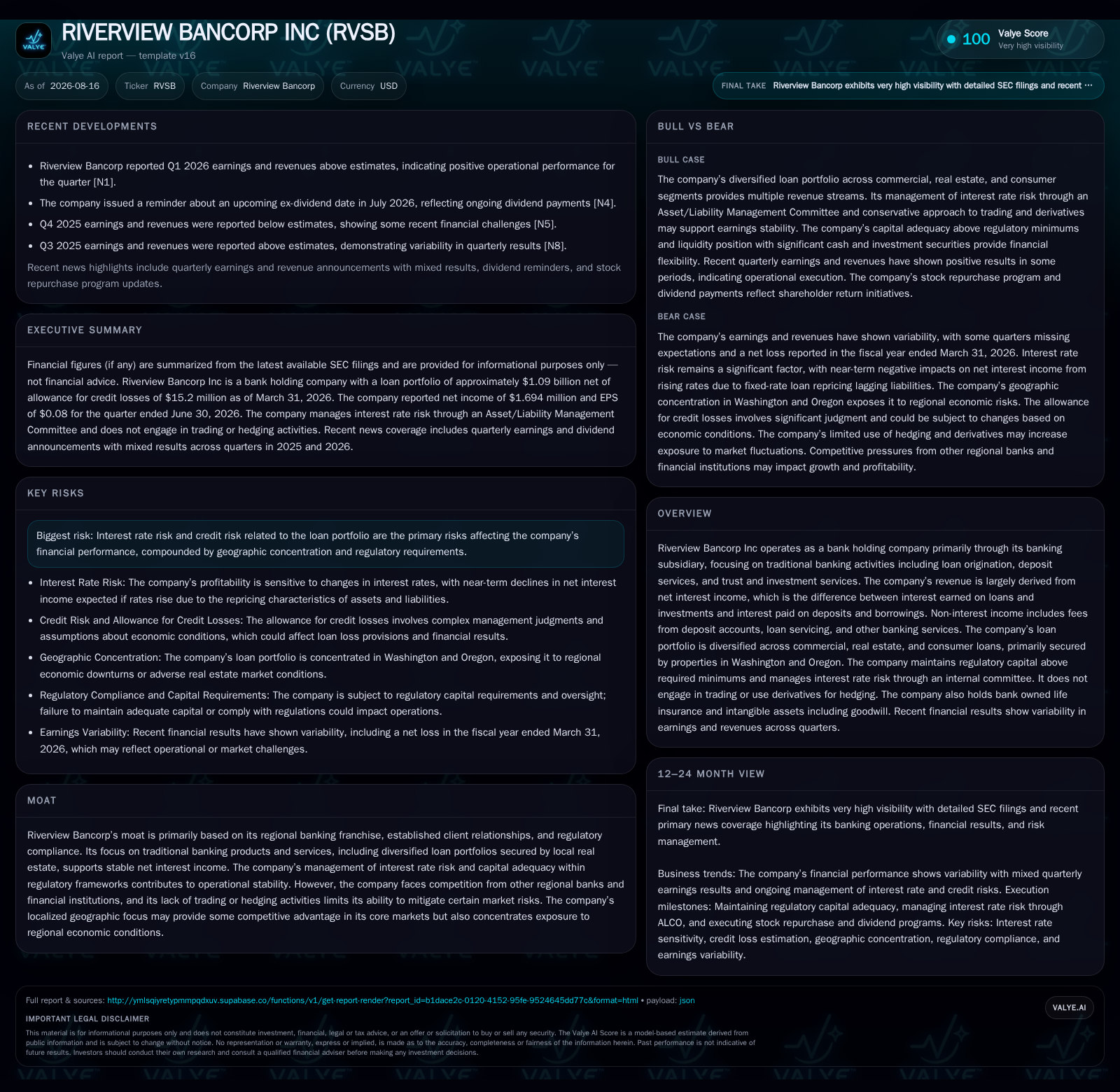
Riverview Bancorp Inc’s latest quarterly filing highlights its continued emphasis on net interest income from a diversified loan portfolio concentrated in Washington and Oregon. The bank manages interest rate risk conservatively without derivatives, while credit loss provisions have pressured recent earnings. Leadership changes in commercial lending may affect growth momentum. Capital remains solid above regulatory minima, supported by a strong deposit base and disciplined underwriting. Growth depends on local economic trends, deposit expansion, and fee income diversification, balanced against geographic concentration and credit risk challenges.
Recent Operating Update and Strategic Context
Riverview Bancorp’s August 2026 quarterly report (10-Q) provides the latest insight into its operating stance as a regional bank focused on Washington and Oregon markets [S2]. The bank continues to generate net interest income primarily through a diversified loan portfolio comprising commercial business loans, owner-occupied and non-owner occupied commercial real estate loans, as well as consumer loans. This portfolio is largely secured by regional properties, anchoring the bank’s asset quality focus. Despite headwinds from a challenging economic environment affecting borrower creditworthiness, Riverview maintains its strategy emphasizing stable deposit gathering alongside fee-generating services such as mortgage production, treasury management, and trust services [S2][N1].
A significant leadership change occurred with the retirement of a veteran commercial lending officer responsible for expanding commercial loans and supporting treasury and mortgage teams over three years. This transition could impact future lending momentum during integration of new leadership [S3]. Importantly, risk governance frameworks remain consistent with prior annual disclosures, underscoring operational stability despite sector-wide pressures [S2].
Business Model: Traditional Regional Banking Centered on Net Interest Income
Operating through its banking subsidiary, Riverview Bancorp focuses on conventional banking products tailored for local businesses and consumers. The revenue model centers on net interest income—the margin between interest earned on loans and securities versus interest paid on deposits and borrowings—with deposits forming the primary low-cost funding source [S1]. This approach aligns with typical regional bank archetypes that emphasize relationship-based lending funded by community deposits.
Non-interest income complements this core stream via fees related to deposit accounts, loan servicing (notably mortgage servicing rights), prepayment penalties, wire transfers, and other ancillary services [S1][S27]. While these fees add revenue diversity, they remain materially smaller than net interest income and subject to variability tied to customer activity levels
Riverview adopts a conservative asset/liability management approach without engaging in derivatives or trading activities. Its Asset/Liability Management Committee (ALCO) employs simulation models to monitor how shifts in market interest rates might affect net interest income over one- to two-year horizons. These models incorporate assumptions about loan volumes, repricing characteristics, deposit sensitivity, and capital plans but acknowledge inherent uncertainties given market volatility [S1]. This prudent stance mitigates speculative risks but limits flexibility in dynamic rate environments.
Industry Structure and Competitive Positioning
Within the regional banking sector serving localized markets with traditional products, Riverview competes alongside peers like Northwest Bancshares (NWBI) and Kearny Financial (KRNY), as well as community banks and credit unions targeting similar customer segments. Key performance benchmarks include net interest margins, credit quality metrics such as non-performing loan ratios, capital adequacy (e.g., CET1 ratios), and efficiency ratios reflecting cost discipline.
Riverview’s competitive strength stems from established client relationships within its Washington/Oregon footprint combined with sound regulatory compliance maintaining capital buffers above minimums. This localized focus offers some protection from fintech competitors or national banks lacking regional presence. However, geographic concentration also exposes the bank to cyclical risks tied to regional economic trends and real estate market fluctuations—a factor requiring vigilant credit risk management.
Growth Drivers
Growth prospects are linked closely to sustained economic expansion in core markets driving demand for commercial loans backed by cash-flow strong businesses and real estate projects. Mortgage production tied to both servicing retained loans and sales generates fee income opportunities. Deposit base growth supports balance sheet expansion while enabling maintenance of favorable loan-to-deposit ratios that reduce reliance on costlier wholesale funding.
Cross-selling treasury management solutions alongside lending products enhances revenue diversification while ongoing technology investments aim to streamline client onboarding and operational efficiency [N1]. Although potential acquisitions could supplement organic growth efforts, no explicit plans were disclosed.
Risks and Watchpoints
Key risks include sensitivity to interest rate movements which can compress net interest margins if deposit repricing lags asset yield increases—especially given the absence of derivative hedging strategies [S1]. Credit risk remains significant due to exposure in sectors vulnerable to economic downturns or property value declines; underwriting standards impose maximum loan-to-value thresholds (typically 65%-80% depending on property type) to mitigate losses [S16][S20].
Geographic concentration amplifies vulnerability to localized economic shocks or regulatory changes disproportionately affecting Washington/Oregon markets relative to national averages. Cybersecurity threats require ongoing attention; Riverview maintains a formal information security program with Board oversight including a dedicated Chief Information Security Officer responsible for incident response protocols [S1]. Operational risks persist around fraud prevention and internal controls.
The recent departure of a senior commercial lending leader creates transitional execution risks that could temporarily affect client acquisition or underwriting throughput until succession is fully embedded [S3]. The allowance for credit losses demands close monitoring as shifts in borrower risk profiles may necessitate increased provisions impacting earnings.
What to Watch Next
Investors should focus on upcoming quarterly disclosures for updates on:
- Net interest margin evolution amid volatile rates.
- Credit quality metrics including non-performing loans ratios and allowance for credit losses adjustments.
- Deposit growth trends relative to loan origination activity affecting funding stability.
- Trajectory of non-interest income indicating success in diversifying revenue.
- Progress in leadership transition impacting commercial lending effectiveness.
- Regulatory developments related to capital requirements or cybersecurity frameworks.
- Regional economic indicators signaling underlying demand strength especially in commercial real estate sectors.
No updated financial guidance was provided post Q1 results; managing expectations around timing of financial recovery amid credit challenges remains prudent [N1][S2]
Financial Profile Discussion
As of June 30, 2026, companyfacts data shows Riverview Bancorp held approximately $102 million in cash and equivalents and $28 million in total debt, resulting in a net cash position near $74 million [F1]. Stable funding is evidenced by deposits modestly growing beyond $1.25 billion at quarter-end; management maintains a conservative loan-to-deposit ratio balancing asset growth with deposit inflows without increasing dependence on Federal Home Loan Bank advances or subordinated debt facilities used sparingly for supplemental liquidity needs [F1][S7][S22].
While recent efficiency ratio figures were not disclosed, cost management remains crucial given fixed operating expenses relative to variable revenues. Dividend policies continue aligned with capital generation capacity though explicit declarations post-Q1 await confirmation [S12][N4]
In sum, Riverview’s financial profile exemplifies typical regional bank characteristics—solid capitalization underpinning a conservative asset/liability strategy navigating cyclical headwinds driven more by macroeconomic uncertainty than structural weaknesses.
This analysis synthesizes publicly filed documents as of August 2026 alongside verified numeric data points without projecting future performance or offering investment advice. readers may want to monitor broader macroeconomic developments influencing the regional banking landscape alongside company-specific updates.
Disclaimer: This is research-only, informational analysis and not investment advice. It may include AI-generated interpretation and general industry context. Always verify important details using primary sources.

Comments