
Tri-County Financial Group Accelerates Regional Banking Scale as Merger Looms
Q2 2026 results highlight steady loan growth and diversified funding ahead of pending merger with HBT Financial, positioning Tri-County for expanded regional scale.
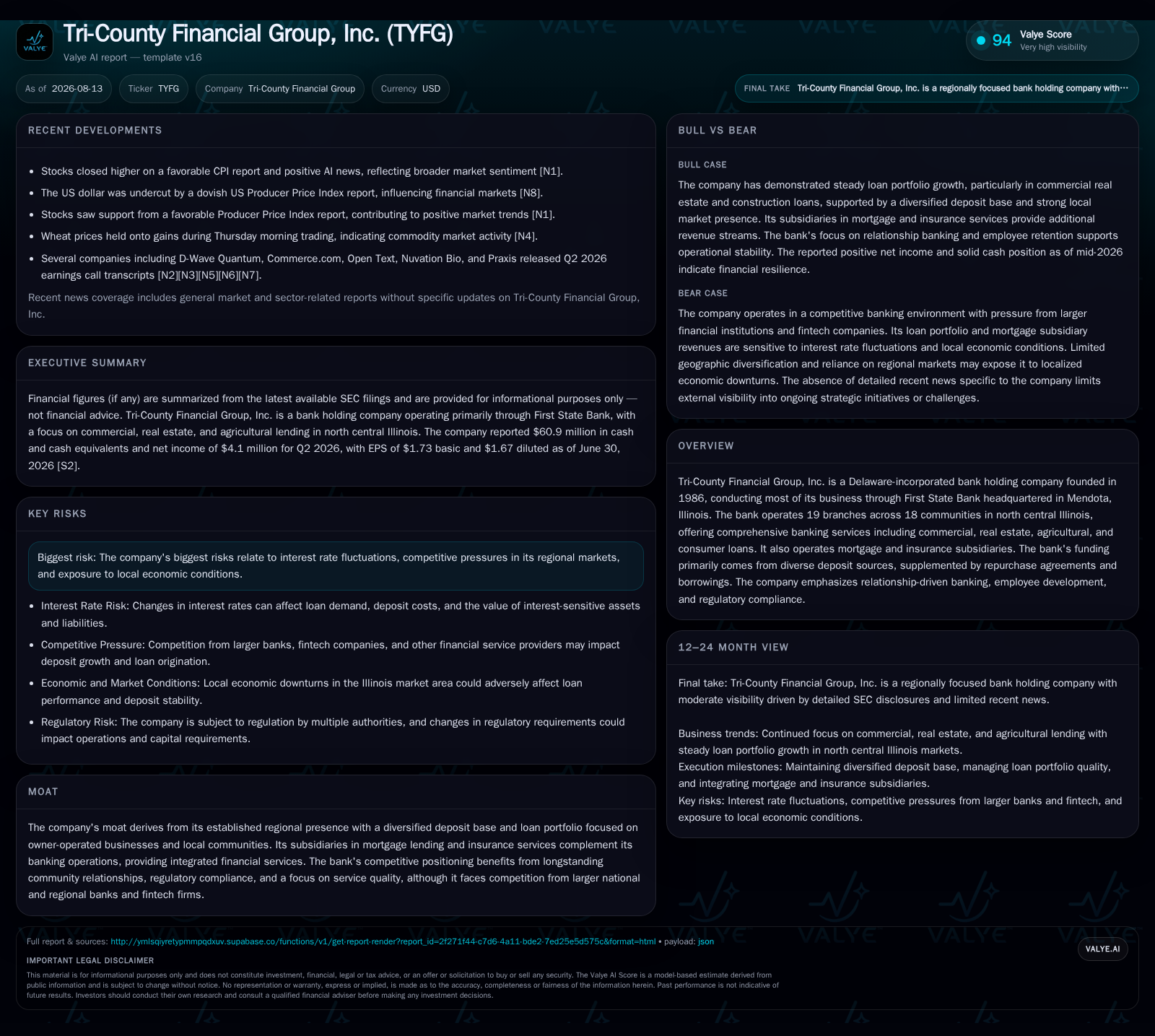
Tri-County Financial Group's latest quarterly update shows sustained momentum in core lending and stable deposit gathering, underpinning net interest income resilience ahead of its announced merger with HBT Financial. The bank's diversified loan portfolio, spanning commercial, real estate—including agricultural—and consumer segments, combined with fee-generating mortgage and insurance subsidiaries, reinforces its integrated community banking model. While the company benefits from longstanding regional relationships and a conservative funding base, risks from local economic shifts and interest rate fluctuations remain relevant as it enters consolidation.
Q2 Operational Trends Ahead of Merger Agreement Finalization
Tri-County Financial Group reported its Q2 2026 results alongside announcing a definitive merger agreement with HBT Financial on August 10, 2026 [S2][S3]. The quarterly disclosures highlight continued loan portfolio growth driven primarily by commercial real estate and agricultural loans — segments that reflect the bank’s deep roots in local Illinois economies. Deposit balances remain stable with a well-diversified base predominantly composed of retail and commercial customers. This mix supports consistent net interest income generation even as repayment risk persists amid shifting regional economic conditions.
Importantly, the merger introduces an inflection point for Tri-County's scale and market reach. The deal anticipates operational synergies that could enhance efficiencies and expand customer offerings across an enlarged geographic footprint [S3]. Management retains customary fiduciary covenants to maintain business continuity during the interim period before transaction close, underscoring cautious stewardship ahead of integration [S3].
Dual Revenue Streams from Core Loans and Fee-Based Subsidiaries Strengthen Model
Tri-County's business centers on lending across three principal categories: commercial loans (including industrial), real estate loans (covering commercial real estate, agricultural real estate, and residential mortgages), and agricultural loans focused on operating needs [S1]. This tripartite loan mix caters to owner-operated businesses integral to north central Illinois’s economy. Lending decisions weigh heavily on borrower cash flow analyses coupled with collateral security assessments — a classic community bank underwriting approach supportive of credit quality stability.
Supplementing net interest income from this core portfolio are significant non-interest revenue streams generated through its subsidiaries: First State Mortgage Services and Tri-County Insurance Services [S1]. Mortgage origination—primarily residential—contributes fee income both via loan sales into secondary markets and retained servicing (though fixed-rate mortgages are mostly sold out)[S1]. The insurance arm diversifies revenue further by catering to overlapping customer bases within existing branch networks. Such integrated service delivery enhances customer retention and cross-selling potential relative to peers lacking similar breadth in ancillary financial services.
'Relationship Banking' Anchors Niche Position Amid Regional Competition
The company's enduring moat rests on its relationship-driven strategy targeting owner-operated enterprises familiar with localized banking models [S1]. By fostering long-term client connections across multiple product lines—commercial loans entwined with deposit services, mortgage products, and insurance—the bank cultivates switching costs that blunt competition from larger national banks or fintech entrants [S1][S23]. This community orientation is bolstered by a 19-branch network dispersed across 18 small towns in north central Illinois—a footprint too localized for large regional players but sufficiently scaled to support robust service capabilities.
Nonetheless, competitive dynamics remain nuanced. Larger banks competing on pricing power can pose challenges for borrower acquisition or deposit pricing. Fintech platforms increasingly encroach on conventional consumer lending and deposit segments by offering digital convenience absent at traditional banks. Tri-County’s historical emphasis on personalized underwriting combined with local market knowledge appears durable but will require agility post-merger to sustain advantage amidst evolving demand patterns.
Diverse Deposit Base and Conservative Funding Enable Stability in Evolving Market
Funding for loan originations derives mainly from a broad-based deposit structure encompassing demand deposits, savings accounts—including money market—and time deposits held by retail consumers as well as small-to-medium businesses [S1][S10]. Brokered or non-core deposits constitute a minor portion (~3%) of the total deposit base at year-end 2025 [S10], indicative of prudent liquidity management prioritizing stable funding sources.
Additional liquidity is accessed via securities sold under agreements to repurchase alongside borrowings from the Federal Home Loan Bank of Chicago [S1]. This layered approach optimizes cost while maintaining flexibility for asset growth or liquidity shocks. Managing the tradeoff between attracting high-cost time deposits versus encouraging low-cost checking accounts aligns with common community banking practices balancing profitability against customer service expectations [S10].
Agri-Realtime Economic Sensitivity: Risks Embedded in Loan Portfolio Composition
A material portion of Tri-County’s real estate portfolio comprises agricultural loans including operating credit lines for farms as well as agriculture-backed real estate mortgages [S1][S20]. These exposures link the balance sheet directly to volatile commodity prices that have trended lower in recent years affecting Midwest farmers' profitability. Protracted agricultural sector weakness could translate into higher delinquencies or impaired assets requiring increased provisions or charge-offs [S1][S26].
This concentration risk requires constant portfolio monitoring especially given macro uncertainties like inflation impact on input costs or geopolitical developments influencing crop exports. Basel III-related regulations necessitate maintenance of capital conservation buffers limiting dividend distributions absent excess capital layers.
These regulatory constraints ensure safety but restrict aggressive capital returns or risky asset expansions without appropriate buffers. For a community bank like Tri-County poised for merger-led growth, sustaining compliance while scaling operations demands sophisticated capital planning aligned with evolving risk profiles. Such governance plays dual roles—acting as both an operational cost driver and a moat element safeguarding depositor confidence.[S12]
Combined Growth Catalysts: Merger Prospects and Cross-Selling Opportunities
The August 2026 merger agreement signed between Tri-County Financial Group and HBT Financial signifies a step toward enhanced scale critical in today's consolidating regional banking landscape [S3][S4]. The transaction aims to blend complementary branch footprints within Illinois regions, tapping into synergistic cost savings through optimized back-office functions alongside revenue enhancements via broader cross-selling across mortgage origination and insurance products.
Strategically, combining forces may improve pricing power on loans owing to increased capital resources while extending product accessibility over a wider geography. Importantly, integrating mortgage subsidiary capabilities allows both legacy partners to tap secondary market sales more efficiently while maintaining essential servicing roles—a lucrative fee stream amid compressed core lending margins.
Key Risks Amid Expansion: Interest Rates, Credit Quality, and Competitive Pressures
Despite firm fundamentals supporting loan growth and deposit retention, Tri-County faces headwinds familiar across regional banks. Interest rate volatility remains paramount; fluctuating rates impact net interest margin via repricing mismatches between earning assets (loans) and funding liabilities (deposits) [S1][N6]. While rising rates typically boost spread income initially, prolonged hikes can dampen borrowing demand or push delinquency rates higher among sensitive borrowers.
Credit risk looms due to economic uncertainties locally—chiefly the agricultural sector tied exposures—as well as retail customer creditworthiness amidst inflationary pressures reducing disposable incomes [S1][N9]. Increased competition not only from larger banks but also digital-native fintech lenders intensifies pressure on pricing models raising strategic urgency around technology investment post-merger.
What to Watch Next: Shareholder Vote, Integration Milestones, and Market Reaction
Key near-term catalysts include obtaining shareholder approval for the merger agreement anticipated in upcoming proxy filings mandated by SEC rule compliance [S4][S24]. Regulatory clearances from banking agencies will also be requisite before deal consummation.
Monitoring execution risks related to IT systems integration, retention of key personnel driving relationship banking value propositions, as well as early evidence of realized cost synergies will be crucial markers signaling successful consolidation progress [F1]. Additionally, investor sentiment post-announcement reflected in stock trading liquidity despite OTC listing status warrants attention amid limited secondary market activity typical for emerging community banks.
In essence, Tri-County stands at a pivotal junction leveraging operational momentum disclosed in Q2 filings paired with strategic alignment through merger activity promising redefined regional competitiveness reliant on prudent risk stewardship combined with scalable franchise expansion.
Disclaimer: This is research-only, informational analysis and not investment advice. It may include AI-generated interpretation and general industry context. Always verify important details using primary sources.

Comments