
Dogwood Therapeutics Advances Halneuron® Development Amid Manufacturing and Financing Challenges
Latest quarterly disclosures highlight encouraging interim Phase 2b data for Dogwood's lead neuropathic pain candidate and progress on a synthetic formulation that could enhance manufacturing scalability and intellectual property protection.
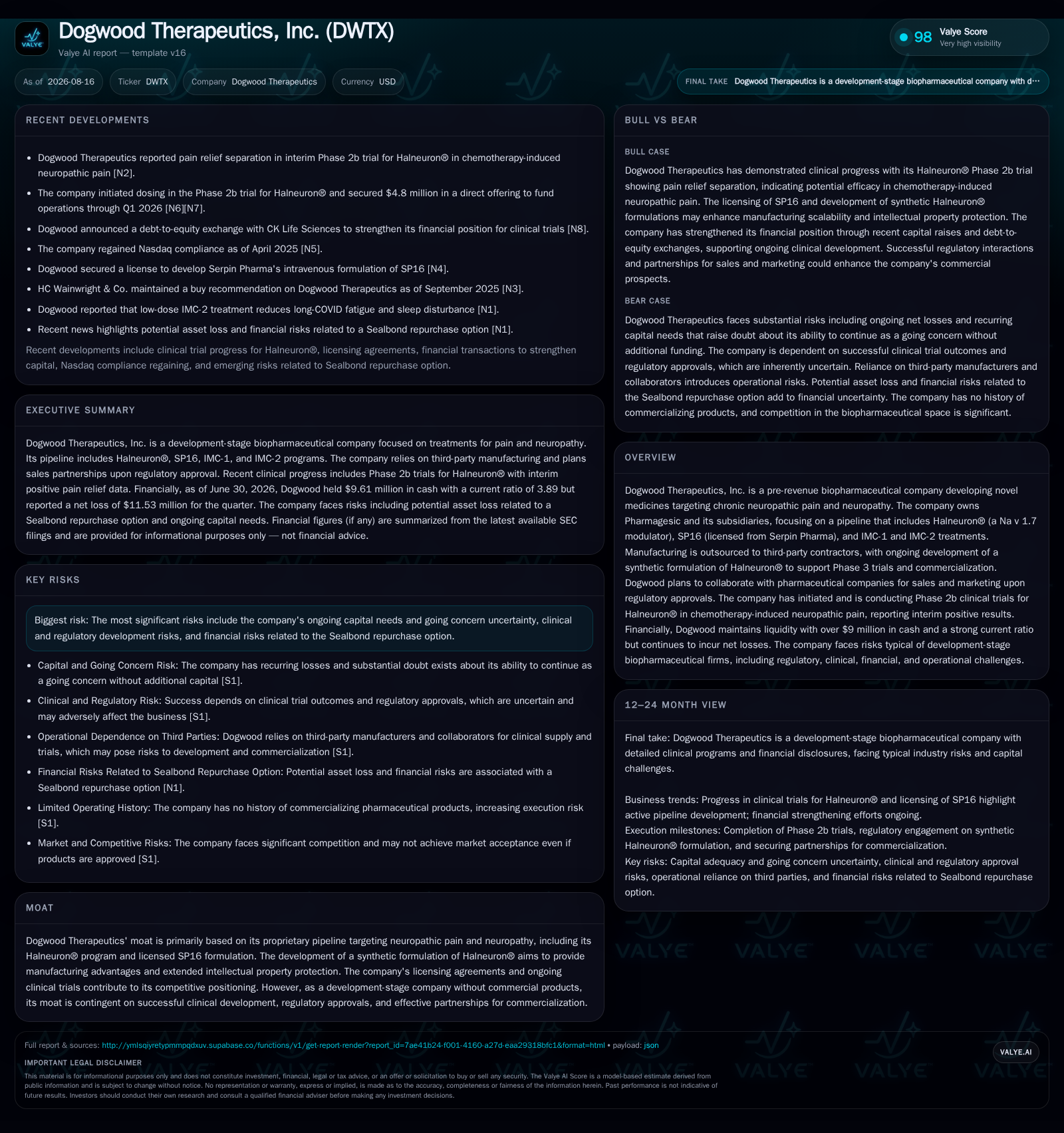
Dogwood Therapeutics reported positive interim results from its ongoing Phase 2b clinical trial of Halneuron®, targeting chemotherapy-induced neuropathic pain, strengthening confidence in the drug candidate's mechanism and tolerability profile [S2][S3]. The company is nearing completion of a synthetic formulation for Halneuron®, which aims to improve manufacturing consistency, reduce reliance on natural sources, and extend patent life [S1][S2]. While Dogwood outsources all clinical and planned commercial manufacturing to third-party CMOs, this strategy introduces execution risks around scale-up and supply chain reliability [S1][S2]. The exclusive licensing agreement acquired from Serpin Pharma expands Dogwood’s pipeline with SP16, diversifying its therapeutic approach beyond sodium channel modulation [S1]. Financially, the company reported $9.6 million in cash with a current ratio of 3.89 as of June 30, 2026, underscoring a constrained cash runway amid continued operating losses near $28 million annually [F1]. Upcoming catalysts include FDA feedback on the synthetic formulation, Phase 2b enrollment completion and readouts, and potential partnership announcements, all critical for advancing toward Phase 3 trials and commercialization [S2][S3][F1].
Recent Clinical Progress: Halneuron® Phase 2b Trial Update
Dogwood Therapeutics’ August 2026 quarterly report details encouraging interim data from its lead asset Halneuron®, a sodium channel (Na v 1.7) modulator aimed at treating chemotherapy-induced neuropathic pain [S2][S3]. The positive signals observed in efficacy and safety endpoints strengthen confidence in the drug candidate’s mechanism of action—a validated target in neuropathic pain management—and suggest potential to surmount common trial challenges such as placebo effects and patient variability.
This advancement supports Dogwood’s timeline toward initiating pivotal Phase 3 trials anticipated in 2027. Steady enrollment progression further underpins operational execution credibility. When benchmarked against peers developing neuropathic pain treatments utilizing novel mechanisms—such as Axsome Therapeutics—Dogwood’s clinical design aligns with industry expectations focusing on rigorous endpoint validation.
Synthetic Formulation: Enhancing Manufacturing Scalability and IP Protection
A significant operational development involves Dogwood’s near-completion of a synthetic version of Halneuron®’s active pharmaceutical ingredient (API), tetrodotoxin [S1][S2]. Transitioning from naturally sourced material to a chemically synthesized API offers multiple strategic benefits: improved batch consistency critical for regulatory compliance; reduced exposure to raw material supply volatility; streamlined scale-up via contract manufacturing organizations (CMOs); and extended intellectual property life through new patent filings planned for late 2026.
This synthetic innovation is integral for establishing robust manufacturing readiness ahead of commercialization and may also facilitate smoother regulatory review by demonstrating chemical equivalence to the natural API.
Manufacturing Strategy: Outsourcing Trade-offs
Consistent with many clinical-stage biotech firms lacking internal production capacity, Dogwood relies entirely on third-party CMOs for both clinical supply manufacture and planned commercial production [S1][S2]. Current partners encompass overseas entities for API synthesis combined with Canadian-based lyophilized fill-finish providers.
While outsourcing reduces fixed costs and capital expenditure burdens—important given Dogwood’s developmental stage—it introduces execution risks including potential capacity constraints during scale-up phases, quality control variability across suppliers, and lead-time unpredictability. These factors can impact timelines for trial advancement and eventual market entry if regulatory approval is secured.
Such dependencies require careful supplier management to mitigate disruptions—a common challenge in specialized biopharmaceutical supply chains.
Pipeline Diversification Through Licensing: SP16 Program
In late 2025, Dogwood secured an exclusive royalty-free global license from Serpin Pharma for SP16, an intravenous cell signaling molecule targeting neuropathy indications beyond sodium channel modulation [S1]. This addition diversifies Dogwood’s therapeutic approach within its pipeline which has been predominantly focused on Na v 1.7 modulation via Halneuron®.
The expanded pipeline enhances strategic optionality by covering multiple mechanisms addressing chronic neuropathic conditions. It also positions Dogwood to pursue milestone-driven collaborations that could provide non-dilutive capital support essential for advancing early-stage candidates.
Growth Drivers: Clinical Milestones and Regulatory Interactions
Near-term value drivers include anticipated FDA feedback in late 2026 regarding regulatory acceptance of the synthetic Halneuron® formulation [S2], which will be pivotal for confirming manufacturing scale-up assumptions ahead of Phase 3 trial initiation.
Completion of Phase 2b patient enrollment along with final efficacy readouts will offer critical validation points potentially influencing partner interest and licensing discussions. Progression milestones related to the SP16 program will further inform long-term growth trajectories.
Risks: Capital Constraints and Regulatory Uncertainties
Despite technical progress, Dogwood faces typical biotech sector risks including recurring operating losses totaling nearly $28 million annually due to intensive R&D spending without revenue generation yet [F1]. Cash on hand was approximately $9.6 million as of June 30, 2026 with current liabilities around $2.8 million yielding a current ratio near 3.9—indicating short-term liquidity sufficiency but underscoring limited runway absent fresh financing or milestone payments [F1].
Regulatory risk remains elevated particularly given the novel introduction of a synthetic API requiring fresh evaluation pathways. The company also depends heavily on external CMOs whose performance variability may affect clinical timelines.
Competitive pressures in neuropathic pain therapeutics necessitate clear differentiation through clinical efficacy or safety benefits to secure market positioning post-approval.
What to Monitor: Catalysts Ahead
Investors should closely watch: - FDA communications expected in H2 2026 concerning synthetic Halneuron® regulatory strategy, - Completion timing of Phase 2b enrollment plus interim/final data releases, - Developments in licensing or partnership arrangements, - Cash burn trends relative to liquidity updates post-Q2, - Clinical progression updates on the SP16 program [S2][S3][F1]. These factors collectively define Dogwood’s near-term risk/reward profile as it seeks to transition from clinical development toward potential commercialization
Financial Profile Discussion: Supporting Ongoing Operations Amid Capital Needs
As reported at quarter-end June 30, 2026, Dogwood held $9.6 million in cash with total current assets around $11 million against current liabilities near $2.8 million resulting in a healthy current ratio of approximately 3.89—a positive indicator of short-term financial stability [F1]. Nonetheless, ongoing operating losses reflecting sustained R&D investments highlight a pressing need for additional capital infusions or milestone-based financing events to maintain uninterrupted clinical progress [F1].
Without such funding sources secured imminently, cash runway limitations may constrain strategic flexibility beyond mid-2027 under typical burn assumptions seen in comparable clinical-stage biotechs.
This analysis synthesizes Dogwood Therapeutics’ recent operational advances within the context of industry-standard developmental risks inherent in pre-commercial biotech focused on neuropathic pain therapeutics. The company's progress on both clinical fronts and manufacturing innovation is promising but must be balanced against capital constraints and external dependencies that will shape execution outcomes going forward.
Disclaimer: This is research-only, informational analysis and not investment advice. It may include AI-generated interpretation and general industry context. Always verify important details using primary sources.

Comments