
Cluster Group Holdings Ltd Co: Speculative Food Industry Acquisition Shell with Significant Execution and Capital Risks
Cluster Group Holdings Ltd Co operates as a non-revenue public shell seeking a merger or acquisition in the food sector without definitive agreements or operational track record.
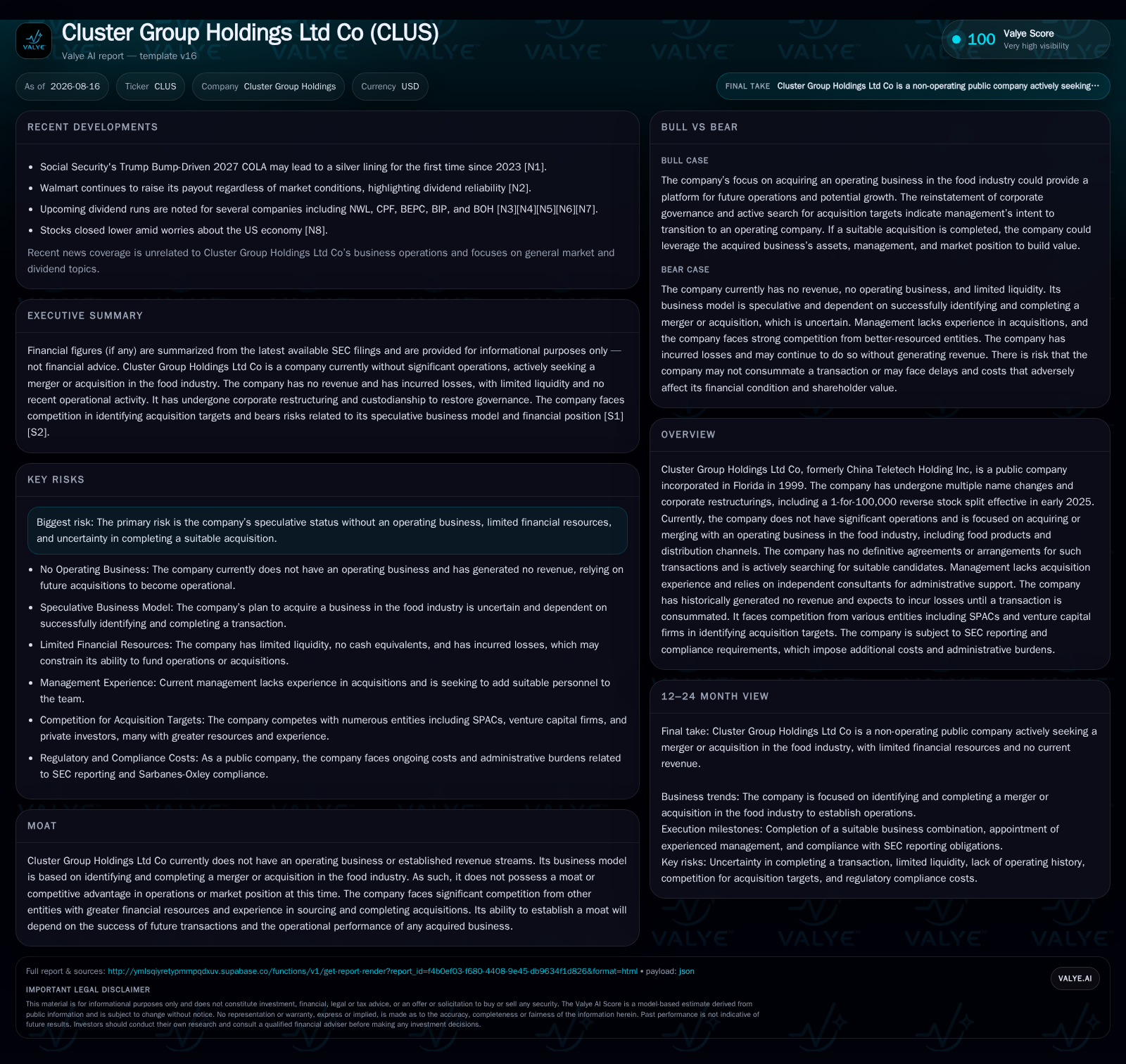
Cluster Group Holdings Ltd Co (CLUS) is a Florida-incorporated public shell company that has no current operating business or revenue and is actively searching for an acquisition or business combination in the food industry, including food products and distribution. Its recent quarterly filings reaffirm the absence of definitive transaction agreements and highlight ongoing speculative status, capital constraints, and management’s lack of acquisition experience. Competition from more established and better-funded acquisition entities compounds execution risks. The company’s success will depend heavily on its ability to identify suitable targets, raise capital, consummate transactions, and build operational capabilities post-acquisition.
Recent Operating Update
Cluster Group Holdings Ltd Co's latest quarterly filing dated August 14, 2026 reinforces its status as a non-operating holding company focused on consummating an acquisition within the food industry—spanning food products to distribution channels [S2]. The filing discloses no binding or definitive agreements to acquire or merge with any operating business as of quarter-end. Management continues an active search process relying substantially on personal networks, professional advisors, and unsolicited proposals for suitable targets [S6]. This ongoing due diligence involves financial analysis, product evaluation, and management assessment of potential candidates but currently remains exploratory without progress toward deal closure. The company anticipates that this review process could require about 30 days per viable candidate once identified [S6].
Business Model Overview
Cluster Group Holdings functions purely as an acquisition vehicle or shell company targeting consolidation within the food industry. It does not operate any commercial activities internally nor generate revenues directly. Instead, its business model relies entirely on raising capital to effect a business combination with an existing food producer or distributor. Post-acquisition, revenue generation would arise from the acquired entity’s operations.
Monetization mechanics revolve around identifying suitable mid-market or growth-oriented food companies exhibiting strong market expansion potential or innovative product offerings. Revenue drivers post-deal would be conventional top-line sales of food products through established channels such as retail or wholesale distribution networks managed by the acquired firm. Margins depend on the acquired business’s historical profitability but can be pressured during integration phases due to restructuring costs.
Until acquisition completion, Cluster Group incurs operating expenses linked mainly to administrative overheads, SEC compliance costs (including legal, accounting, auditing services), and consultants who assist with due diligence and corporate governance activities [S24][S28]. Because it conducts no operations independently, revenue mechanics hinge wholly on successfully closing a deal.
This approach parallels common public shell companies focusing on targeted industries where acquiring a foothold depends primarily on transaction execution rather than organic growth.
Industry Context and Competitive Position
The broader segment of Food Industry Acquisition and Holding Companies comprises public shells and SPAC-like entities actively seeking operating companies in fragmented markets ripe for roll-up strategies. Successful players tend to blend significant capital access with experienced M&A teams adept at sourcing undervalued targets while navigating complex regulatory frameworks domestically and internationally.
Comparatively, Cluster Group appears disadvantaged given historical abandonment by former management necessitating court custodianship reinstating corporate control in 2020—a disruption uncommon among healthier peer vehicles [S11][S10]. The current executive leadership lacks acquisition experience and heavily depends on external consultants for administrative functions [S1][S28], limiting competitive agility relative to peers backed by seasoned investment firms or specialized sponsors.
Furthermore, the company faces direct competition from SPACs dedicated to food & beverage sectors along with private equity funds possessing deeper pockets capable of aggressive bidding for attractive targets. Venture capital-backed food startups also vie for attention as potential growth platforms but often prefer strategic investments over outright acquisitions by shells.
Regulatory risk adds complexity in cross-border scenarios. Cluster’s prior focus includes Chinese operational links which introduce layers of approval processes under PRC M&A rules and anti-monopoly laws—factors that could prolong deal timelines or curtail options if national security reviews apply [S23][S19]. These challenges exacerbate competitor advantages when others are solely domestic-focused or have robust local expertise.
Growth Drivers
Notwithstanding speculative status today, market fundamentals underpin opportunity within the highly fragmented global food production and distribution arena. Key growth drivers supporting Cluster Group’s stated sector focus include:
- Increasing consolidation trends favoring roll-up strategies to achieve scale benefits in manufacturing efficiency or expanded retail footprint.
- Rising consumer demand for specialty foods including organic and health-oriented products which create niches for innovative producers valued by acquirers.
- Strong capital market appetite persists for acquisitions fueled by low interest rates enabling financing flexibility via equity issuances or convertible instruments.
- Potential strategic partnerships facilitating joint ventures that can enhance scale before full acquisitions.
- Expanding retail channels both offline hybridized with e-commerce broaden addressable markets for acquired businesses.
- Favorable regulatory environments encouraging merger activity although contingent on geographic execution specifics.
Successful execution capturing these tailwinds requires timely identification of underperforming yet scalable entities paired with seamless integration capabilities after deal closure—both unproven factors for Cluster Group currently.
Risks and Watchpoints
Primary risks center around:
- Execution Risk: No definitive deals exist; probability hinges on locating attractive targets amidst intense competition from SPACs and private equity firms better resourced in both capital and expertise [S13][S21].
- Capital Risk: Reported zero cash at quarter-end signals high dependency on external funding sources; failure to raise proceeds restricts operational continuity beyond minimal administrative functions [F1][S25].
- Dilution Risk: Any capital raise through share issuance or convertible preferred stock conversion increases share dilution significantly due to large authorized shares outstanding—typical among shell companies but problematic for shareholder value concentration [S5][S1].
- Management Experience: Limited past M&A experience within current leadership elevates uncertainty regarding due diligence thoroughness, negotiation efficacy, integration oversight post-acquisition [S1][S28]. Reliance on consultants implies constrained internal control over critical timing-sensitive decisions.
- Regulatory Risk: Potential increased regulatory scrutiny post-transaction especially involving PRC jurisdictions complicates approvals causing delays or transaction abortion risk [S19][S26].
- Going Concern: Auditor warnings about financial viability underscore precariousness without immediate infusion of funds or transaction completion [S25].
Monitoring these areas alongside progress toward concrete milestones such as formal announcement of engagements with target companies or successful fundraising rounds offers clarity into trajectory.
What to Watch Next
Key catalytic developments include:
- Appointment of experienced M&A professionals augmenting management demonstrating preparedness to execute transactions effectively.
- Announcements confirming capital raises sufficient to cover due diligence expenses plus initial acquisition-related payments.
- Identification of credible prospective deals aligned with stated selection criteria—growth potential, competitive positioning within food sector niches.
- Filing updates reflecting entering into letters of intent or definitive agreements corroborating transactional momentum.
- Regulatory filings revealing approvals from relevant authorities accelerating closing prospects.
Absence of these markers within coming quarters would amplify speculative concerns; conversely rapid progression toward consummation validates operational hypotheses underpinning valuation argument structures found among peer shells that evolve into operating companies.
Financial Profile Discussion
As of June 30, 2026, Cluster Group Holdings reported zero cash balances alongside no current assets while carrying nominal current liabilities near $76k evidencing extremely limited liquidity headroom precluding any meaningful operating expenditures beyond essential overheads [F1][S2]
Operating results reveal sustained losses consistent with non-operating holding patterns: net loss approximated $52k per annum last reported period affirming burn rates typical for shells pursuing transactions without own revenues [F1]
The company's large share authorization combined with historical reverse stock split executed in early 2025 suggests preparation for sizeable equity-based dilution events necessary to fund acquisitions but which dilute existing shareholders substantially post-deal if not carefully managed [S7][S5]. No dividends have ever been declared nor anticipated given missing earnings capacity typical under this model emphasizing capital appreciation via transaction success as sole shareholder return pathway currently.
Maintaining SEC compliance expenses despite limited resources indicates further cash usage requiring financing imminently lest filing obligations jeopardize listing status or legal standing affecting strategic options negatively [S24]
Overall financial positioning reinforces high-risk speculative profile dependent fundamentally on resource infusion events paired with swift effective deployment against acquisition cost levers—absence thereof compels reversion toward wind-down risks common in dormant shell scenarios absent new life injection via deals.
This analysis is based solely on publicly available SEC filings through August 2026 along with standard industry knowledge frames applicable to acquisition-focused holding companies within the food sector. No material confidential information is included; readers should consider all associated speculative risks inherent in pre-revenue corporate shells when evaluating this profile.
Disclaimer: This is research-only, informational analysis and not investment advice. It may include AI-generated interpretation and general industry context. Always verify important details using primary sources.

Comments