
Family Office of America Targets CPA Roll-Ups but Faces Liquidity and Integration Challenges
FOFA pursues a roll-up strategy in the fragmented CPA and family office services market, leveraging consultant retention and integrated offerings amid operational headwinds.
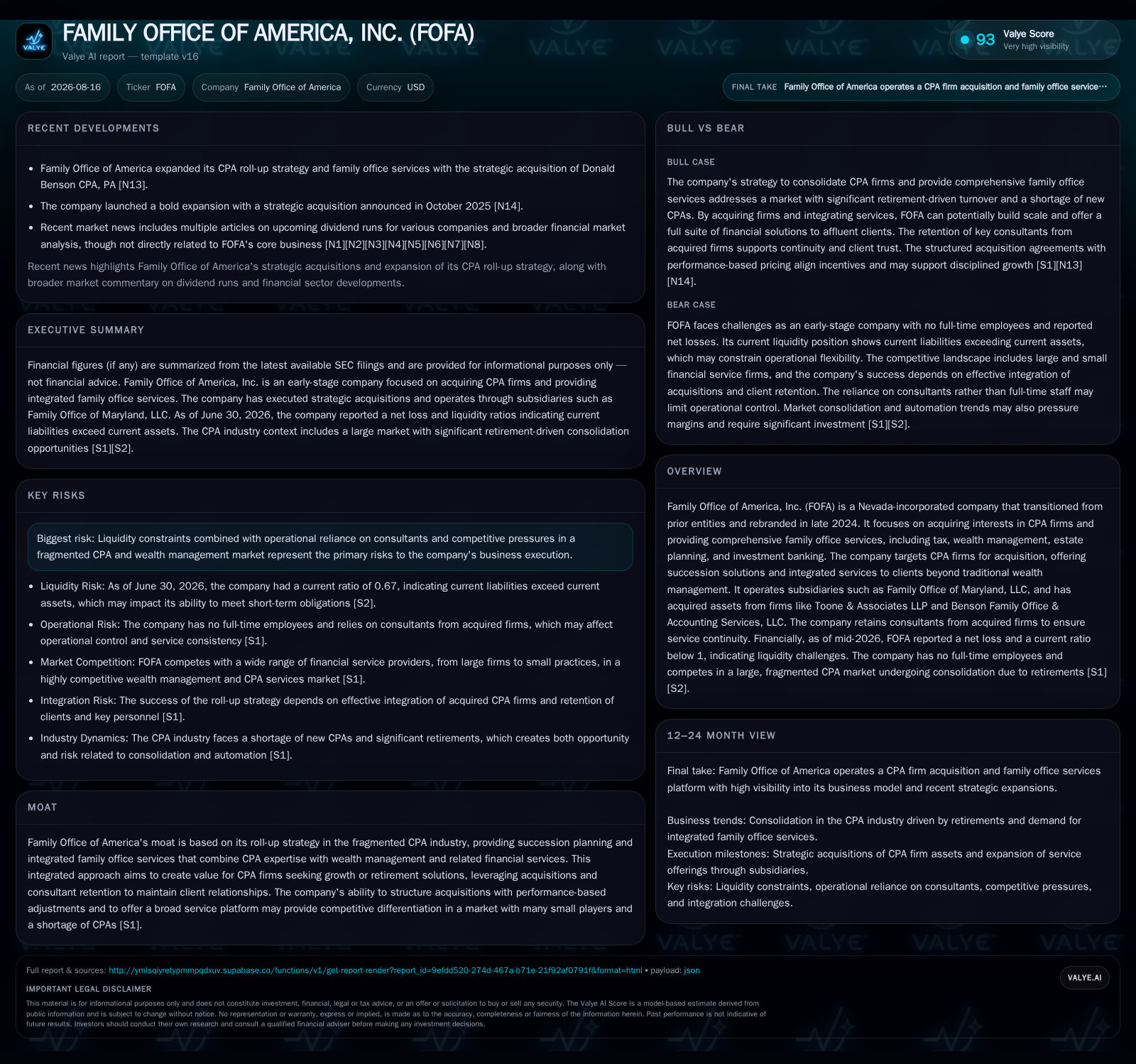
Family Office of America, Inc. (FOFA) has redefined its business model with a focus on acquiring CPA firms to offer comprehensive family office services, including tax, wealth management, estate planning, and investment banking. Its latest quarterly results reveal liquidity constraints underscoring operational risks common in consultant-reliant models within a fragmented industry. Growth relies on successful acquisition integrations, succession planning solutions for aging advisors, and expanding service breadth. However, current financial strains and market competition temper near-term scalability and stability.
Recent Operating Update
Family Office of America, Inc. (FOFA) filed its latest quarterly report as of June 30, 2026, revealing important signals about its evolving operating profile. The company reported current assets of approximately $810K against current liabilities of around $1.21 million, resulting in a current ratio of just 0.67 [F1], a level below the typical 1.0 benchmark signaling potential liquidity stress. Additionally, FOFA held total debt near $208K [F1], which coupled with the low liquidity ratio raises concerns about short-term financial flexibility vital for continued acquisition activity and day-to-day operations.
Although the company did not disclose quarterly profitability metrics explicitly in this filing cycle, prior annual data show persistent net losses (nearly -$493K as of end-2025) [F1] that underscore an ongoing investment phase in building the platform through acquisitions and consultant network development rather than immediate cash generation.
Business Model Analysis
FOFA's strategic pivot since late 2024 centers on acquiring interests in small to mid-sized Certified Public Accounting (CPA) firms, then providing a broad suite of family office services encompassing tax preparation, wealth management, estate planning advisory, bookkeeping, plus investment banking support [S1]. This positions FOFA at the intersection of traditional CPA advisory with integrated financial planning aimed at high-net-worth individuals and families—a segment characterized by demand for consolidated service delivery.
Revenue derives primarily from client fees linked to these professional services—fee-based revenue streams typical of wealth management firms—but FOFA distinguishes itself by focusing on succession solutions for legacy CPA owners who lack in-house resources or leadership pipelines [S1]. By acquiring these firms or their assets (e.g., Toone & Associates LLP), FOFA absorbs client rosters while retaining consultants from acquired entities to sustain service continuity—critical given the relationship-driven nature of this business [S1].
This roll-up strategy leverages fragmented market dynamics where many small CPA providers operate independently but face succession challenges amid increasing regulatory complexity and client demands for integrated financial solutions. FOFA aims to create scale economies by cross-selling complementary services via an expanded platform anchored by accounting expertise.
Notably, FOFA does not currently employ full-time staff; instead it relies heavily on external consultants retained post-acquisition [S1]. While this model keeps fixed costs low, it also elevates risks around consultant availability, knowledge transfer gaps during integrations, and limits capacity expansion unless consultants increase billable hours or new hires are engaged externally.
Industry Structure and Competitive Position
The family office and wealth management sectors are highly fragmented with numerous small advisory practices juxtaposed against large diversified wealth managers like Raymond James Financial or Mariner Wealth Advisors that offer end-to-end solutions including asset management, estate planning, tax advice, and investment banking services. FOFA competes mostly against small-to-mid CPA firms offering limited scope tax/accounting services as well as boutique family offices.
In this context, FOFA’s moat is predicated on its roll-up acquisition ability combined with delivering a more comprehensive set of client offerings and alleviating succession bottlenecks facing aging CPA firm principals [S1]. Its subsidiary Family Office of Maryland exemplifies localized market expansion leveraging existing service lines tailored geographically.
However, compared to peers such as Plante Moran—which maintains large full-time teams across multiple advisory disciplines—FOFA’s consultant-reliant operating structure may limit competitive positioning due to smaller scale and less operational control. Fee revenue growth depends heavily on effective post-deal integration including maintaining high client retention rates post-transition—a common industry challenge that determines whether acquisitions translate into sustainable cash flow enhancements.
Growth Drivers
Structural tailwinds support FOFA’s strategy: the increasing complexity of tax laws combined with growing wealth demographics creates sustained demand for integrated financial advice combining accounting rigor with investment insight. Aging ownership among small CPA businesses fuels active succession planning needs; these firms seek buyers able to maintain client trust while expanding services beyond basic accounting.
Industry consolidation through roll-ups remains a proven pathway for fragmentation-driven sectors like CPAs and family offices since scale enables broader marketing reach, technology investments, compliance infrastructure improvements, and cross-selling opportunities—all pivotal growth levers [S1]. Furthermore, clients increasingly prefer holistic advisors rather than segmented providers; FOFA’s strategy targets this evolving preference gap.
Key KPIs that will underpin growth include assets under management (AUM) progression as investment services expand; year-over-year fee revenue increases reflecting deeper wallet share per client; number and quality of completed acquisitions demonstrating deal pipeline health; post-acquisition integration success rates critical to retention; and consultant utilization rates indicating operational leverage effectiveness.
Risks and Watchpoints
Liquidity constraints evidenced by sub-1 current ratio metrics heighten execution risk especially given ongoing net losses—raising questions about how swiftly cash flow breakeven can be achieved absent capital raises or debt refinancing [F1]. Given reliance on consultants instead of salaried employees, control over service quality and consistency can fluctuate depending on consultant availability or competing commitments.
Acquisition integration challenges remain paramount: maintaining legacy client satisfaction after ownership changes is notoriously difficult without smooth consultant retention strategies backed by clear communication plans [S1]. The competitive landscape is crowded with both local independent CPAs protecting entrenched client relationships as well as larger incumbents offering richer product ecosystems.
Tracking subsidiaries’ geographic expansions such as Family Office of Maryland offers insight into regional diversification potential. Moreover, clarity around evolving fee structures—from flat-rate tax prep toward asset-based or performance-linked fees—would signal maturation toward sustainable family office economics.
Financial Profile Discussion
At the end of Q2 2026, Family Office of America reported total debt approximating $208K alongside current assets near $810K versus liabilities totaling roughly $1.21 million resulting in a current ratio below standard thresholds at 0.67 [F1]. This imbalance points to short-term liquidity pressures that could restrict the company’s ability to fund operations or pursue deal-making without external financing support.
Careful scrutiny of cash flow from operations alongside accounts payable/receivable cycles will be essential going forward to assess whether cash burn accelerates or decelerates as acquisitions contribute revenue streams that offset fixed cost absorption.
Disclaimer: This analysis is based solely on public filings and available information without insider access. It does not constitute investment advice or research view.
Disclaimer: This is research-only, informational analysis and not investment advice. It may include AI-generated interpretation and general industry context. Always verify important details using primary sources.

Comments