
SPAR Group Q2 2026: Revenue Mix Shift and Legal Risks Amid Tight Liquidity
SPAR Group's Q2 2026 results show contrasting geographic revenue trends, stable interest costs, and new legal challenges impacting financial and operational outlook.
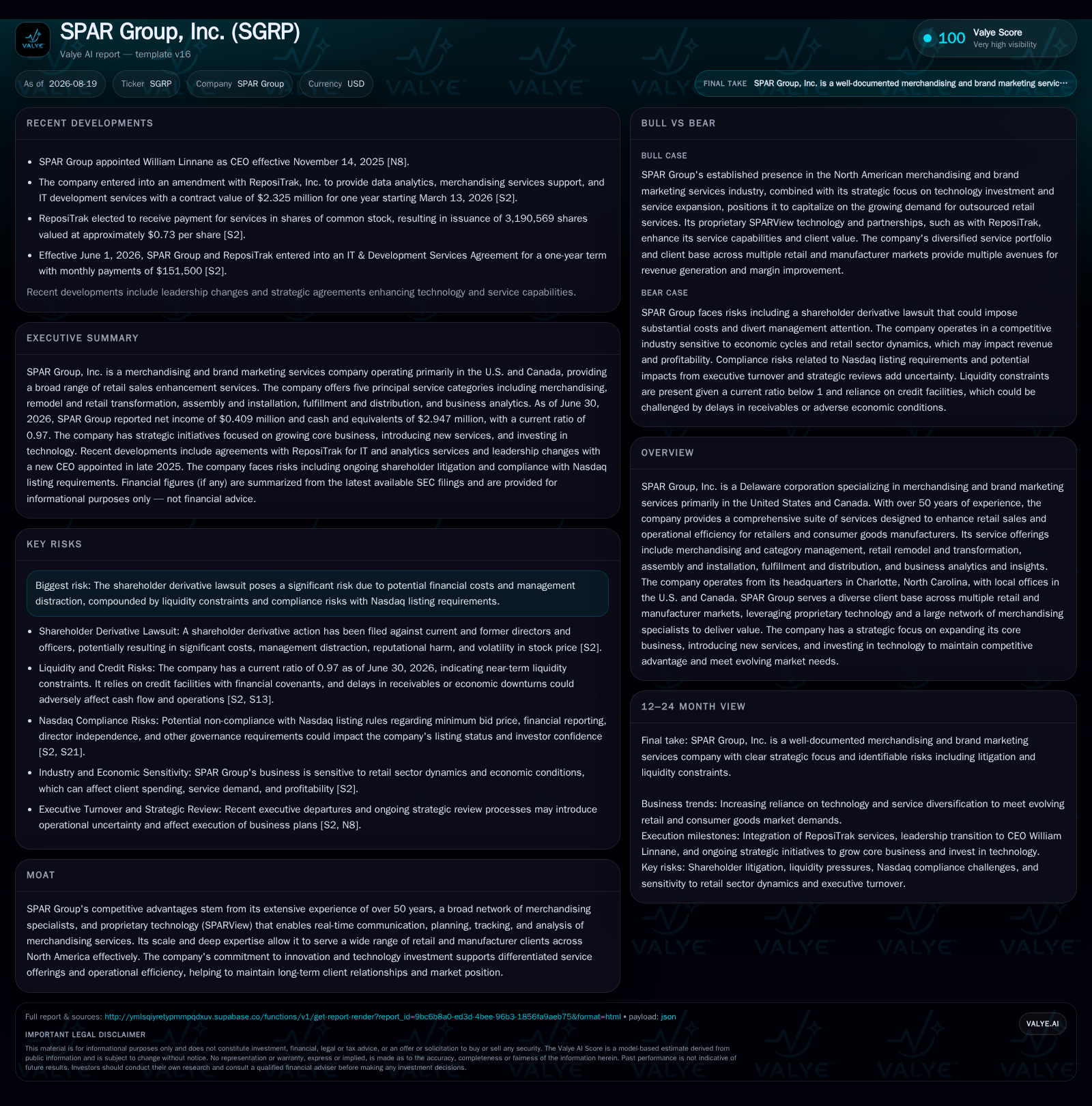
In the six months ended June 30, 2026, SPAR Group experienced a decline in U.S. cost of revenues driven by reduced revenue and service mix changes, while Canadian cost of revenues increased due to higher revenue and service mix shifts. Interest expense remained stable year-over-year, but liquidity tightened with a current ratio below 1.0 as of June 30, 2026. Post-quarter, the company faced a shareholder derivative lawsuit alleging breach of fiduciary duty, introducing potential financial and reputational risks. These developments highlight operational adjustments amid financial constraints and legal uncertainty, with future performance hinging on the balance of geographic growth and resolution of legal matters.
Q2 2026 Operating Performance and Revenue Mix
SPAR Group's latest operating results for the six months ended June 30, 2026, reveal a notable geographic divergence in cost of revenues, a key indicator of service activity and revenue trends in the merchandising and brand marketing services sector [S2]. The U.S. cost of revenues declined to $52.2 million from $56.3 million in the same period of 2025, reflecting a contraction or reprioritization of service engagements in the U.S. market. This decline aligns with reduced revenue and changes in service mix, suggesting softness or competitive pressures in the U.S. operations.
Conversely, Canadian cost of revenues increased to $5.8 million from $4.6 million year-over-year, driven by higher revenue and service mix changes [S2]. This growth in Canada indicates expanding client demand or successful penetration in that market, partially offsetting the U.S. softness and contributing to geographic diversification benefits.
Cost of revenues in this industry closely track service volume and mix, encompassing labor and materials related to merchandising, display installation, shelf stocking, store remodeling, and distribution center staffing. Therefore, the observed shifts in cost of revenues reflect underlying changes in client project activity and service focus across North America. The U.S. decline may pressure margins if lower-margin projects predominate or if fixed costs are less flexible, while Canadian growth could support margin stability if service mix and operational efficiency are favorable.
SPAR Group's business model centers on providing merchandising and brand marketing services to retailers and consumer goods manufacturers and distributors primarily in the U.S. and Canada [S1]. Clients pay for services including product placement, display installation, shelf stocking, store remodeling and transformation, new store preparation, distribution center staffing and operations support, and sales assistance. Revenue is generated mainly through service contracts and project-based engagements tailored to client objectives.
Margins and cash conversion are influenced by service mix, geographic operations, labor costs, operational efficiency, and the deployment of proprietary technology known as SPARView [S1]. This technology enables real-time communication, planning, tracking, analysis, and optimization of merchandising services, offering a competitive edge in operational execution and client reporting.
With over 50 years of experience and a broad network of merchandising specialists, SPAR Group leverages scale, expertise, and technology to differentiate itself from competitors. However, the merchandising services industry remains cyclical and sensitive to retail and manufacturing sector health, with client budgets and demand subject to economic fluctuations [S1].
Legal Risks and Shareholder Derivative Lawsuit
Following the end of Q2 2026, SPAR Group became subject to a shareholder derivative lawsuit alleging breach of fiduciary duty and unjust enrichment by certain current and former directors and officers [S2]. The complaint requests declaratory and equitable relief related to alleged void or voidable board actions.
Such litigation introduces significant legal and reputational risks that could materially affect the company's financial condition and operational focus. Potential impacts include substantial defense and indemnification costs, diversion of management and board attention from business execution, and increased scrutiny of corporate governance practices. Moreover, reputational harm may affect investor confidence and stock price volatility.
The company disclosed its intent to vigorously defend the action but acknowledged the inherent uncertainty of litigation outcomes. Directors' and officers' liability insurance may not fully cover defense or settlement costs, exposing SPAR Group to potential financial strain beyond insurance limits. Even if the company successfully defends the lawsuit, the process could be costly, time-consuming, and disruptive to stakeholder relationships [S2].
This legal development compounds existing operational challenges by potentially increasing financial burdens and distracting management at a time when the company is navigating shifts in its revenue mix and tight liquidity conditions.
Liquidity and Financial Condition
SPAR Group's liquidity position as of June 30, 2026, reflects working capital constraints with a current ratio of 0.97, derived from current assets of $40.6 million against current liabilities of $42.0 million [F1]. This working capital tightness may constrain the company's ability to absorb operational shocks, invest in growth initiatives, or manage unexpected expenses, including those arising from legal proceedings. Stable interest expense of approximately $1.1 million for the six months ended June 30, 2026, consistent with the prior year, suggests no material change in debt servicing costs, but does not alleviate the pressure from working capital constraints [S2]. In a project-based service business like merchandising and brand marketing, timely client payments and efficient management of receivables and payables are critical to maintaining liquidity [S1]. The company continually monitors the collectability of accounts receivable based on client credit information and financial condition, writing off uncollectible balances as necessary.
Any unexpected legal costs or further revenue softness could exacerbate liquidity pressures, potentially limiting SPAR Group's ability to fund operations or invest in strategic initiatives.
Business Model and Competitive Positioning
SPAR Group operates primarily in the U.S. and Canada, having exited international markets such as Mexico, Brazil, South Africa, China, Japan, and India during 2024 to focus on its core North American operations [S1]. The company aims to be the most creative, energizing, and effective retail services provider, driving sales, margins, and operating efficiency for its clients.
The company’s services encompass a broad range of merchandising and brand marketing activities, including launching new products, installing displays, assembling fixtures, ensuring shelf stocking and reordering, sales assistance, store renovations, new store preparations, and distribution center staffing [S1]. SPAR Group’s competitive advantages include over 50 years of industry experience, a broad network of merchandising specialists, and proprietary technology (SPARView) that provides real-time insight and management capabilities. This technology facilitates communication, planning, tracking, analysis, and optimization of merchandising services, enhancing operational efficiency and client satisfaction [S1].
The merchandising and marketing outsourced services industry is cyclical and sensitive to economic conditions affecting retail and manufacturing sectors. Client budgets and demand can fluctuate with economic cycles, impacting revenue and profitability [S1]. The shareholder derivative lawsuit introduces material legal and reputational risks that could impose significant costs and divert management attention. These factors collectively create a complex operating environment where geographic growth balance, financial discipline, and legal resolution will critically influence SPAR Group's performance and stability going forward.
Investors should watch for signs of revenue stabilization or further decline, legal expense developments, and liquidity trends to assess the company's capacity to navigate these challenges effectively. Additionally, monitoring interest expense trends and client contract renewals or cancellations will provide insight into financial health and operational momentum.
Grounded Watchpoint
A key watchpoint for SPAR Group is the ongoing impact of the shareholder derivative lawsuit on financial and operational performance. Given the potential for substantial defense costs, indemnification obligations, and reputational harm, the lawsuit could materially affect liquidity and management focus. The adequacy of directors' and officers' liability insurance coverage and the company's ability to manage legal expenses without impairing working capital will be critical.
Any adverse legal outcomes or further revenue softness, particularly in the U.S. market, could strain cash flows and operational flexibility. Investors should closely monitor subsequent quarterly filings for updates on legal expenses, revenue trends by geography, and changes in liquidity metrics.
The company’s ability to leverage its competitive advantages and manage these challenges will be pivotal in determining its near-term financial stability and growth prospects.

Comments