
Fidelity Solana Fund Offers Regulated SOL Exposure with Staking-Enhanced Returns
The Fund’s recent quarterly update highlights stable passive management and operational reliability amid the evolving digital asset regulatory landscape.
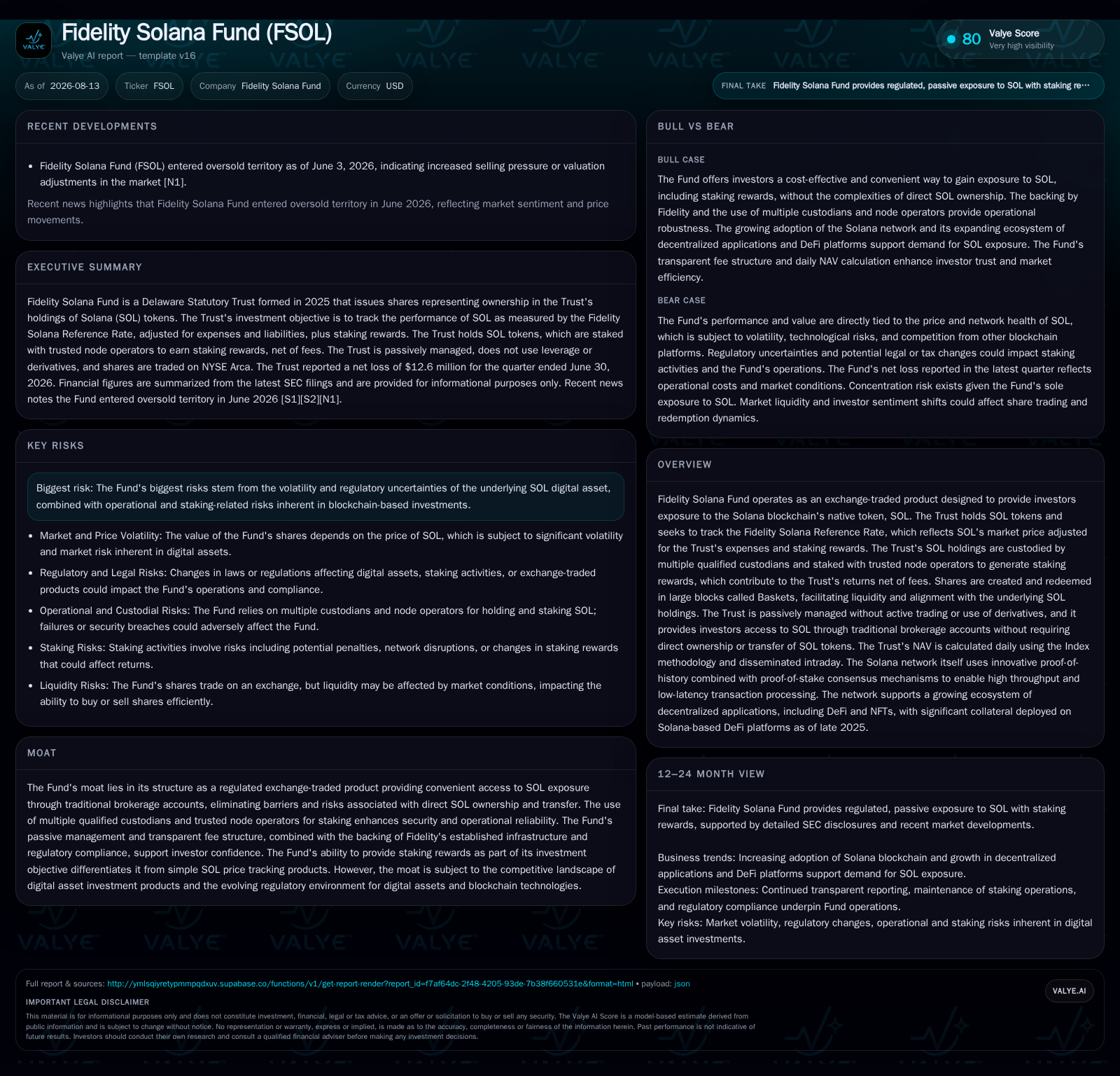
Fidelity Solana Fund (FSOL) is a Delaware Statutory Trust operating as a regulated exchange-traded product (ETP) providing investors exposure to Solana’s native token, SOL. The Fund holds SOL assets custodied by multiple qualified institutions and generates additional return through staking rewards managed by trusted node operators. Its structure enables investors to access SOL via traditional brokerage accounts while mitigating direct custody risks. Recent filings confirm continued adherence to passive management without derivatives and underscore regulatory clarity around SOL’s classification as a digital commodity. However, digital asset volatility and regulatory uncertainty remain inherent risks. Growth is driven by increasing demand for crypto exposure and staking opportunities, while the evolving regulatory environment and operational risks require ongoing monitoring.
Recent Operating Update: Stability in Q2 amid Regulatory Milestones
Fidelity Solana Fund’s latest quarterly filing dated August 13, 2026, did not report material changes to its operating model but reaffirmed its adherence to passive management, holding collateralized SOL tokens while collecting staking rewards that enhance performance above the referenced index net of expenses [S2][S14]. The Fund continues operations initiated in late 2025 following its formation under Delaware law with shares trading on NYSE Arca in large blocks called Baskets (25,000 shares each), enabling institutional-level creation/redemption processes that preserve NAV alignment [S1][S6].
A defining near-term development for the digital asset industry impacting FSOL is the March 2026 SEC-CFTC joint interpretation explicitly categorizing SOL as a "digital commodity" rather than a security, clarifying federal regulatory oversight and reducing compliance uncertainty for products like FSOL providing indirect cryptocurrency exposure through regulated vehicles [S10]. This enhanced legal clarity supports confidence that the Fund's staking activities comply with grantor trust tax treatment and regulatory expectations [S12][S18]. Despite such progress, risk disclosures continue emphasizing crypto-asset volatility and rapidly evolving rules requiring investors and fiduciaries to monitor related impacts carefully [S14][S19].
Business Model: Passive ETP Providing Staking-Adjusted SOL Exposure
Fidelity Solana Fund operates as an exchange-traded product issuing publicly traded Shares representing fractional undivided beneficial ownership interests in Trust-held SOL tokens [S1][S6]. The core investment strategy is fully passive—holding native Solana tokens without engaging in active trading or derivative use — but supplemented by securing staking rewards through delegation of these tokens to trustworthy node operators within the proof-of-stake network architecture [S12]. This approach aims to deliver returns capturing both underlying SOL price appreciation and incremental yield from staking operations net of annual sponsor fees.
Custody is a critical element; all tokens are held by multiple qualified custodians—Anchorage Digital Bank N.A., BitGo Bank & Trust N.A., and Coinbase Custody Trust Company LLC—chosen for operational reliability and security safeguards essential in managing private key risk in blockchain assets [S1][S6]. Shares trade on public exchanges enabling traditional brokerage access without exposing retail investors to the technical challenges or counterparty risks involved with direct crypto wallets or exchanges.
Liquidity management hinges on Authorized Participants (APs) who create or redeem Baskets directly with the Trust by delivering or receiving corresponding quantities of SOL tokens (or cash equivalents under certain procedures), thus anchoring secondary market pricing closely to Trust NAV per share adjusted per the Fidelity Solana Reference Rate and staking accruals [S13][S24]
Sponsor compensation consists of a single unified fee equal to 0.25% annually applied to SOL holdings’ value measured against the index price methodology; this modest expense ratio aligns with other passive crypto-focused ETPs catering primarily to institutional clients seeking simple crypto exposures combined with yield enhancement via staking [S22]. Fee expenses directly affect net returns realized by shareholders after adjusting the Index performance for accrued costs.
Industry Structure and Competitive Position: Positioned Among Regulated Crypto ETPs
FSOL sits within an emerging class of regulated digital asset investment vehicles designed to translate blockchain tokens into familiar financial structures while preserving investor protections under U.S. securities laws. Peers include offerings like CoinShares Digital Asset ETPs or VanEck Digital Assets funds that provide exposure to various proof-of-stake cryptocurrencies with similar custody/staking frameworks.
By focusing exclusively on SOL—the native token of the high-throughput Solana blockchain—the Fund differentiates itself from multi-token index funds or Bitcoin-centric trusts like Grayscale Bitcoin Trust (GBTC). Solana’s network properties, including low latency transaction processing and growing DeFi ecosystem adoption, underpin investor interest but expose FSOL indirectly to the blockchain’s operational resilience risks.
FSOL’s moat stems primarily from its integration into Fidelity’s established distribution network coupled with transparent governance over staking arrangements and custodian vetting. This institutional pedigree offers relative assurance around regulatory compliance—especially critical given federal agencies’ enhanced scrutiny on crypto products—and prevents retail investors from complexities associated with direct token custody or trading platform vulnerabilities.
Growth Drivers: Rising Demand for Regulated Crypto Exposure Enhanced by Staking Yields
Growing institutional adoption of cryptocurrency assets catalyzes demand for regulated ETPs offering turnkey access without self-custody complexity—a key advantage driving FSOL uptake through brokerage platforms where traditional assets reside. The native staking feature creates additional appeal by generating incremental yield consistent with Solana’s proof-of-stake economics while maintaining tax efficiency net of sponsor fees.
Regulatory clarifications achieved in early 2026 regarding SOL’s non-security status facilitate broader participation by fiduciary investors wary of potential securities law violations or ambiguous tax treatments. Further growth may be fueled by technological improvements strengthening Solana network stability and new product innovations expanding staking-based revenue streams.
Improvements in custody solutions supporting multi-custodian frameworks foster operational scalability enhancing investor confidence amid volatile markets. Increasing education about crypto investing among retail segments accessible via Fidelity’s user base also supports organic share volume growth.
Risks and Watchpoints: Volatility, Regulatory Flux, Custody Security, and Tax Complexity
Despite formal classifications easing some uncertainties, FSOL remains vulnerable to high digital asset price volatility characteristic of cryptocurrencies which can induce rapid NAV fluctuations affecting secondary market share prices relative to intrinsic value.
Regulatory landscapes remain fluid. Although current SEC-CFTC guidance delineates clear boundaries for non-security digital commodities like SOL [S10], potential future actions around enforcement priorities, state-level rules, or taxation could materially impact operational feasibilities or cost burdens on funds utilizing crypto network activities such as staking.
Operational risks include custody breaches—given the irreversible nature of blockchain transactions—and staking-related hazards like slashing penalties resulting from node operator failures or Validator misbehavior reducing reward yields unexpectedly.
Tax treatment poses complexity; Shareholders must recognize gross staking rewards as taxable income upon distribution periods notwithstanding actual cash distributions potentially lagging recognition timing [S16][S18]. Variability in individual shareholder holding periods affects capital gains characterization adding another layer of reporting challenge for tax advisors aligned with FSOL shareholders
Secondary market liquidity can experience stress during times of extreme market turbulence which could widen bid-ask spreads or create premium/discount deviations versus daily NAV estimations [S11][S23]
What To Watch Next: Operational Metrics and Regulatory Developments
Key upcoming milestones include monitoring quarterly AUM trends reflecting demand shifts amid crypto market cycles; yield performance reporting showing realized versus expected staking returns adjusting net performance outcomes; tracking creation/redemption volume activity signaling supply-demand balance; as well as announcements regarding new regulatory guidance relevant to decentralized finance products or digital asset taxation.
Investors should also observe possible network forks or hard forks within Solana ecosystem protocols that might prompt asset abandonment policies or forced liquidations impacting FSOL holdings consistency.[S18]
Continued transparency in custodian audits or any disclosed security incidents will serve as early warning signals affecting trustworthiness perceptions crucial for expanding institutional engagement.
On a broader scale, enhancements in Fidelity’s indexing methodologies or incorporation of emerging spot market data feeds shaping benchmark reference rates will influence index tracking accuracy impacting tracking error KPIs vital for passive product efficacy.[S12][S26]
Financial Profile Discussion
Cash flow dynamics hinge heavily on fundraising rounds tied to investor appetite for regulated crypto investments and are supported structurally through Authorized Participant facilitates enabling periodic basket creations that inject new capital into Trust-managed SOL holdings [S13][S24]
In summary, FSOL maintains foundational financial discipline prioritizing secure asset custody and expense prudence during growth phases necessary before reaching scale-out profitability contours potentially achievable with rising AUM inflows bolstered by expanded market acceptance of staking-enabled digital asset products.
This analysis is based solely on publicly filed documents as referenced herein and does not constitute investment advice or research views. It focuses on operational structure, industry context, risk factors, growth drivers, and financial aspects relevant to Fidelity Solana Fund's ongoing business model execution.
Disclaimer: This is research-only, informational analysis and not investment advice. It may include AI-generated interpretation and general industry context. Always verify important details using primary sources.

Comments