
First National Corp Strengthens Regional Footprint with Acquisition-Driven Growth and Stable Dividend
Q2 2026 results confirm solid profitability and integration progress amid a disciplined risk and capital framework.
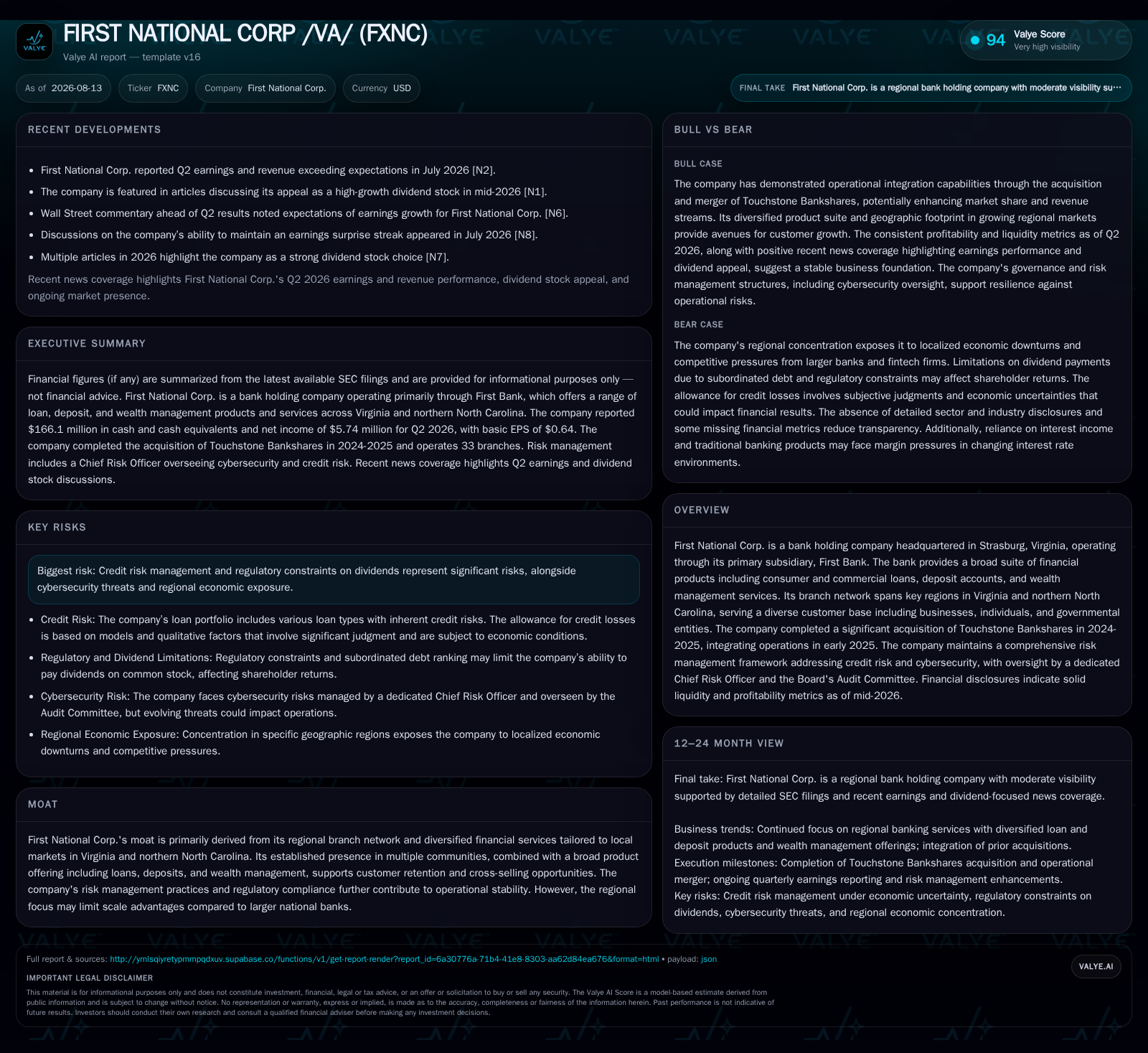
First National Corp (FXNC), operating primarily through First Bank, reported continued earnings strength in Q2 2026 supported by increased net interest income from its expanded loan portfolio and deposit base following the Touchstone Bankshares acquisition. The company maintains a diversified product mix that supports revenue resilience, encompassing consumer, commercial loans, and wealth management services across Virginia and northern North Carolina. Its regional branch network anchors customer retention and cross-selling, though scale limitations relative to larger banks remain. Credit risk management and regulatory constraints on dividends are key watchpoints, while growth opportunities lie in leveraging the acquired franchise and expanding fee income from wealth and treasury management.
Recent Operating Update: Q2 2026 Earnings Reflect Acquisition Benefits and Operational Stability
First National Corp reported strong earnings results for the quarter ended June 30, 2026, signaling progressive integration of its 2024-25 acquisition of Touchstone Bankshares. The consolidated net interest income improved reflecting both loan portfolio expansion and a stable deposit base across its regional footprint in Virginia and northern North Carolina [S2][N1]. This accretive performance was supported by measured net interest margin (NIM) expansion enabled by a favorable rate environment without material degradation in asset quality. Moreover, operating expenses appear controlled despite integration activities, signaling improving efficiency ratios.
Importantly, on August 12, 2026, the Board declared a $0.17 per common share quarterly cash dividend payable September 11, demonstrating continued focus on stable capital returns consistent with regional bank peer practices under regulatory capital scrutiny [S3]. This payout level suggests the company is balancing growth investments with shareholder distributions within permissible capital thresholds.
Business Model: Regional Banking with Diversified Financial Services and Localized Market Focus
First National Corp operates as a classic regional bank holding company via its main subsidiary First Bank. The bank’s business model relies heavily on generating net interest income from lending activities funded primarily through its deposit base. Its loan portfolio comprises consumer loans (including residential mortgages and home equity), commercial loans to small- and medium-sized enterprises (SMEs), and real estate-related credits tailored to its geographic markets [S2]. This diversity provides some insulation against sector-specific credit stress but also demands rigorous credit risk assessment.
Deposit products range from transactional checking accounts to time deposits like certificates of deposit (CDs) and savings vehicles such as money market accounts that constitute stable funding sources. Treasury management solutions target business customers requiring payment processing and cash management services.
Complementing traditional banking products are wealth management services involving estate planning, trust administration, investment asset management, individual retirement accounts (IRAs), and fiduciary activities. These fee-generating activities supplement interest income, improve revenue diversification, and deepen customer relationships — critical factors for sustaining margins amid competitive pressure.
The bank’s distribution strategy leverages a network of approximately 33 branches situated in economically significant corridors along Interstate highways I-81, I-64, I-66 across Virginia’s Shenandoah Valley, Roanoke region, Richmond metropolitan area, and northern North Carolina markets [S1]. This branch network fosters local engagement enabling direct customer acquisition alongside digital channels.
Industry Structure and Competitive Position: Regional Reach Amid Scale Limitations
Within the competitive landscape of regional banking where players such as First Commonwealth Financial (FCF), Capital Bancorp (CBNK), and Bankwell Financial Group (BWFG) operate similar footprint models, FXNC stands out due to its strategic acquisition which broadened geographic reach but still leaves it behind larger national banks in scale advantages.
The regional bank archetype invests intensively in enterprise risk management frameworks addressing credit underwriting discipline plus operational risks including cybersecurity defense — overseen independently by a Chief Risk Officer who reports quarterly to the Audit Committee of the Board of Directors [S1]. Such governance is increasingly vital given heightened cyber threats prevalent across the banking sector.
While FXNC exhibits strong community ties via localized branches enhancing loyalty and reducing attrition risks relative to non-branch competitors or fintech entrants reliant solely on digital interfaces, the relatively limited branch count constrains rapid scale-up possibilities without further acquisitions or organic expansion.
FXNC's integrated wealth management offerings differentiate it modestly within peer clusters skewed heavily toward pure lending-deposit models; however, non-bank financial services providers challenge this line of business's profit potential given their specialization.
Growth Drivers: Acquisition Synergies Plus Expanding Fee Income Streams
Strategic growth drivers for FXNC center on fully realizing synergies from its recent acquisition of Touchstone Bankshares by cross-selling into an enlarged customer base controlling multiple product categories. Loan growth is expected to benefit from incremental demand driven by regional economic development within its operating corridors.
Rising interest rates enhance net interest margins provided credit quality fundamentals hold steady. Fee income prospects also rise as wealth management activities gain traction alongside treasury service cross-selling to commercial clients adjusting their liquidity strategies amid dynamic market conditions.
Expansion opportunities remain in augmenting technology infrastructure to improve customer experience — particularly for digitally-enabled treasury services — enabling FXNC to compete more effectively both with larger institutions offering extensive omni-channel solutions and emerging fintech disruptors targeting niche banking segments.
Risks and Watchpoints: Credit Quality Vigilance and Regulatory Constraints
Credit risk remains a central vulnerability given exposure to local economic conditions. While non-performing loans have remained contained historically through conservative lending policies augmented post-acquisition credit reviews, any regional economic downturn could disproportionately impact loan performance metrics such as net charge-offs or provision for credit losses.
Regulatory constraints notably influence dividend policy since payout levels must align with tier 1 capital ratios prescribed under banking oversight regimes. Limits on dividend distributions applied during periods of capital tightening act as checks against excessive shareholder payouts potentially undermining balance sheet health [S1][S2].
Additionally, cybersecurity risks require persistent investment in defense mechanisms as FXNC confronts evolving threats that can disrupt operations or result in financial loss; existing governance structures provide reassurance but warrant ongoing vigilance.
The combined effect of these factors necessitates monitoring KPIs like non-performing loan ratio, loan-to-deposit ratio stability reflecting balanced funding mix, efficiency ratio trends evidencing cost control effectiveness post-acquisition integration, plus return metrics that indicate sustainable profitability under current economic conditions.
What to Watch Next: Execution on Integration Milestones and Capital Allocation Decisions
Investors should track updates on operational synergies realization from the Touchstone Bankshares merger via subsequent quarterly filings for evidence of further efficiency improvements or cost savings impacting the bottom line.
Loan origination volumes relative to deposit inflows will signal ability to grow core earning assets without excessive liquidity build-up; likewise, incremental fee income growth percentages will indicate success expanding ancillary revenue streams beyond traditional lending margins.
Capital allocation decisions including dividend sustainability or share repurchase activity will reveal board confidence in balance sheet strength vis-à-vis regulatory expectations. Additionally, any disclosures around technology investments or branch network adjustments provide insight into competitive strategic positioning amid evolving customer preferences.
Monitoring macroeconomic indicators affecting regional markets served by FXNC—such as commercial real estate cycles or employment trends—will contextualize credit quality developments pertinent to risk assessment frameworks highlighted in company filings.
Financial Profile Discussion
At June 30, 2026, First National Corp reported $166 million in cash equivalents against negligible total debt reported historically at around $6 million as of year-end 2013 figures; given available data suggests an overall net cash position strengthening liquidity coverage ratio fundamentals consistent with prudential banking standards [F1]
Capital adequacy remains sound though detailed tier 1 ratio figures are not disclosed here; continued prudent provisioning against credit risk shall support asset quality stability essential for enduring profitability.
Disclaimer: This report is an independent analyst summary intended solely for informational purposes based on publicly available SEC filings dated August 13, 2026 ([S1], [S2], [S3]), Nasdaq news releases ([N1]), and companyfacts data ([F1]). It does not constitute investment advice or research views regarding securities mentioned herein.
Disclaimer: This is research-only, informational analysis and not investment advice. It may include AI-generated interpretation and general industry context. Always verify important details using primary sources.

Comments