
DUKE Robotics Expands Regulatory Footprint and Executive Team Amid Commercialization Push
DUKE Robotics reports operational progress in drone infrastructure services and military technology development, emphasizing regulatory approvals and leadership enhancements.
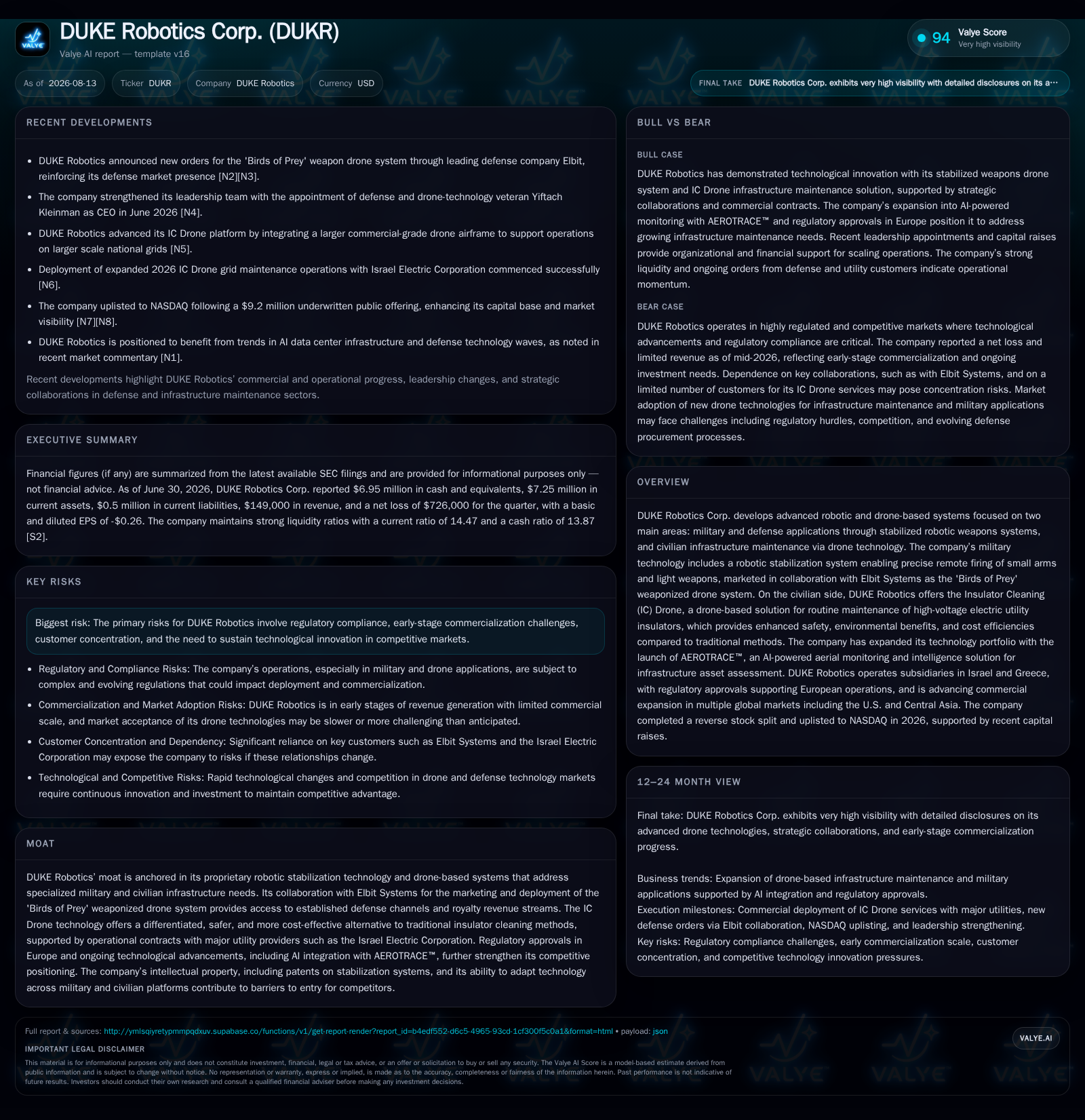
In its latest quarterly filing, DUKE Robotics demonstrated ongoing efforts to commercialize its dual-use robotic stabilization and drone systems, with notable regulatory advancements in Europe and expanded executive roles supporting future growth. The company faces classic early-stage risks around limited revenue, capital needs, and customer concentration but leverages a proprietary technology moat reinforced by collaboration with Elbit Systems. Its business model spans military weaponized drones and civilian infrastructure maintenance, relying heavily on regulatory certifications like the EU SORA process to unlock market access. Continued R&D investment and operational scale are key milestones to watch.
Recent Operating Update
DUKE Robotics Corp.'s latest Form 10-Q for Q2 2026 [S2] reveals stability in previously disclosed risk factors but significant internal developments intended to support scaling operations. The board approved an increase in monthly compensation for the CEO alongside elevating the CTO's role to full-time with a substantial pay raise and stock options [S2]. Such moves typically indicate management’s intent to reinforce leadership capabilities during early commercialization challenges. Additionally, director remuneration increases suggest efforts to attract or retain governance expertise.
No material operational breakthroughs were reported this quarter; however, prior event filings confirm steady advances such as receipt of the Hellenic Civil Aviation Authority’s operational approval through the Specific Operations Risk Assessment (SORA) process completed by January 2026 [S1][S4]. This milestone authorizes DUKE’s utility-focused Insulator Cleaning (IC) Drone operations within Greece under EU regulatory frameworks. The SORA certification is critical for expanding civil drone service offerings in Europe due to stringent aviation safety standards.
Business Model Overview
DUKE Robotics pursues a bifurcated business strategy targeting both military/defense markets via stabilized robotic weapon systems and civilian markets through industrial unmanned aerial systems (UAS), specifically drones for infrastructure maintenance [S1][S23].
The military segment features proprietary robotic stabilization technology enabling precise remote firing from unmanned platforms—marketed largely through a collaboration agreement with Elbit Systems under the "Birds of Prey" weaponized drone branding [S1]. This partnership serves as both a marketing channel into established defense procurement networks and a revenue conduit via royalties or licensing arrangements. Unlike traditional defense contractors that often rely on direct sales contracts with government entities, DUKE leverages Elbit's broader portfolio integration and sales infrastructure.
On the civilian side, DUKE offers the IC Drone targeted at electric utilities for high-voltage insulator cleaning—a hazardous task traditionally performed manually or by helicopters. The drone solution provides safer operation conditions alongside environmental benefits and cost reductions [S1][N2]. Complementing this is AEROTRACE™ introduced in February 2026, which integrates AI analytics with aerial data capture to enable enhanced asset monitoring for infrastructure operators [S14]. These products are primarily monetized through sales of drone units coupled with long-term service contracts encompassing maintenance and operational support.
Revenue generation therefore combines hardware sales (military robotics kits and drones) with post-sale service contracts and royalties/licensing from defense collaborations. Price/mix drivers include number of units sold per segment—the military unit sales dependent heavily on contract awards—and geographic expansion tied closely to regulatory approvals such as FAA or EU certifications that govern UAS commercial operations.
Industry Structure and Competitive Position
DUKE Robotics operates within the advanced robotics and unmanned systems industry characterized by high R&D intensity, complex regulatory environments, and a bifurcation between defense-focused players versus commercial drone manufacturers. Its intellectual property portfolio anchors a competitive moat concentrated in robotic stabilization—an area requiring precision engineering essential for effective remote-fire capability in military platforms.
Partnering with Elbit Systems situates DUKE favorably amidst well-established defense contractors competing against giants like Lockheed Martin or Northrop Grumman who offer extensive military-grade robotics but less focused small-arms stabilization modules. In civilian markets, DUKE competes against commercial UAS manufacturers like AeroVironment or DJI whose strengths lie in broad-based drone manufacturing but lack specialization in industrial maintenance verticals like insulator cleaning.
Regulatory certification status differentiates players operating cross-border civil drone services; DUKE's successful SORA certification for Greek operations exemplifies crucial steps toward wider European access. Many peers remain challenged by fragmented regulations limiting scalable deployments.
The company's limited commercial scale (~$377K revenue recognized as of FY2025) reflects typical early-stage dynamics within this industry segment where lengthy qualification processes delay meaningful recurring revenue streams. A small current order backlog base combined with concentrated customers—government agencies for military technologies and select utility companies for civilian drones—heightens operational risk profiles.
Growth Drivers
Growth prospects center around escalating global defense budgets prioritizing unmanned technologies suited for remote warfare scenarios. DUKE's stabilized weapons platform aligns well with these macro trends given increasing investment by armed forces in remotely operated weapon systems today.
Civilian infrastructure demand grows as utilities seek safer cleaner technologies complying with enhanced environmental regulations. DUKE’s IC Drone targets this niche effectively by replacing labor-intensive manual methods prone to safety incidents.
AI integration as seen through AEROTRACE™ is pivotal—embedding advanced image processing enhances product differentiation relative to commoditized drones that only provide raw data capture without actionable insights [S14].
Regulatory acceptance notably impacts addressable market size; recent Greek approval indicates potential replicability elsewhere in Europe contingent on meeting similar safety standards [S4]. Further geographic expansion depends on obtaining equivalent authorizations from FAA or other aviation authorities.
Partnerships deepen distribution reach while reducing go-to-market costs—collaboration with Elbit Systems not only produces royalties but accelerates defense acquisition cycles leveraging Elbit's established reputation [S1].
Risks / Watchpoints
Ongoing funding needs present arguably the most salient near-term risk. Despite recent capital raises detailed historically [S6], current cash resources (~$6.95M as of June 2026) must underpin continued R&D investment plus commercialization expenses without assurance of break-even profit generation anytime soon [F1]. The company acknowledges substantial doubt about going concern status absent additional financing within twelve months [S1][S2].
Customer concentration remains significant; particularly government customers face budgeting uncertainties shaped by geopolitical events or policy shifts that may delay orders or reduce contract values unpredictably.
The evolving nature of the civilian IC Drone business model introduces execution complexities spanning regulatory compliance nuances to establishing scalable service infrastructures abroad [S1]. Competition from larger diversified vendors could pressure pricing power if scale economies are not achieved swiftly.
Intellectual property protections create barriers but also expose DUKE to patent contests or infringement claims common in militarized robotics sectors. Export control laws such as Israeli Defense Export Regulations impose constraints impacting international sales opportunities requiring thorough compliance vigilance.
Finally, talent retention strategies recently updated via executive compensation changes appear designed to counteract risks related to losing key technical leaders vital for sustaining innovation pipeline velocity required by rapidly advancing robotics fields [S2]
What To Watch Next
Key milestones will include verification of new contract awards especially following expanded market access post-SORA certification beyond Greece into other EU countries or potentially U.S. jurisdictions.
Tracking R&D spend as a percentage of revenue can signal investment intensity balancing innovation against resource constraints.
Monitoring backlogs and recurring service contract renewals will yield insights into sustainable revenue base formation beyond one-off hardware sales.
Capital raising activities or collaborations providing non-dilutive funding sources would be critical to prolong financial runway given current doubts over going concern status highlighted publicly [S1].
Executive leadership changes or strategic hires reflecting scaling organization robustness should also be digested considering their bearing on execution effectiveness.
Further technology integration success in AI-powered offerings like AEROTRACE™ could serve as differentiators driving new customer acquisition hence merit close observation.
Financial Profile Discussion
As of Q2 2026 ending June 30th, DUKE Robotics held $6.95 million in cash equivalents against modest current liabilities ($0.5 million), yielding a robust current ratio near 14.5 indicating liquidity adequacy at present [F1]. Reported total debt remains negligible ($5 thousand dating back multi-year), highlighting low leverage though reflecting reliance solely on equity-based financing sources thus far rather than bank debt structures [F1].
Revenues remain limited historically ($377K reported as of calendar year-end 2025) while net losses reflect heavy operating investments consistent with early commercialization stages [F1]. The negative operating income (~$-1.2 million) underscores ongoing expense absorption ahead of scalable top-line growth.
The company explicitly states continuing material uncertainty about its ability to fund operations beyond twelve months without fresh capital infusions [S1][S2], underscoring critical watchpoints around fundraising success aligned directly with technological development timelines and order intake improvements.
This analysis focuses strictly on publicly disclosed facts without offering investment advice or speculative forward-looking claims about DUKE Robotics Corp.'s prospects. All statements are grounded in available SEC filings dated through August 13, 2026 ([S1],[S2],[S3],[F1]) complemented by structured sector-normalized framing from robotics industry knowledge layers.
Disclaimer: This is research-only, informational analysis and not investment advice. It may include AI-generated interpretation and general industry context. Always verify important details using primary sources.

Comments