
Adia Nutrition Targets Stem Cell Therapy Growth Amid Regulatory and Liquidity Challenges
Adia Nutrition reemerged from dormancy to build a regenerative medicine platform integrating FDA-registered biologics and clinical services with focus on scalable autologous stem cell therapies.
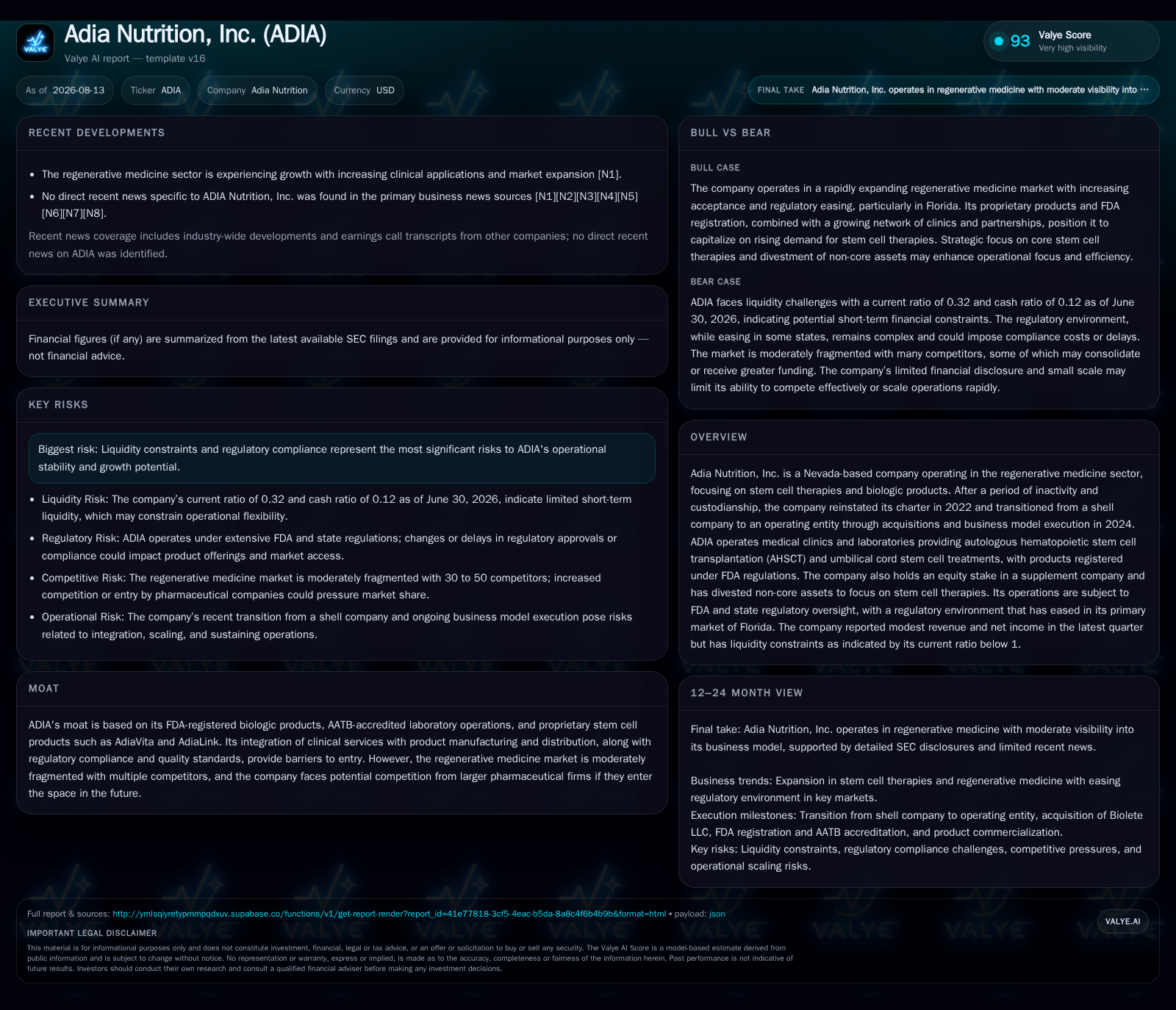
After reinstating its corporate charter in 2022, Adia Nutrition shifted from shell status to operating company in 2024 through acquisitions in the regenerative medicine sector. The company now operates clinics and laboratories delivering autologous hematopoietic stem cell transplantation (AHSCT) and umbilical cord stem cell treatments backed by FDA-registered biologic products and accredited labs. While the regulatory environment in Florida is easing, Adia faces significant liquidity constraints and market acceptance risks amid moderate sector fragmentation. Success hinges on replicating its clinical model across facilities, navigating reimbursement uncertainty, and progressing proprietary product development.
Recent Operating Update
This quarterly disclosure follows the pivotal company reset outlined in the March 31 annual filing where ADIA detailed its reinstatement from custodial dormancy to an operational regenerative medicine platform via acquisitions that established clinics offering autologous hematopoietic stem cell transplantation (AHSCT), umbilical cord stem cell treatments, and manufacturing/distribution of FDA-registered biologic products like AdiaVita [S1]. The transition from shelved entity to service provider signifies the company's commitment to building a vertically integrated regenerative healthcare model.
Business Model Overview
Adia Nutrition’s business architecture centers on blending clinical services with proprietary biologic product development. Their core offerings include personalized stem cell therapies administered through owned medical clinics staffed by trained professionals who execute AHSCT procedures alongside umbilical cord stem cell treatments designed to address chronic or degenerative conditions [S1]. This clinical foundation is augmented by FDA-registered biologic products manufactured in AATB-accredited laboratories—a status that denotes adherence to stringent standards for cellular therapy materials—such as their proprietary AdiaVita and AdiaLink lines.
The revenue model is multifaceted: primarily driven by fees for medical procedures and patient treatments conducted onsite at Adia Med facilities; additionally supplemented by sales of proprietary biologics distributed through controlled channels; with some diversification via strategic equity interests in related supplement suppliers. Unlike conventional pharmaceutical sales driven heavily by payor reimbursements or insurance payments, ADIA's clinical revenues currently rely substantially on out-of-pocket payments bolstered through direct marketing tactics including word-of-mouth referrals, seminars educating potential patients on alternative regenerative options, and repeat treatment protocols fostering patient retention [S1]. The model’s replicability across additional geographic locations presents scalability prospects contingent on successful clinic launch execution and localized regulatory compliance.
Industry Structure and Competitive Positioning
Operating within the regenerative medicine space situates ADIA at a nexus combining evolving clinical modalities with complex regulatory frameworks predominantly governed by the U.S. Food & Drug Administration for cellular and tissue-based products (HCT/Ps). Their focus on autologous stem cells distinguishes them from allogeneic-based competitors but also confines growth to specialized treatment niches often requiring bespoke laboratory processing supported by AATB accreditation—a competitive barrier given the capital intensity and expertise demands.
The market remains moderately fragmented with multiple small-to-mid sized clinics vying alongside emerging biotechnology firms developing novel cellular therapies. While ADIA’s possession of FDA-registered biologics confers an important structural moat protecting product legitimacy, broader market acceptance hinges on overcoming skepticism towards alternative medicine approaches prevalent among paying patients and mainstream providers alike. Additionally, reimbursement ambiguity—stemming from lack of standardized insurance coverage for many regenerative treatments—introduces demand-side uncertainty that can cap customer acquisition pace absent legislative or insurer policy shifts.
Pharmaceutical corporations eyeing regenerative medicine add potential future competitive pressure given their deeper pockets for R&D investment and ability to scale product launches rapidly once clinical validation occurs. Moreover, ADIA must maintain strict regulatory compliance across federal and Florida state authorities to preserve licensure advantages newly enabled by local easements in oversight requirements [S1].
Growth Drivers
Key internal growth catalysts include expanding clinical volumes via increased patient throughput and higher treatment frequency per patient achieved through repeat engagement strategies. Operationally this requires driving up clinic utilization rates while replicating successful clinic openings beyond Florida to other states receptive to regenerative therapies. The inherent replicability of ADIA’s business model provides a structural lever if capitalized effectively.
On the product side, accelerating development pipelines that progress proprietary biologics towards further FDA clearances enhances commercial defenses against generic-like competition while enabling premium pricing opportunities. Furthermore, forming partnerships with research institutions or strategic pharma buyers could unlock licensing revenue or co-development deals.
Externally, growth is driven by increasing prevalence of chronic diseases amenable to stem cell intervention amidst aging populations alongside growing consumer appetite for alternative health interventions validated through improved data transparency initiatives. Regulatory easing at state levels improves market access while consumer education campaigns foster broader awareness—critical when introducing relatively novel therapeutic categories that require overcoming entrenched skepticism.
Risks and Watchpoints
Liquidity constraints present immediate operational risk; current assets fall significantly short relative to liabilities indicating potential cash flow pressures if revenue growth stalls further or unexpected costs arise [F1]. Successful capital raising or restructuring would be essential to sustain runway.
Regulatory compliance remains an ongoing hurdle with any misstep potentially resulting in license revocation or onerous corrective measures affecting both clinical operations and biologic product manufacturing fidelity. Moreover, failure to demonstrate convincing safety/efficacy profiles at scale may impede broader market acceptance.
Market adoption risks persist given that regenerative therapies often fall outside conventional insurance reimbursement frameworks causing out-of-pocket cost barriers for patients—limiting volume growth without policy changes.
Competition from better-funded biotech or pharmaceutical entrants could compress pricing or dilute mindshare especially if they introduce faster-to-market or perceived safer alternatives.
Operationally, successful replication across new facilities depends on talent recruitment aligned with specialized scientific skills plus maintaining standardized quality across decentralized sites—a nontrivial managerial challenge.
What To Watch Next
Analysts should monitor announcements regarding additional FDA clearances beyond existing registered biologics which would validate pipeline progression. Increases in clinic count or expansion announcements provide tangible evidence of scaling efficacy. Quarterly updates showing improved patient volume metrics or higher treatment revenue per patient would confirm traction.
Liquidity improvement via financing activity or expense rationalization will be critical signals reflecting sustainability intentions. Market access evolution including insurer stance shifts or legislative amendments impacting reimbursement policies also merit close attention due to direct demand implications.
Progress reports relating to proprietary products like AdiaVita could expose potential inflection points either accelerating top-line momentum or signaling development setbacks.
Financial Profile Discussion
As of June 30, 2026, companyfacts shows Adia Nutrition holds cash and equivalents of approximately $128K against current liabilities of about $1.06 million, resulting in a current ratio of 0.32, indicating significant liquidity constraints [F1]. Revenues reported at calendar year-end 2025 totaled about $700K with operating losses near $366K and net losses around $395K, reflecting the early commercialization stage typical for firms transitioning from development to active service delivery [F1].
Capital expenditure levels were not explicitly detailed recently but expected to remain elevated given requirements tied to laboratory accreditation upkeep plus new clinic openings critical for scaling growth trajectories established post-2022 recovery phase [S1], [S2].
Overall financials depict a company early in its lifecycle attempting to solidify recurring topline revenues amid difficult cash flow environments compounded further by high upfront costs intrinsic to regulated biologics production plus clinical operations integration common within regenerative medicine incumbents.
Disclaimer: This is research-only, informational analysis and not investment advice. It may include AI-generated interpretation and general industry context. Always verify important details using primary sources.

Comments