
Owlet’s Subscription Strategy and Hardware Sales Fuel Q2 Momentum Amid Profitability Challenges
Owlet's latest quarterly filing reveals progress in blending device sales with subscription growth, while net losses persist amid solid liquidity.
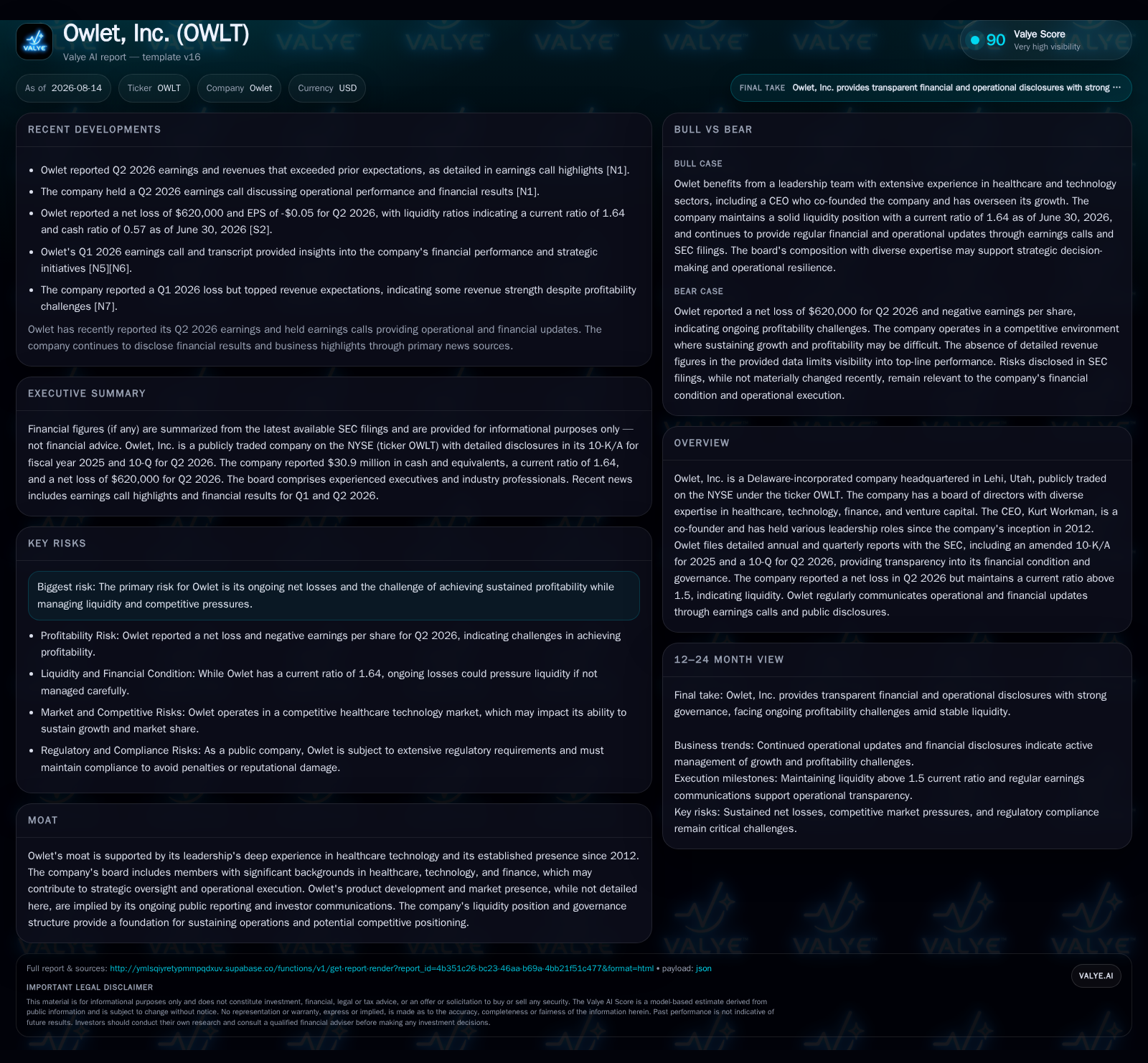
In Q2 2026, Owlet, Inc. demonstrated ongoing operational execution with increased hardware sales complemented by expanding subscription services, contributing to a diversified revenue base. Despite beating revenue estimates, the company continued to report net losses, highlighting the challenge of scaling profitability within the consumer health technology sector. Maintaining a healthy current ratio of 1.64 and $30.9 million in cash underscores Owlet’s liquidity position as it navigates competitive and regulatory pressures. Key near-term focus areas include subscriber retention, product innovation pace, and managing customer acquisition costs.
Q2 Operating Results Reveal Evolving Revenue Mix and Profitability Challenges
Owlet’s Q2 2026 results from its August 14 filing underscore a nuanced operational profile driven by direct-to-consumer hardware sales paired with an expanding subscription business [S2]. The company reported an operating loss continuing near $8.26 million for the quarter [F1], reflecting persistent profitability pressures common in the consumer health technology devices space where upfront hardware costs can constrain margin expansion early in the product lifecycle.
Owlet enters Q3 2026 equipped with approximately $30.9 million cash on hand supported by current assets totaling $88.3 million against current liabilities of $53.8 million yielding a current ratio near 1.64 according to latest SEC data [F1]. Total debt remains modest at roughly $2.11 million measured against cash reserves resulting in net cash positioning conducive to incremental borrowing capacity if warranted [F1]. This liquidity position affords necessary capital runway during negative operating income hovering around -$8.26 million per quarter based on annualized extrapolation from recent data points [F1].
The interplay between device unit sales — where Owlet markets wearable baby health monitoring sensors directly largely via e-commerce channels — and growing subscription attachment rates frames the company’s evolving revenue mix. Each hardware sale typically seeds potential recurring monthly revenue streams via software-based health monitoring analytics sold on a subscription basis [S1]. This hybrid model aims to blend immediate device sale cash flow with longer-term recurring revenue that could improve gross margins over time.
Owlet’s Dual Revenue Engine: Hardware Sales Paired with Subscription Services Dynamics
Owlet’s business model is emblematic of consumer health tech companies integrating connected wearable devices with mobile health apps delivering real-time data analytics and alerts [S1]. Revenue accrues primarily through direct purchases of proprietary sensor-equipped wearable monitors targeted at parents to track infant vitals including oxygen levels and sleep patterns, complemented by optional subscription plans that provide enhanced data insights, notifications, historical trends, and expert content.
Key operating KPIs driving this model include device unit sales growth – which expands the installed base eligible for subscriptions – alongside attachment rate (percentage of device users who adopt subscriptions) and churn rate impacting monthly recurring revenue (MRR) stability [S2]. Owlet’s filings suggest ongoing efforts to accelerate user engagement through software platform enhancements while managing customer acquisition efficiency within marketing budgets [S1]. These dynamics are critical given the cost-sensitive nature of consumer discretionary spending on infant care products.
The product lifecycle stage also influences margin profiles; new product launches leveraging next-generation sensor technology can command premium positioning but often incur upfront R&D costs delaying profitability improvements. As seen in comparable firms like Fitbit or Withings historically, successful transition from hardware-focused sales toward SaaS-like recurring income is key to unlocking durable margin expansion.
Competitive Landscape Anchored by Subscription Retention and Cost Efficiency Metrics
Within the consumer wearable health device sector, Owlet competes indirectly with entities such as Fitbit (now part of Google), Withings, Garmin, Philips, and specialized firms like ResMed that have established subscription ecosystems attached to their hardware offerings. While these peers vary in target demographics and medical focus, all face similar challenges around balancing sizeable upfront costs of device manufacturing against subscription retention economics.
Retention metrics—especially churn rates—strongly impact lifetime customer value (LTV) calculations that underwrite acceptable customer acquisition cost (CAC) thresholds. Owlet appears focused on improving these metrics through software updates, loyalty incentives, and expanded digital content aimed at boosting engagement within its parent-focused user base [S2]. However, consistently high CACs relative to ARPU remain an industry-wide pressure point that necessitates disciplined marketing spend management.
Such competitive pressures are compounded by brand trust factors especially relevant in infant monitoring products where product safety claims undergo heightened scrutiny from consumers and regulators alike. Hence, Owlet’s integration of sensor accuracy with timely alerting capabilities forms a core part of its value proposition differentiating it within this niche while underpinning subscription service relevance.
Growth Catalysts: Innovation Pipeline and Expanding Consumer Health Awareness
Several macro trends underpin Owlet’s medium-term opportunity set. Rising parental awareness around infant health combined with broader societal interest in personal health tracking fuels demand for advanced connected health devices suitable for home use [S1]. Additionally, technological advances in low-power wireless communication standards coupled with miniaturized sensor technology enhance potential for more sophisticated yet user-friendly devices entering the market.
The expanding adoption of telehealth services provides further tailwinds by normalizing remote patient monitoring tools across demographics including pediatric care settings. As healthcare providers explore digital partnerships or data integration opportunities with consumer device makers like Owlet, this could open complementary B2B channels beyond primary direct-to-consumer sales.
The mobile app ecosystem also plays a pivotal role by driving continuous user engagement post-device purchase through features such as personalized insights or community forums—a critical retention lever supporting sustained subscription conversions [S1]. This aspect aligns Owlet closer to platforms exemplified by Withings or ResMed which blend hardware functionality tightly with cloud-based health analytics.
Risk Signals: Regulatory Compliance, Product Safety, and Market Competitiveness Pressure Points
Operating in an intersectional space covering consumer electronics fused with medical-grade monitoring brings inherent regulatory complexity. Owlet must adhere strictly to FDA guidelines due to its medical claims linked to infant vital sign monitoring as well as US consumer product safety standards [S1]. Any delays or failures in regulatory clearance could materially disrupt product launch cadence or trigger costly recalls impacting brand reputation.
Product liability risks also loom large given the sensitive demographic targeted; adverse events or perceived reliability issues could spur litigation or negative publicity damaging adoption momentum [S1]. Furthermore, elevated customer acquisition cost trends combined with the necessity to maintain low subscription churn present financial hurdles constraining path toward sustainable profitability.
Supply chain disruptions—commonplace in tech manufacturing today—pose additional operational risks affecting inventory availability crucial during peak seasonality periods impacting device sales volumes. Competitive pressure from incumbents supported by larger scale or deeper pockets adds another layer requiring Owlet to continuously innovate both hardware design and software functionality to preserve market share.
Key Questions Ahead: Tracking New Product Timelines, Subscriber Trends, and Cash Flow Targets
Looking forward into late 2026 and beyond, key milestones signaling execution success will be tied closely to the timing and reception of new product introductions hinted at in earnings commentary but not explicitly detailed in filings [N1][N2][S2]. Accelerating time to market for next-gen sensors or augmented mobile app capabilities could enhance differentiation versus competitors.
Additionally, subscriber metrics demand close monitoring: upward shifts in MRR growth coupled with stable or declining churn would validate improvements in user engagement efficacy while supporting incremental margin benefits. Conversely higher CAC relative to subscriber gains would warrant scrutiny questioning scalable marketing effectiveness.
On the cash flow front, bridging persistent net losses without deteriorating liquidity requires prudent operating leverage management likely involving balancing R&D investment pacing against achievable revenue ramp targets [N1][S2]. Investors should watch upcoming quarterly disclosures for incremental signs of narrowing loss trajectories coupled with adjusted marketing spend effectiveness metrics
Financial Profile Discussion: Assessing Liquidity, Net Loss Trajectory, and Capital Resources
Owlet enters Q3 2026 equipped with approximately $30.9 million cash on hand supported by current assets totaling $88.3 million against current liabilities of $53.8 million yielding a current ratio near 1.64 according to latest SEC data [F1]. This relatively comfortable liquidity position affords necessary capital runway amid negative operating income hovering around -$8.26 million per quarter based on annualized extrapolation from recent data points [F1].
Total debt remains modest at roughly $2.11 million measured against cash reserves resulting in net cash positioning conducive to incremental borrowing capacity if warranted [F1]. Sustaining operations through continued investment cycles will depend on achieving improved gross margins via recurring revenue leverage alongside tightening control over sales & marketing expenses which historically dominate expense ratios in this subsector [S1].
Owlet's latest quarterly disclosures reveal an evolving business balancing rapid innovation-driven hardware rollout alongside growing software-enabled subscription revenues reflective of wider consumer health technology trends rooted in connected wearables. The coming quarters will test management’s ability to convert subscriber growth into durable cash flow improvements while capitalizing on tailwinds tied to telehealth expansion and heightened parental health awareness.
Disclaimer: This is research-only, informational analysis and not investment advice. It may include AI-generated interpretation and general industry context. Always verify important details using primary sources.

Comments