
QXO’s Scale and Technology Drive Building Products Distribution Expansion Amid Supply Chain Risks
QXO, Inc. advances its position as the largest publicly-traded building products distributor through strategic acquisitions, technology investments, and operational initiatives.
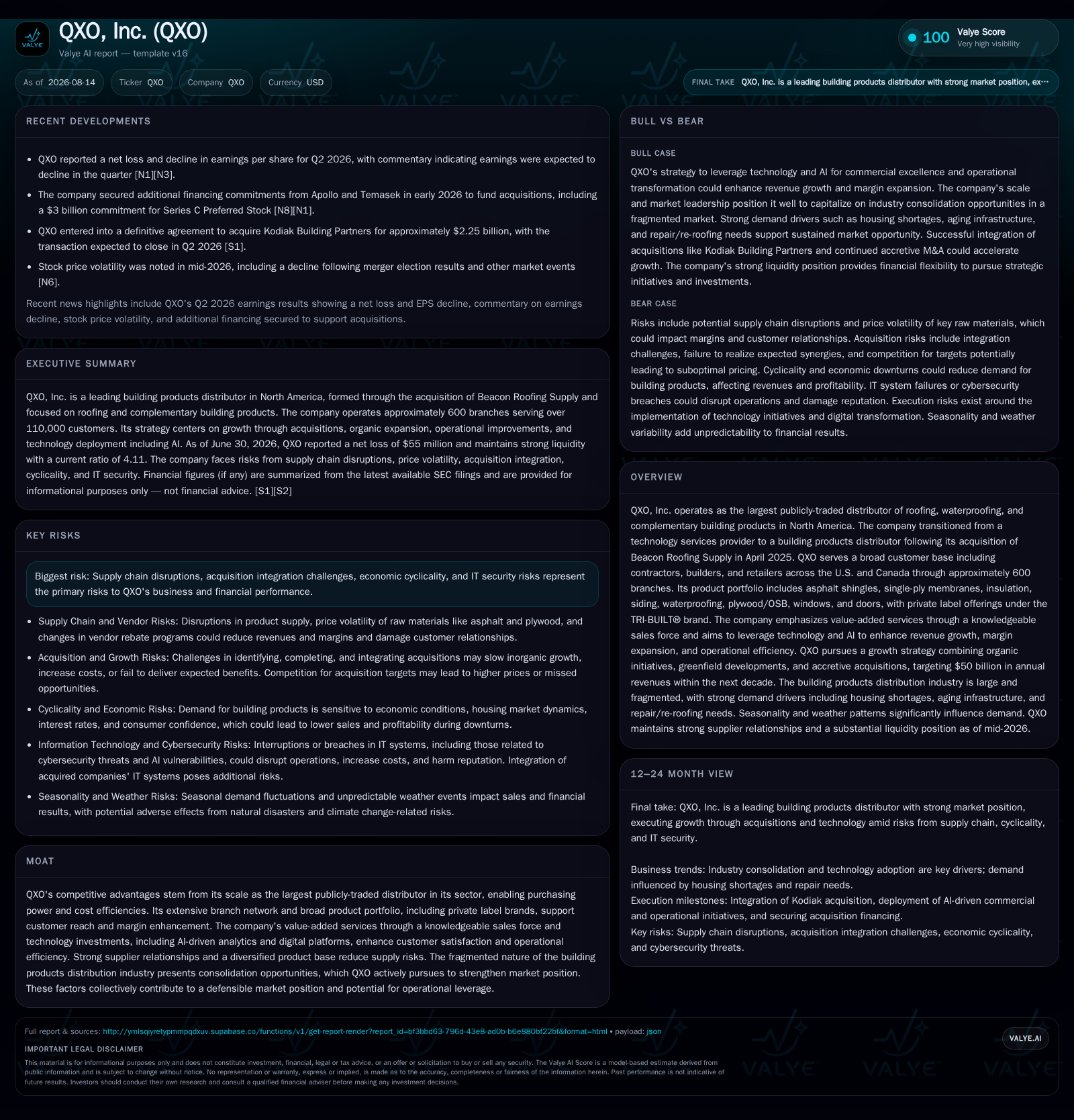
QXO, Inc.’s recent quarterly update highlights continued integration of the Beacon Roofing acquisition and further consolidation with TopBuild, reinforcing its scale in North American roofing and complementary building material distribution. The company’s business model relies heavily on a vast branch network, supplier relationships, private label products, and technology-enabled services to serve contractors, builders, and retailers. Industry dynamics favor growth through repair/remodel demand and infrastructure spending, while supply chain disruptions and commodity cost volatility present margin risks. QXO is actively leveraging AI and digital platforms to optimize inventory and salesforce productivity as it pursues organic growth alongside mergers and acquisitions.
Recent Operating Update: Expanding Scale Through Acquisitions
QXO’s latest quarterly filing dated August 14, 2026, provides critical insight into the company’s ongoing transformation from a technology services provider into North America’s largest publicly-traded distributor of roofing and complementary building products following its April 2025 acquisition of Beacon Roofing Supply [S2,S1]. With this acquisition now fully integrated as QXO Building Products operating approximately 600 branches across all U.S. states plus seven Canadian provinces, the company serves an extensive customer base exceeding 110,000 clients including contractors, builders, and retailers [S1]. In addition to Beacon Roofing, QXO closed on its transformative acquisition of TopBuild in July 2026—a strategic move that further consolidates its position in roofing distribution while adding scale in insulation and other exterior products categories [S3,S17,S23].
These milestones mark significant expansion steps within the fragmented $800 billion building products distribution sector where scale translates directly into purchasing power, broader product assortments, and enhanced operating leverage.
Business Model: Integration of Distribution Scale with Technology-Enabled Services
QXO generates primary revenue by acquiring building materials such as asphalt shingles, single-ply membranes, plywood/OSB, siding, waterproofing products, insulation, windows, doors—and reselling them through its expansive branch network primarily to contractors engaged in new construction or repair/remodel (R&R) projects as well as retail customers [S1]. The company’s private label brand TRI-BUILT® supplements third-party products providing margin enhancement opportunities through differentiated offerings.
The monetization dynamic depends on driving volume across branches with disciplined pricing responsive to raw material cost volatility—particularly notable in asphalt prices tied to oil—and balancing inventory breadth with turnover efficiency [S1,S2]. Salesforce expertise plays a vital role in customer service excellence that enables broad reach into both professional contractors requiring technical specification support and smaller remodelers dependent on availability.
Technology investments constitute a strategic pillar aiming at improving operational efficiency along multiple dimensions: AI-driven lead generation enhances customer prospecting; predictive analytics refine SKU-level inventory forecasting reducing stockouts or overstocks; route optimization software maximizes delivery fleet utilization; and digital sales channels expand customer access beyond traditional branch walk-in traffic [S1,S14]. These initiatives target both revenue growth acceleration beyond industry rates and margin expansion.
Industry Structure and Competitive Positioning
The building products distribution industry remains highly fragmented with a mix of national players like QXO (post-Beacon and TopBuild), regional distributors such as ABC Supply (a private competitor focused on roofing) or Builders FirstSource which operates broadly across building materials categories. The fragmentation persists because many dealers are local or regional specialists serving specific geographies or customer niches.
QXO differentiates through scale economies permitting negotiating leverage with suppliers who allocate limited materials during shortages considering volume commitments; this fosters favorable pricing terms that smaller distributors might not access [S1,S2]. Complementary product assortment breadth offers customers one-stop convenience which is increasingly valued given supply chain uncertainties. Their private label strategy adds resilience against brand-specific pricing pressures by capturing downstream margin.
Operating KPIs such as number of branches (~600), gross margin percentage uplift via private label penetration, sales per branch improvements driven by segment-specific salesforce coverage models; inventory turnover influenced by demand forecasting accuracy—serve as core metrics signaling competitive health.
Growth Drivers
Structural demand tailwinds underpin sustainable growth prospects for QXO. Notably:
- The U.S. housing supply shortfall estimated at roughly four million units underpins robust new residential construction activity supporting roofing product demand.
- Repair & remodeling (R&R) comprises approximately 80% of industry revenue according to QXO's filings; importantly 94% of R&R spend is considered non-discretionary due to weather damage or aging infrastructure requiring urgent roof repairs or replacements which supports stable baseline volumes even amid economic fluctuations [S1].
- Infrastructure investment requirements estimated at $2 trillion over two decades in North America incentivize refurbishment spending including waterproofing and siding upgrades.
- Weather event frequency quadrupling over two decades stimulates episodic surges in urgent roofing repairs boosting volumes beyond typical baselines.
- Continued M&A-driven industry consolidation provides inorganic growth avenues enabling scale expansion into adjacent categories like insulation or siding complementing core roofing exposure [S1,S14].
- Advances in AI technology adoption elevate operational capabilities—improving sales effectiveness through data-driven segmentation and pricing elasticity modeling enhancing both top-line consistency and gross margin recovery.
Risks and Watchpoints
Key risks remain significant:
- Supply chain interruptions represent a pervasive risk given three suppliers account for about 35% of total purchases exposing the company to allocation risks especially during unanticipated demand spikes or production disruptions driven by labor shortages or geopolitical events impacting raw material procurements such as asphalt or steel inputs [S1,S2].
- Price volatility linked primarily to commodity inputs like asphalt (oil derivative) poses recurring pressure on margins unless promptly passed onto customers; historic pass-through has been achievable but timing mismatches can cause temporary margin compression highlighting sensitivity to input cost fluctuations [S2].
- Acquisitions such as Kodiak Building Partners ($2.25 billion deal) financed partly with common stock create integration complexity risks including harmonizing operational systems or retaining key commercial relationships amidst change management initiatives which if mismanaged could impair expected synergies [S12,S22].
- Elevated leverage following large-scale deals increases financial flexibility constraints necessitating diligent cash flow management amid cyclical downturns potentially limiting investments or dividend policies [F1,S9,S12].
- Cybersecurity risks arise due to heavy reliance on digital platforms for predicting inventory demands and managing delivery logistics potentially exposing operations to disruptive attacks impacting fulfillment reliability [S7,S8].
What to Watch Next
Upcoming milestones include:
- Execution progress against integration plans for TopBuild post-July close including realization of anticipated cost synergies from overlapping facilities rationalization.
- Trajectory of AI system deployments targeting incremental improvements in inventory forecast accuracy measured by order fulfillment rates per SKU.
- Branch-level sales metrics capturing effectiveness of salesforce segmentation changes aimed at increasing penetration of complementary product lines like waterproofing or siding.
- Monitoring commodity input price trends especially asphalt prices relative to oil markets that will directly influence gross margin swings.
- Debt servicing capacity and interest coverage ratios reflecting impact of recent acquisitions on overall credit profile aligned against operating cash flow generation capacity.
- Competitive moves from private peers such as ABC Supply maintaining pressure on local market shares amidst consolidation waves.
Financial Profile Discussion
QXO’s balance sheet evidences strong current liquidity with $2.77 billion in cash & equivalents against $2.52 billion current liabilities yielding an exceptional current ratio near 4.11 as of June 30, 2026—a signifier of ample short-term solvency capacity supporting operational demands including working capital needs stemming from distribution activities requiring upfront inventory funding [F1]. Managing debt servicing commitments while maintaining free cash flow generation will be critical for sustaining investment flexibility amid cyclical construction spending patterns. The company's ability to optimize working capital—specifically inventory turnover improvements allied with vendor payment terms—will materially influence liquidity going forward.
This analysis synthesizes available SEC filings including the latest quarterly (8/14/2026), annual (2/27/2026), recent events reports (8-K filings), supplemented with valuation-relevant financial snapshot metrics. It clarifies how QXO's distinct transition toward large-scale building product distribution marries legacy tech capabilities with scale-dependent value-chain positioning within a structurally growing yet commodity-price-sensitive sector prone to consolidation dynamics. Continuous monitoring of supply chain conditions alongside integration execution will be crucial determinants of medium-term operating performance.
Disclaimer: This is research-only, informational analysis and not investment advice. It may include AI-generated interpretation and general industry context. Always verify important details using primary sources.

Comments