
Avnet’s Working Capital and Margin Gains Support Resilient Distribution amid Cyclical Demand
Avnet’s latest quarter reveals margin expansion and strong liquidity underpinned by financing flexibility and broad-based demand recovery.
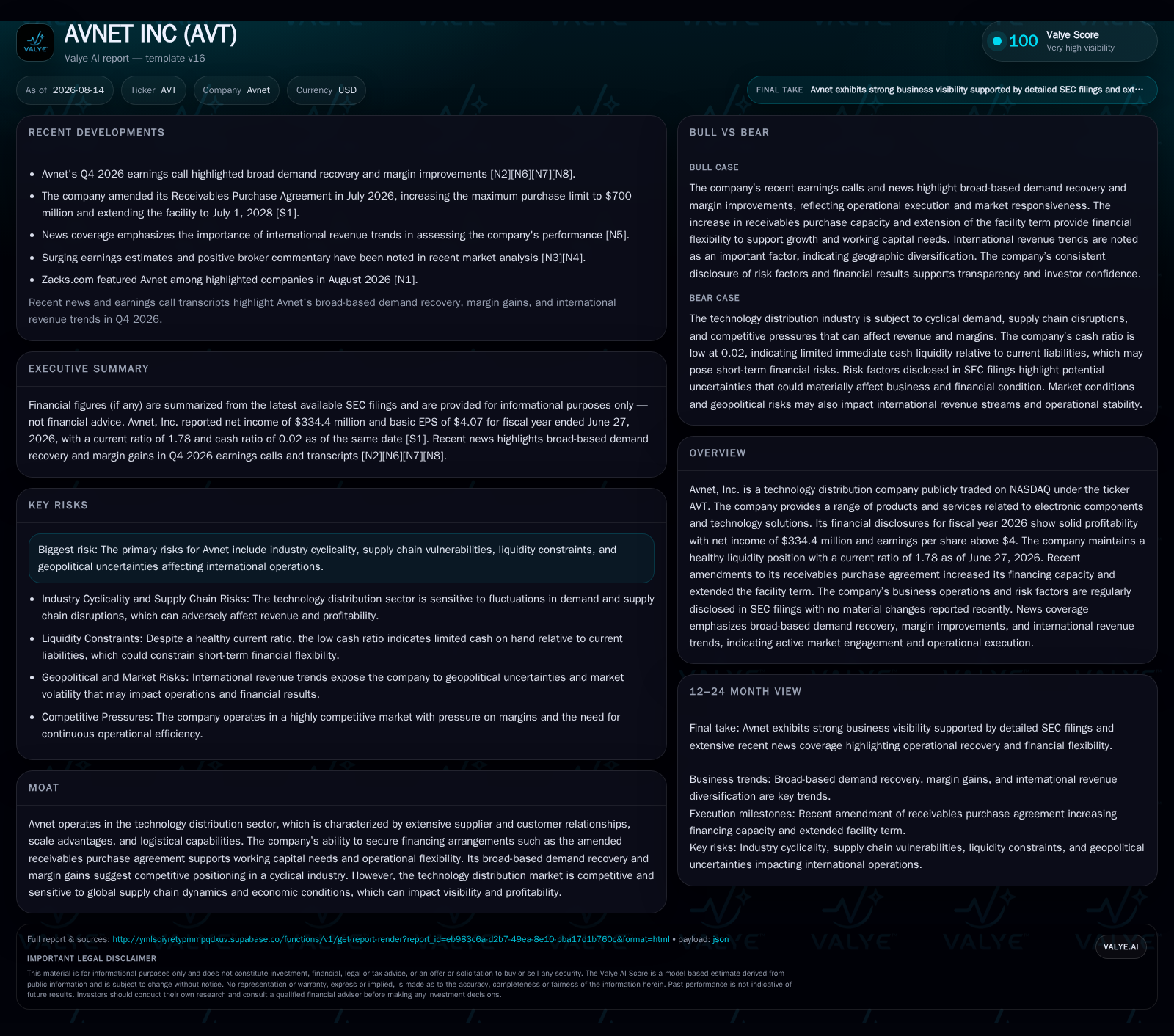
Avnet Inc. reported steady operational progress in its fiscal Q3 2026, highlighted by improved margins across global technology distribution channels and a healthy current ratio of 1.78 bolstered by an amended receivables purchase agreement. The company’s intermediary role connecting semiconductor and electronic component manufacturers to OEMs and contract manufacturers leverages scale advantages and value-added services like supply chain management and design support. While cyclical demand and supply chain volatility remain persistent risks, Avnet's financial flexibility and international growth position it well to capture underlying upswings in electronic components driven by emerging technologies such as IoT and 5G infrastructure. Ongoing focus on inventory turnover and working capital efficiency will be key to sustaining margin gains amid competitive pricing pressures.
Recent Operating Update
In its latest quarterly filing dated May 1, 2026, Avnet reported ongoing operational strength characterized by margin improvements driven by solid demand recovery across multiple markets served [S2]. This progress reflects positively on the company's ability to manage cost pressures while navigating a complex global supply chain environment. Additionally, an event filing from August 5, 2026 detailed enhancements to Avnet’s receivables purchase agreement — increasing its financing headroom and extending facility maturity — which underscores the firm's strategic focus on liquidity management [S3]. This development is crucial in an industry that demands tight working capital control due to volatile inventory cycles and customer payment terms.
Business Model Overview
Avnet acts as a pivotal intermediary within the technology distribution ecosystem, sourcing electronic components predominantly from semiconductor manufacturers and supplying them to original equipment manufacturers (OEMs), contract manufacturers, and other downstream technology producers [S1]. The company generates revenue primarily through resale of these components but supplements top-line growth with value-added services such as logistics optimization, supply chain management solutions, technical design support, and financing arrangements aimed at facilitating customer cash flow.
The complexity inherent in managing vast inventories of electronic parts—often subject to rapid obsolescence—places a premium on effective inventory turnover ratios and days sales outstanding (DSO) metrics. By maintaining strong supplier relationships alongside diversified end-user channels spanning industrial automation to telecommunications infrastructure, Avnet mitigates concentration risks inherent in the technology distribution sector. The added advantage of a receivables purchase agreement provides financial flexibility enabling Avnet to operate with lower funding costs than competitors that may rely heavily on traditional bank debt or slower cash conversion cycles.
Industry Structure and Competitive Positioning
Within the broader technology distribution industry—a space also occupied by Arrow Electronics and Tech Data—Avnet leverages scale advantages derived from its extensive supplier base and global logistics network [S1]. Its scale enables favorable negotiating leverage with manufacturers while service breadth enhances customer stickiness through integrated solutions beyond simple component resale.
This intermediary role is underscored by the industry's sensitivity to macroeconomic swings; technology distributors experience notable cyclical demand related to enterprise spending patterns on IT infrastructure upgrades or consumer electronics refresh cycles. Supply chain disruptions frequently impact distributors’ ability to fulfill orders promptly which can compress margins through expedited shipping costs or forced inventory markdowns. Avnet’s recently disclosed margin expansion suggests that it is managing these pressures better than some peers through disciplined pricing strategies coupled with operational efficiency gains.
Growth Drivers
Emerging technology trends represent substantive tailwinds for Avnet's core markets. The proliferation of IoT devices necessitates robust supply chains for numerous semiconductor components including sensors and connectivity chips. Similarly, advancements in automotive electronics fueled by electric vehicle adoption drive higher content per vehicle sourced via contract manufacturers supported by distributors like Avnet.
Additionally, rollout of expansive 5G infrastructure globally increases demand for network equipment that incorporates cutting-edge chips requiring complex logistics management—a service layer where Avnet's value proposition strengthens customer retention. The continuing trend towards outsourcing production amplifies reliance on contract manufacturers who prefer partners offering integrated inventory management combined with flexible financing options provided through receivables purchase agreements.
Geographic expansion into emerging markets further offers incremental revenue streams albeit with attendant geopolitical risk considerations addressed below. Improvements in digital tools for order fulfillment optimization also hold promise for enhancing order accuracy rates while controlling logistics costs tightly relative to sales.
Risks and Watchpoints
Avnet faces typical structural risks prevalent within the technology distribution sector: cyclical downturns reduce demand visibility leading to underutilized inventory or increased obsolescence charge-offs. Supply chain volatility caused by raw material shortages or transportation bottlenecks can elevate costs sharply or delay deliveries jeopardizing customer relationships.
Beyond operational execution risks lie financial risks associated with credit exposures to customers during downturns; however, enhanced financing arrangements help offset liquidity strains [S3]. Foreign exchange fluctuations alongside geopolitical tensions complicate international sourcing strategies especially given Avnet’s global footprint outlined in filings [S1].
Intense price competition among distributors keeps upward pricing power limited despite some margin gains noted; thus continuous efficiency improvement is necessary to maintain profitability levels. Market adoption delays for new technologies can slow component uptake negatively impacting revenue growth expectations.
What to Watch Next
Key milestones include monitoring quarterly backlog trends signaling sustained order intake momentum post recent broad-based demand uptick [N4][N5]. Further amendments or renewals of receivables purchase agreements will indicate continued access to working capital flexibility crucial for operating cycle management.
Operational KPIs warrant close attention: inventory turnover ratios will reveal how effectively obsolete risk is managed amid fluctuating volumes; days sales outstanding measure credit collection efficacy directly tied to cash conversion cycle strength; operating income margins remain a barometer of pricing discipline versus cost inflation.
International revenue mix shifts amid unpredictable geopolitical environments must be tracked given their potential impact on overall results [N3]. Additionally, logistical cost pressure developments potentially related to fuel prices or transportation capacity constraints could influence net profitability.
Financial Profile Discussion
As of June 27, 2026, Avnet reported total debt near $3.23 billion alongside cash balances approximating $155 million resulting in net debt around $3.08 billion—a leverage position consistent with supporting a large-scale distribution operation requiring substantial working capital investment [F1]. The current ratio stands at a healthy 1.78 indicating sound short-term liquidity supported by expanded receivables financing facilities enhancing operational flexibility [F1][S3].
This analysis draws exclusively on disclosures within the latest quarterly (10-Q dated May 2026), annual (10-K August 2026), event filings (8-K August 2026), supported financial snapshot data as of June 27, 2026, along with relevant market commentaries focusing on operational performance trends without speculative forecasting. It is intended solely as an informational resource reflecting company fundamentals within the evolving technology distribution landscape.
Disclaimer: This is research-only, informational analysis and not investment advice. It may include AI-generated interpretation and general industry context. Always verify important details using primary sources.

Comments