
Broadway Financial’s Mission-Driven Model and Adjustable-Rate Strategy Underpin Resilience in Q2 2026
Broadway Financial's latest quarterly filing highlights the steady performance of its adjustable-rate loan portfolio paired with a community-focused deposit base, reinforcing its strategic resilience.
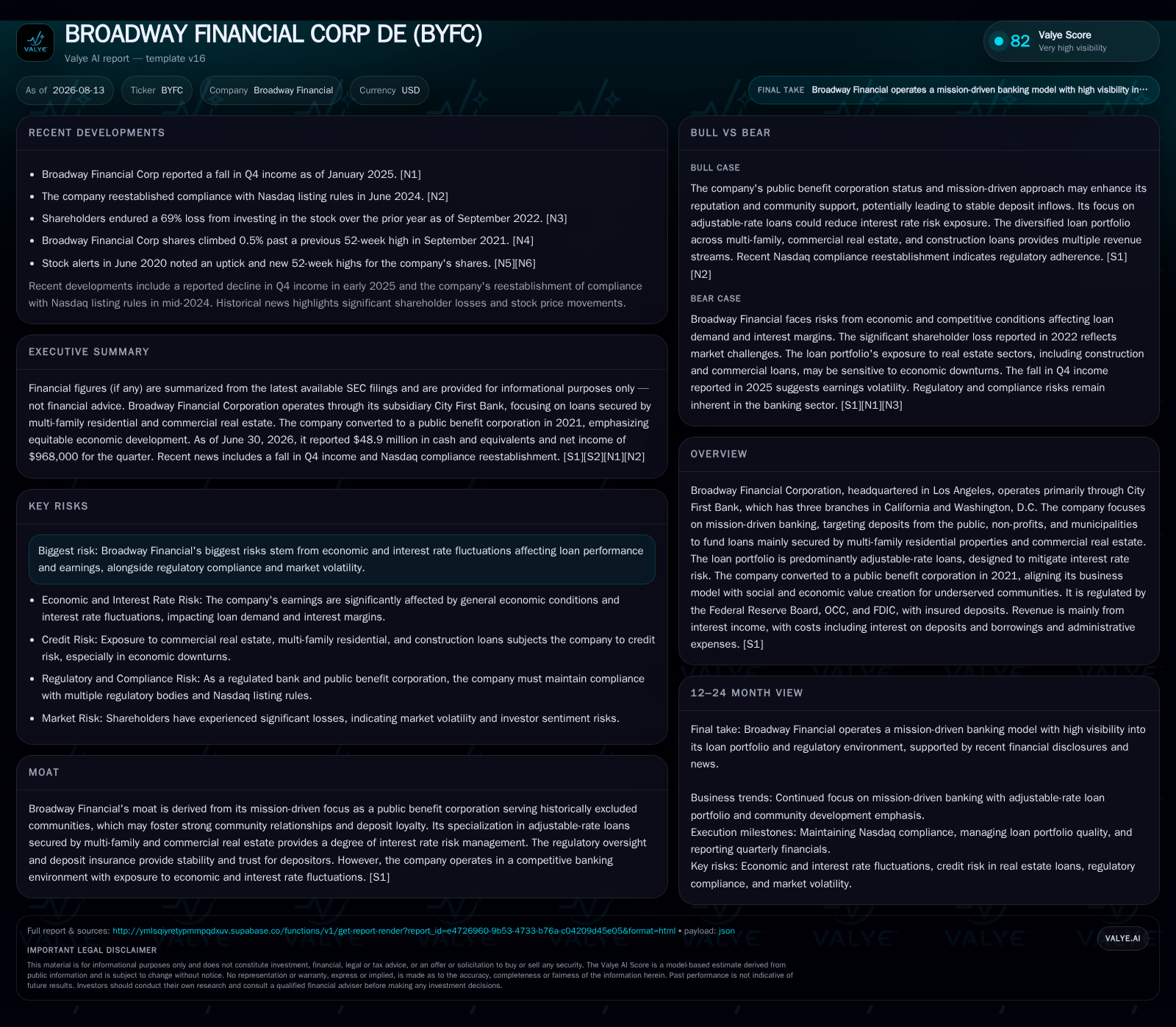
Broadway Financial Corporation continues to leverage its unique positioning as a public benefit corporation, focusing on adjustable-rate loans primarily secured by multi-family and commercial real estate. The company’s June 2026 quarterly report shows maintained portfolio composition and deposit stability amid competitive and economic challenges. Its emphasis on mission-driven banking supports loyal deposits from municipal and nonprofit clients, which enables measured funding costs relative to regional peers. Credit quality remains cautiously managed with ongoing monitoring of non-performing assets in its real estate-heavy loan book. Looking forward, the firm faces macroeconomic headwinds, regulatory oversight, and scale constraints but sustains multiple growth vectors tied to its social impact mission.
Q2 Operational Update Highlights: What Shifted in Loan and Deposit Trends?
The August 2026 Form 10-Q highlights Broadway Financial's continued commitment to an adjustable-rate loan portfolio structure with over 82% of loans bearing repricing features as of year-end 2025 [S1]. Although some loans are in initial fixed-rate periods or subject to floors, this approach significantly buffers the bank against wholesale interest rate risk in volatile environments. The loan composition remains focused on multi-family residential properties and commercial real estate concentrated in the bank’s geographic markets of Southern California and Washington D.C., consistent with prior disclosures [S1][S2]. Deposits continue to be sourced primarily from retail customers, large nonprofits, municipalities, and community-minded depositors attracted to Broadway's public benefit model. While exact figures for loan growth or deposit increases during Q2 were not explicitly detailed in the latest filing [S2], the absence of material shifts signals stable fundamentals amidst challenging macro conditions.
Mission-Aligned Lending Model: Revenue Drivers and Interest Rate Risk Management via Adjustable Loans
Broadway Financial generates revenue chiefly through net interest income derived from its lending activities centered on adjustable-rate commercial mortgages and multi-family housing loans [S1]. This structural choice mitigates risk exposure typical for fixed-rate portfolios by enabling periodic repricing aligned with market rates. The bank's mission-driven status as a Delaware public benefit corporation integrates social impact criteria into lending decisions, fostering a loyal borrower base focused on underserved communities [S1]. This alignment potentially enhances credit retention and reduces customer acquisition costs relative to conventional banks lacking such a mandate. Moreover, the hybrid nature of these loans—with initial fixed periods transitioning to adjustable rates—helps balance income predictability with responsiveness to interest rate changes.
Community-Centric Deposit Base: Stability Factors and Funding Cost Considerations Compared to Peers
Broadway's deposits principally come from individuals, municipalities, and nonprofits committed to the bank's social mission footprint in Los Angeles and Washington D.C. Such clientele tends to exhibit lower deposit beta — meaning their deposits are less sensitive to rising market interest rates — helping keep funding costs manageable even when baseline interest rates rise [S1][S2]. While Broadway operates just three branches limiting physical scale compared to larger regional banks like East West Bancorp or First Republic Bank, its niche community focus appears to bolster depositor loyalty amid competition from national institutions [S1]. All deposits are FDIC insured up to statutory limits which adds a layer of depositor confidence critical during times of market volatility [S1]. However, a relatively smaller network may constrain rapid deposit growth or diversification.
Navigating Credit Quality: Monitoring Non-Performing Assets in Real Estate-Focused Loan Portfolio
Broadway maintains vigilance regarding credit quality metrics as it lends heavily against multi-family residential and commercial real estate collateral [S1][S2]. The adjustable-rate nature reduces duration risk but does not eliminate inherent credit risk from economic cycles or borrower defaults. The filings show no significant uptick in non-performing asset levels as of Q2 2026; however, provisions for loan losses remain important markers for absorbing prospective defaults. Given inflationary pressures that can stress borrowers’ cash flow—such as rising operating costs for tenants or developers—the company's proactive monitoring practices are crucial [S1]. The company also leverages regulatory CRE workout guidance frameworks to manage distressed loans prudently without immediately resorting to charge-offs [S1].
Emerging Risks: Economic Sensitivities, Regulatory Oversight, and Competitive Pressures in Market Footprint
Economic uncertainty remains a notable risk factor due to inflation-driven Federal Reserve interest rate hikes over recent years that have elevated funding costs industry-wide [S1]. Furthermore, geopolitical events present unpredictable financial market impacts that could affect borrower liquidity or investor sentiment. Regulatory burdens continue intensifying due to both bank supervision under the Federal Reserve (holding company level) and the OCC/FDIC (bank level), alongside compliance with Nasdaq listing standards [S1][S24]. Competition against larger institutions benefits from scale advantages in technology and marketing reaches but lacks Broadway’s differentiated impact-oriented branding targeting historically underserved neighborhoods.
Growth Vectors: Opportunities Aligned with Mission and Market Environment Constraints
The company’s growth strategy aligns tightly with expanding its portfolio of multi-family residential and commercial real estate loans within mission-served communities while fostering deep relationships with municipal and nonprofit sectors [S1][S3]. Cross-selling fee-based services is suggested but appears limited by overall scale factors. Given a modest branch network restricted largely to two California locations plus D.C., organic geographic expansion opportunities appear constrained relative to larger regional peers [S1]. Nonetheless, leveraging its status as a public benefit corporation facilitates attracting deposits from values-aligned customers potentially over competitors that do not emphasize social impact.
Markers to Monitor: Ahead on Earnings Guidance, Asset Performance, Deposit Trends, and Regulatory Developments
Looking forward into subsequent quarters post-June 2026 reporting cycle, key indicators include tracking any movements in net interest margin driven by loan repricing or deposit cost changes [S2][S3]. Close attention is warranted toward provision expense trends reflecting credit environment shifts especially concentrated in commercial/multifamily real estate segments. Deposit retention patterns will signal depositor loyalty amid macroeconomic uncertainty. Similarly, regulatory updates affecting capital requirements or compliance obligations could materially influence operational flexibility. Public disclosure cadence hints at ongoing quarterly updates without specific forward guidance issued [S2][S3].
Financial Profile Discussion
This report incorporates data extracted from SEC filings dated through August 13, 2026 ([S1], [S2], [S3]) alongside current balance-sheet snapshots ([F1]). It does not constitute investment advice but serves as an analytical overview based on publicly available documents.
Disclaimer: This is research-only, informational analysis and not investment advice. It may include AI-generated interpretation and general industry context. Always verify important details using primary sources.

Comments