
Atmospheric Water Generation Emerges as Inflection Point Acquisition Corp. III Leverages Proprietary Technology and Partnerships
Inflection Point Acquisition Corp. III’s recent quarterly filing crystallizes its operational shift post-SPAC merger, highlighting strategic technology deployment and commercial partnership traction in the atmospheric water sector.
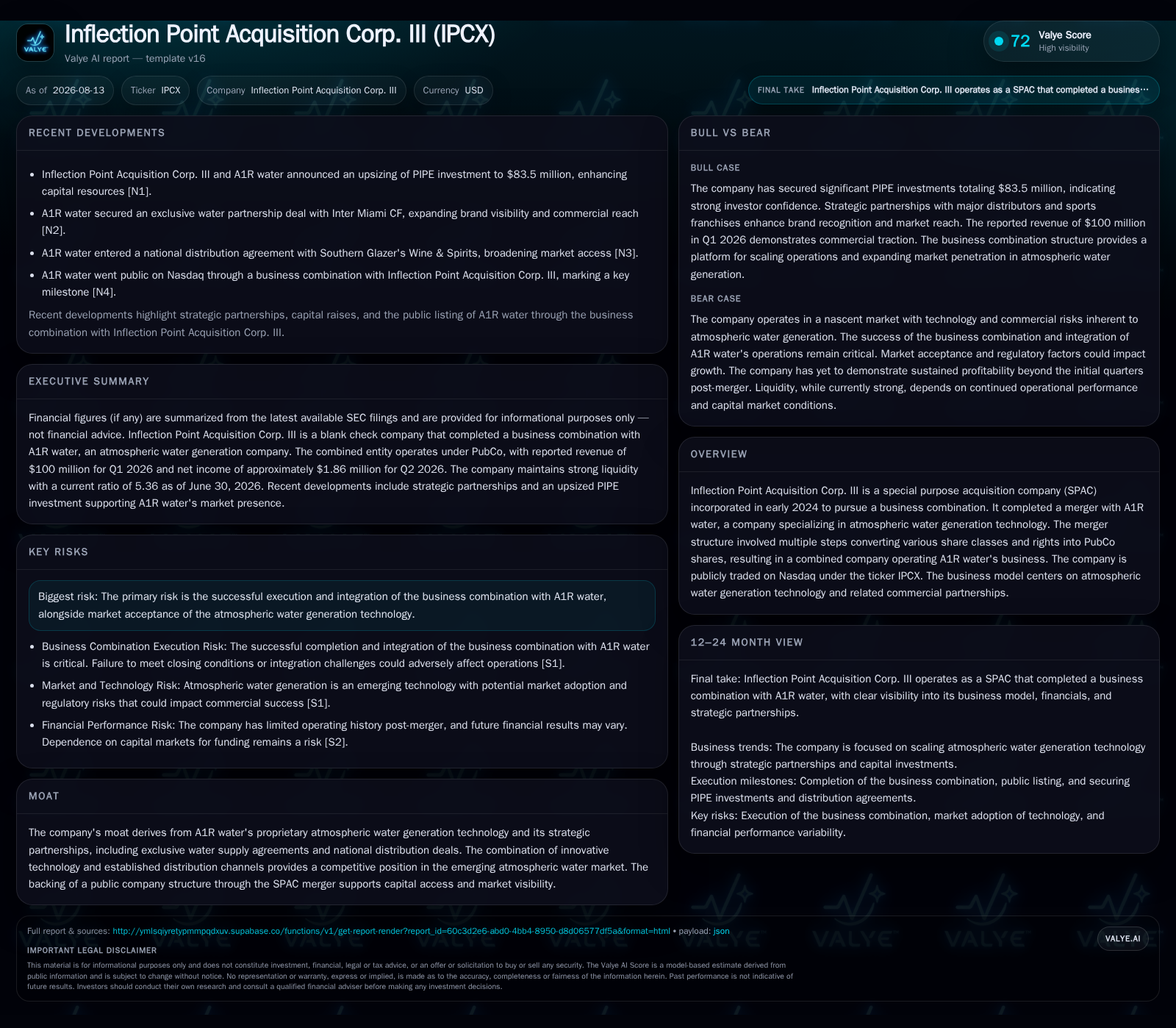
Following the completion of its multi-stage SPAC merger with A1R water, Inflection Point Acquisition Corp. III (IPCX) has transitioned from a blank-check vehicle into an operating company focused on proprietary atmospheric water generation technology. The August 2026 10-Q marks IPCX’s first detailed operational disclosure, underscoring the integration progress, governance structures protecting preferred shareholders’ rights, and initial commercial activity evidencing contractual revenue visibility. Positioned within an emerging cleantech niche that addresses global water scarcity through decentralized solutions, IPCX benefits from exclusive supply agreements and national distribution deals that could scale revenue amid advancing energy-efficient extraction technologies. However, risks remain around market adoption pacing and merger execution complexity. IPCX’s capital position remains sound, supporting ongoing product development and deployment efforts.
Quarterly Transition: From SPAC Formation to Operational Integration
Inflection Point Acquisition Corp. III (IPCX) marked a critical inflection point in its corporate life cycle with the August 2026 Form 10-Q filing detailing its formal transition from a special purpose acquisition company (SPAC) shell to an operational entity. Completing the business combination with A1R water—a developer specializing in atmospheric water generation technology—cemented this shift [S2][S3][S1]. The filing elucidates the complex share-class conversion mechanics effectuated during the merger, which consolidated various rights into public common shares, effectively giving rise to the current publicly traded operational firm listed on Nasdaq under IPCX.
From an operational perspective, the quarter shows early-stage integration results where IPCX begins deploying A1R’s proprietary atmospheric water generators commercially. While comprehensive deployment metrics remain limited at this nascent stage, the transformation unlocks key performance indicators such as the volume of units sold and contracted output that will inform revenue trends going forward. Governance-wise, recently enacted protections tied to Series A Preferred Shareholders heighten oversight over significant corporate actions—including liquidation or amendment of governing documents—requiring majority consent from preferred shareholders so long as they maintain at least 20% ownership post-merger [S3]. This establishes a protective buffer shaping future strategic flexibility.
Harnessing Proprietary Atmospheric Water Generation Technology for Market Differentiation
At the heart of IPCX’s operational identity lies A1R's proprietary atmospheric water generation technology designed to extract potable water directly from ambient air. This capability situates IPCX within a growing segment dedicated to decentralized solutions that address persistent global challenges in water scarcity by enabling on-demand clean water extraction without relying on traditional infrastructure or sources.
This technology advantage is foundational to IPCX’s positioning: it allows competitive differentiation by combining energy efficiency with scalable production of potable water units suitable for diverse customer profiles ranging from municipal providers to industrial users and potentially commercial consumers [S1]. This technological edge is expected to influence essential KPIs such as units of atmospheric water generators sold—which drives top-line growth—and contractually backed volumes of supplied water that underpin recurring revenues. The firm’s ability to maintain operational uptime at low maintenance costs will be pivotal in proving product reliability and driving adoption cycles.
Commercial Partnerships as Revenue Visibility Anchors
A notable strength identified in filings is IPCX’s strategic deployment of commercial partnerships including exclusive water supply contracts alongside national distribution agreements currently under implementation [S1]. These arrangements serve dual roles: they crystallize revenue streams by contracting defined volumes of supplied water—thus enhancing predictability—and facilitate broader geographic reach through established distribution channels critical for scaling deployments.
Such contracts are typical in this industry where long-term locked-in volumes not only stabilize cash flow but can also lower customer acquisition costs by leveraging existing relationships rather than building from scratch. This approach echoes practices seen among peers such as Watergen and Ecoloblue who supplement reactor sales with service contracts or supply agreements acting as recurring revenue pillars. Effective management of partner relations will track closely through metrics like number and scale of partnerships secured.
Competitive Landscape: Benchmarking Against Synthetic Technologies and Cleantech Peers
Within the atmospheric water generator manufacturing space, companies like Ecoloblue and Watergen exemplify product-market fit dynamics balancing technological sophistication with accessible deployment models. Unlike higher-scale municipal or industrial operators such as Xylem or Pentair—whose focus includes filtration and integrated purification systems—IPCX leans heavily on innovative extraction hardware melded with commercial contract models.
Given IPXC’s genesis from a SPAC merger structure akin to other cleantech firms accessing public capital markets recently, parallels emerge regarding funding intensity required for manufacturing scale-up, installation lead times driven by production capacity constraints, and regulatory navigation applicable across jurisdictions dealing with potable water safety standards. Unlike some peers entrenched in longer procurement cycles typical within municipal contracts, IPCX benefits from embedded national deals providing a quicker ramp potential but must still contend with execution risks inherent in new technology rollout.
Growth Catalysts: Market Drivers Supporting Scale-Up Potential
Several structural growth drivers anchor demand for IPCX's offering. Foremost is the increasing global emphasis on alleviating clean water scarcity amplified by urbanization trends pushing off-grid communities into reliance on decentralized solutions [S1]. Regulatory frameworks incentivizing sustainable clean-water technologies further catalyze adoption rates as entities seek compliance plus environmental impact reduction.
Technological innovation enhancing energy efficiency in atmospheric water extraction serves both cost optimization and sustainability narratives critical to end-user buy-in. Meanwhile, corporate sustainability initiatives paired with expanding government subsidies create favorable ecosystems fostering capital inflows into players like IPCX enhancing R&D efforts.
Operating KPIs impacted positively include accelerated unit sales linked to expanded footprint alongside incremental contracted supply volumes reinforcing stable top-line momentum.
Risks Around Market Adoption & Integration Execution
Despite promising fundamentals, risk factors spotlight challenges around effective integration post-business combination especially given complexity inherent in SPAC mergers involving multiple share classes and governance recalibrations [S2][S1][S4]. Disruptions related to concurrent corporate restructuring may delay planned rollouts or distract management focus.
Market adoption remains uncertain relative to traditional centralized water providers; customers may be slow to switch pending proven reliability at scale or cost competitiveness. Moreover, external dependencies such as regulatory approvals or component supply chain resilience add layers of operational risk potentially impacting uptime metrics or installation timelines.
Customer concentration risk may manifest if early contracts dominate revenues prior to diversification while competition from traditional sources or alternative technologies could pressure pricing power over time.
Governing Structure Post-Merger: Protective Mechanisms in Place
IPCX adopted governance safeguards ensuring preferred shareholders maintain veto rights over material corporate actions absent majority consent [S3]. These include prohibitions against liquidation, altering organizational documents adversely affecting preferred rights, creating junior equity securities without consent, or incurring indebtedness outside ordinary course operations.
Such provisions align shareholder interests by offering downside protection post-merger while potentially limiting strategic agility depending on shareholder alignment dynamics—a tradeoff typical among SPAC combinations transitioning toward standalone operation.
What To Watch: Upcoming Milestones Influencing Trajectory
Key near-term indicators include: - Progress in unit deployments confirming installation scalability, - Expansion of exclusive supply partnerships signaling revenue pipeline growth, - Regulatory approvals maintaining pathway for broad commercialization, - Updates on post-merger integration efficiencies reflecting organizational stability, - Any public disclosures updating financial guidance or contract wins signaling demand validation [S2][S3]. Monitoring these domains provides tangible readouts on execution discipline versus initial strategic promises documented during merger proceedings
Financial Profile Discussion: Liquidity, Leverage, and Capital Strategy
As of Q2 2026 quarter-end, IPCX holds approximately $761k in cash and equivalents against modest total debt near $144k (as reported end-Mar 2026), resulting in a robust current ratio exceeding 5x—a liquidity profile supportive of short-term operational needs including inventory buildup or capex investments tied to manufacturing capacity expansion [F1][S2][S3]
The low leverage position underscores prudent capital stewardship consistent with early-stage growth companies reliant on equity financing initially accessed via their SPAC transaction vehicle. While operating losses persist reflecting typical investment phase outlays—including R&D intensification toward technology enhancement—the company's capital structure appears sufficient to sustain ongoing development absent immediate refinancing concerns.
Maintaining tight control over working capital alongside progressing commercial contract monetization will shape future cash flow trajectories critical for scaling profitability metrics.
Disclaimer: This analysis is for informational purposes only and does not constitute investment advice or research views. It synthesizes publicly available filings and industry context as of August 2026 without projecting future performance beyond documented disclosures.
Disclaimer: This is research-only, informational analysis and not investment advice. It may include AI-generated interpretation and general industry context. Always verify important details using primary sources.

Comments