
Biohaven Advances Clinical Pipeline Amid Capital Structure Tied to Future Revenues
The clinical-stage biopharmaceutical company reports steady R&D investment and stable liquidity while managing debt tied to future product sales.
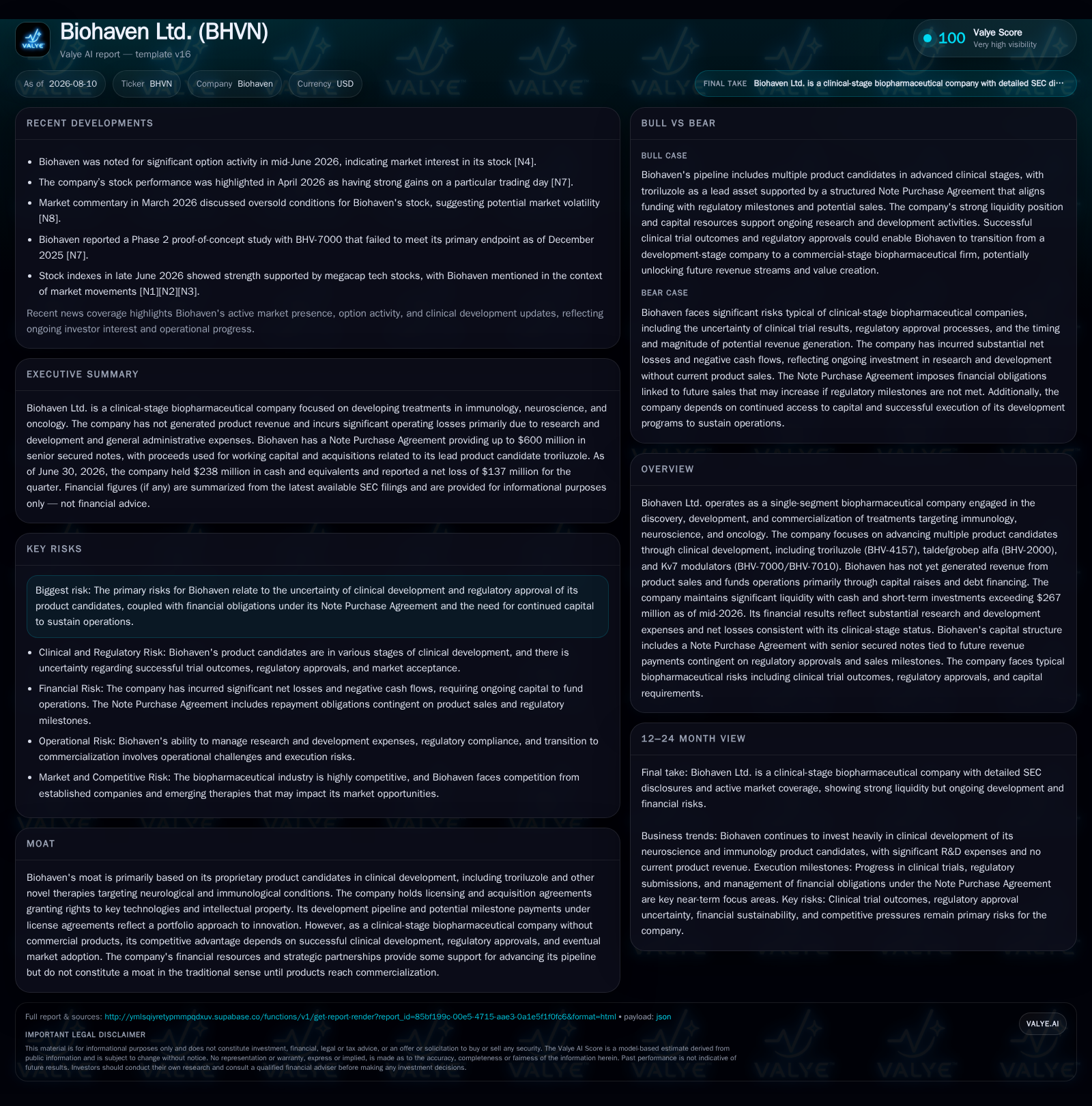
Biohaven Ltd. remains a clinical-stage biotech with no commercial product revenue, focusing on advancing multiple neurological and immunology candidates through expensive, multi-phase trials. As of Q2 2026, the company holds over $238 million in cash and maintains a healthy current ratio, supporting ongoing operations without near-term revenue. Its capital structure includes senior secured notes linked to future net sales of its lead candidate troriluzole, creating contingent obligations dependent on regulatory approval and commercialization success. The effectiveness of Biohaven's strategy hinges on clinical progression, milestone achievements, and timely regulatory milestones amid typical sector risks.
Recent Operating Update Highlights
In its latest Form 10-Q for the quarter ended June 30, 2026, Biohaven Ltd. maintained liquidity with $238 million in cash and equivalents and a current ratio of approximately 4.73, signaling sufficient short-term financial flexibility for continuing its clinical development programs without immediate financing pressure [F1][S2]. The filing confirms ongoing commitment to research and development activities centered around its pipeline candidates but does not report any revenue from product sales, consistent with its status as a clinical-stage biotechnology company [S2][S1].
This latest operational update underscores that Biohaven continues executing on its multi-year R&D roadmap during the inherent uncertainties of clinical development timelines. The company’s August 2026 8-K event filing reiterates its strategic focus on advancing pivotal regulatory milestones that will be crucial for transitioning from an expense-abundant R&D stage into potential revenue generation upon successful product commercialization [S3]
Business Model
Biohaven’s business model pivots on discovering and advancing novel therapeutics targeting neurological disorders and immunological diseases via preclinical studies leading into phase 1 through phase 3 clinical trials. Currently without market-approved products or associated sales revenue, the company funds operations primarily through capital raises—including equity issuances—and sophisticated debt instruments structured around future commercialization outcomes [S1][S2]
Revenue generation prospects hinge on three pathways: achieving regulatory approvals allowing for direct product sales; securing licensing agreements that yield milestone payments; or entering partnerships which may provide upfront or ongoing royalties [S1]. Until regulatory green lights are received—particularly for lead candidate troriluzole—Biohaven incurs substantial research and development expenses encompassing payments to contract research organizations (CROs) for clinical trials, contract manufacturing organizations (CMOs) for drug supply scaling, employee salaries focused on discovery and trial management, manufacturing scale-up costs, regulatory compliance efforts, and milestone-related fees payable under partnerships or licenses
Importantly, Biohaven’s operating expenses scale with the progression of clinical trial phases; later-stage trials demand greater patient recruitment efforts and longer durations. The firm’s focus on multiple pipeline candidates including troriluzole (BHV-4157), taldefgrobep alfa (BHV-2000), and Kv7 modulators reflects a portfolio approach aimed at diversifying scientific risk within neurological indications [S2][S1]. However, the absence of commercialized products means that reported net losses remain substantial.
Industry Structure and Competitive Position
Within the biotechnology industry value chain, Biohaven operates firmly in early to mid-stage pharmaceutical development. Its role involves discovery innovation followed by oversight of outsourced CROs/CMOs managing clinical trials and production—a model standard among clinical-stage biotechs. Unlike larger peers such as Biogen or Amgen who have legacy commercial franchises alongside pipelines, Biohaven faces more pronounced financial volatility tied to clinical outcomes.
Competitively, Biohaven must advance its proprietary intellectual property through stringent U.S. FDA review processes while contending with other developers pursuing treatments in overlapping neurological domains. Peer benchmarking suggests that efficient pipeline advancement speed, effective patient enrollment in trials, strong data readouts at pivotal regulatory stages, and solid capitalization are critical levers determining long-term viability. Strategic licensing deals or partnerships might strengthen competitive positioning by sharing developmental risk.
Growth Drivers
Biohaven's growth depends heavily on several interlinked biological innovation cycles:
- Clinical Trial Progress: Timely patient enrollment leading to successful phase completions improves internal valuation signals and spurs investor confidence.
- Regulatory Milestones: FDA approvals unlock pathways to commercialization revenues crucial for initial sustainability.
- Pipeline Diversification: Broadening candidate programs reduces reliance on any single therapeutic outcome.
- Licensing & Partnerships: Milestone payments infuse non-dilutive capital supporting extended research horizons.
- Capital Raising Capability: Available liquidity buffers against periods of elevated R&D spend before product revenues materialize.
Each driver maps directly onto KPIs such as enrollment rates, phase transition success rates, milestone cash inflows from licenses, research expense management efficiency, and operating cash flow trends.
Risks and Watchpoints
Biotech-sector risks are collectively acute for Biohaven due to:
- Clinical Uncertainty: Trial failures or delays could stall anticipated milestones.
- Regulatory Risk: Prolonged reviews or rejections impede commercialization timelines.
- Cash Burn Pressure: Persistent net losses necessitate future capital raises at potentially dilutive terms.
- Debt Obligations: The Note Purchase Agreement’s contingent repayment linked to future drug sales requires vigilant monitoring post-commercial launch to manage cash outflows effectively [S1].
- Intellectual Property Challenges: Patent disputes could disrupt market exclusivity projections.
- Supply Chain Dependencies: Reliance on external CROs/CMOs can introduce operational bottlenecks.
- Market Adoption Unknowns: Even post-approval, pricing/reimbursement frameworks may limit uptake compared to forecasts.
Watchpoints include upcoming data readouts from late-stage trials of troriluzole expected within the next year along with anticipated FDA feedback dates shaping timing of possible regulatory submissions. Equally important is observing any amendments or expansions in financing arrangements signaling shifts in capital availability or debt covenants [S3][S2]
What to Watch Next
Investors and observers should focus on:
- Clinical Data Releases: Outcome announcements particularly for BHV-4157 pivotal trials offer clarity on product viability.
- FDA Regulatory Submissions & Decisions: Receipt of Investigational New Drug (IND) application approvals or marketing authorization decisions will materially shift business prospects.
- License/Milestone Payments: Tracking realized or anticipated milestone receipts will indicate validity of partnerships fueling the pipeline.
- Balance Sheet Developments: Changes in cash runway estimates or new financing highlight operational resilience.
- Strategic Partnerships: Announcements regarding collaborations might reduce risk or enhance development scale.
Timely updates against these factors will either confirm execution efficiency or raise red flags regarding pace toward commercialization.
Financial Profile Discussion
As of June 30, 2026, Biohaven reported $238 million in cash and equivalents paired with current assets totaling approximately $297 million against current liabilities near $63 million—yielding a robust current ratio of about 4.73 which signals firm near-term liquidity covering working capital needs comfortably amidst ongoing R&D expenditure demands [F1]. This liquidity is critical given the absence of operating revenue.
Debt facilities under the Note Purchase Agreement total initial proceeds of $250 million from first tranche senior secured notes issued in April 2025; subsequent tranches depend on regulatory event triggers like FDA approval of troriluzole [S1]. These notes entail royalty-like payments starting at a baseline percentage (~6.25%) of global net sales increasing if certain conditions go unmet by predefined dates—effectively linking financial obligations directly to product market performance [S1]. This structure aligns incentives but also embeds repayment uncertainty until commercial scale is attained.
Maintaining this balance sheet profile while progressing pipeline assets toward key inflection points will be essential for sustaining operations without undue capital dilution or solvency risk beyond current horizons.
This report is an independent analytical review based solely on publicly filed information provided by Biohaven Ltd., industry knowledge frameworks and standard financial interpretations without investment research views.
Disclaimer: This is research-only, informational analysis and not investment advice. It may include AI-generated interpretation and general industry context. Always verify important details using primary sources.

Comments