
USA Rare Earth Advances US-Based Rare Earths Processing Amid Robust Liquidity and Industry Reshoring
The company reported operational progress and maintained strong liquidity in Q2 2026, aligning strategically with U.S. critical minerals reshoring efforts.
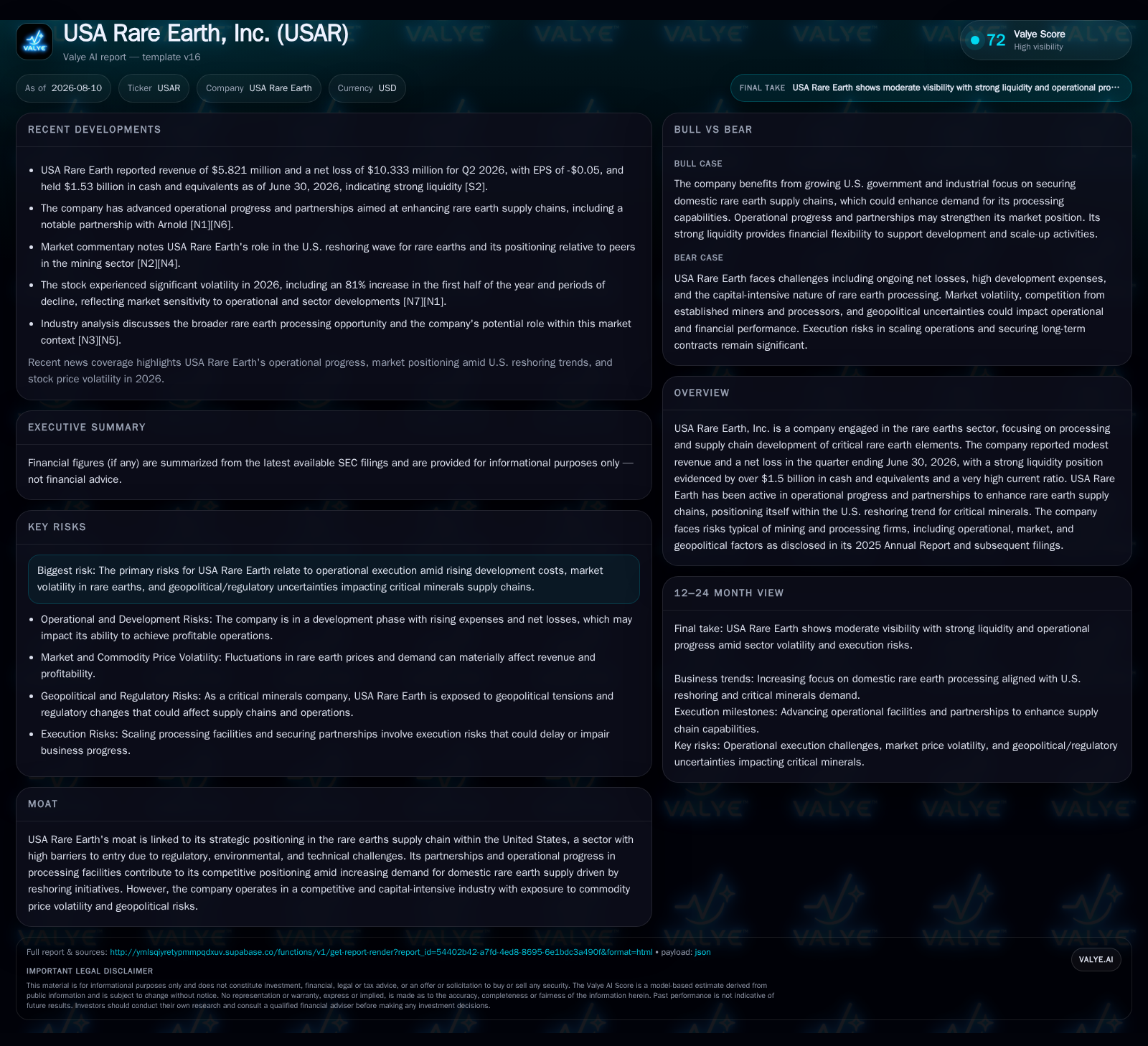
USA Rare Earth, Inc. continued to develop its rare earth processing capabilities in Q2 2026, delivering modest revenue amid substantial net losses characteristic of its capital-intensive growth phase. The company's strategic focus on building a domestic rare earth supply chain positions it well amid increasing U.S. government support for critical minerals reshoring. Despite operating losses, USA Rare Earth's exceptional liquidity and zero debt provide significant runway to execute expansion plans. Key risks include operational execution challenges, commodity price volatility, and regulatory complexities inherent to the rare earth sector.
Recent Operating Update
In its Q2 2026 filing ending June 30, USA Rare Earth reported modest revenue alongside continued net losses typical for a company transitioning from development toward commercial operations [S2][F1]. The earnings release emphasized ongoing investments focused on scaling its chemical separation processing capabilities and integrating strategic acquisitions announced earlier in the year [S3]. These operating losses align with expectations given the capital intensity of rare earth refining.
Critically, the company finished the quarter with approximately $1.53 billion in cash and equivalents and no outstanding debt obligations [F1]. This unprecedented liquidity position provides USA Rare Earth substantial financial runway to fund plant expansions, secure feedstock supplies through acquisitions or partnerships, and invest in downstream manufacturing capabilities—essential factors for competitiveness in an industry marked by long lead times and heavy upfront investments.
Business Model Analysis
USA Rare Earth operates primarily in upstream rare earth mining and processing segments encompassing beneficiation (ore concentration) followed by complex chemical separation to produce high-purity rare earth oxides. These refined intermediates are sold mainly to domestic manufacturers producing neodymium magnets, batteries, electronics components, and defense-related materials. Revenue generation depends on volume throughput of ore concentrate processed into purified products meeting stringent customer specifications.
The business model involves multi-year scale-up phases requiring substantial capital expenditures for mining infrastructure and processing facilities capable of isolating individual REEs cost-effectively.
Strategic vertical integration efforts are evident through recent mergers with entities such as Serra Verde Group (SVG) and Texas Mineral Resources Corp (TMRC), which strengthen control over ore concentrate sources and processing assets [S5][S26]. Additionally, partnership agreements emphasize product quality consistency tailored to customer demands—a competitive advantage in high-tech downstream markets.
Industry Structure and Competitive Position
The rare earth mining and processing sector features significant technical barriers due to the chemical similarity of REEs, necessitating complex separation processes under stringent environmental regulations. Global supply remains heavily concentrated among Chinese producers, creating geopolitical risks that motivate U.S. initiatives for domestic supply chain reshoring.
Within this landscape, USA Rare Earth operates predominantly upstream—from mining through refinement into rare earth oxides—that serve as inputs for downstream magnet manufacturers reliant on stable high-purity feedstocks. Peers like MP Materials Corp offer relevant US-based benchmarks but differ in asset scale and production ramp timing.
Capital intensity is pronounced; projects require extensive upfront investment before positive cash flow emerges. Environmental compliance further adds cost complexity given rigorous U.S. standards on permits and community impact mitigation.
Growth Drivers
Demand for rare earth oxides is propelled by rapid adoption of electric vehicles (EVs), renewable energy technologies such as wind turbines dependent on neodymium-iron-boron magnets, miniaturization trends in electronics, and heightened defense sector needs for strategic minerals [S1]. Geopolitical dynamics incentivize reshoring critical mineral supply chains to reduce reliance on foreign sources.
U.S. government programs—including Department of Commerce financing—support companies like USA Rare Earth via conditional capital infusions tied to milestone achievements [S5]. Technological improvements in beneficiation processes that increase recovery rates or reduce chemical usage could further improve margins.
Strategic acquisitions like SVG (processing assets) and TMRC (rare earth-bearing mineral rights) enhance feedstock control feeding into operations at facilities such as Stillwater—key for scaling throughput volumes aligned with anticipated customer demand from EV magnet manufacturers [S26]
Risks and Watchpoints
Operational execution remains a principal risk; commissioning complex chemical separation plants often faces delays due to technical fine-tuning requirements.
Commodity price volatility poses revenue risk; while long-term contracts may mitigate some exposure, global pricing remains influenced by dominant Chinese suppliers. Regulatory compliance costs across jurisdictions add uncertainty around expansion feasibility.
Government financing agreements impose restrictive covenants including domestic content mandates that constrain operational flexibility but enable access to critical funding [S5]. Geopolitical tensions raise concerns around export controls or retaliatory trade policies potentially disrupting supply chains.
Customer conversion from preliminary discussions or memorandums of understanding into binding orders is another key milestone validating demand assumptions supporting capacity build-out plans.
What to Watch Next
Key near-term indicators include ramp-up progress at the Stillwater magnet manufacturing facility alongside integration milestones following acquisitions such as SVG and TMRC. Monitoring contracted sales volume conversions will provide insight into demand traction [S3]
Environmental permitting timelines impacting new or expanded facilities warrant close attention due to potential cascading effects on costs or revenue targets [S5]. Continued government funding linked to milestone achievement under Department of Commerce agreements remains critical.
Emerging beneficiation technologies that enhance production yield or reduce per-ton operating costs represent potential upside if successfully commercialized at scale.
Financial Profile Discussion
As of June 30, 2026, USA Rare Earth's balance sheet showed cash & equivalents totaling approximately $1.53 billion against no recorded debt—yielding a current ratio near 32.8x—indicative of exceptional short-term financial health capable of supporting ongoing project investments without liquidity constraints [F1]. This positions the company well ahead of many peers still navigating early commercial stages within this capital-heavy sector.
Long-term financial flexibility is reinforced by a clean balance sheet free from debt service obligations allowing management discretion over capital expenditure pacing aligned with market developments.[F1] Nonetheless, equity dilution risks remain inherent to emerging miners reliant on external financing though not detailed in current filings.[S3]
This analysis synthesizes publicly available SEC filings supplemented by sector expertise without providing investment research views or forecasts. The rare earth sector's combination of geopolitical sensitivity, technological complexity, environmental regulation rigor, and capital intensity frames USA Rare Earth's operational narrative as it scales domestic capabilities amid U.S. policy emphasis on critical mineral independence.
Disclaimer: This is research-only, informational analysis and not investment advice. It may include AI-generated interpretation and general industry context. Always verify important details using primary sources.

Comments