
TTEC Holdings Balances AI-Driven Innovation With Managed Services Amid Leadership Shifts
The latest quarterly update highlights strategic executive appointments, investments in AI-powered customer experience technology, and operational challenges.
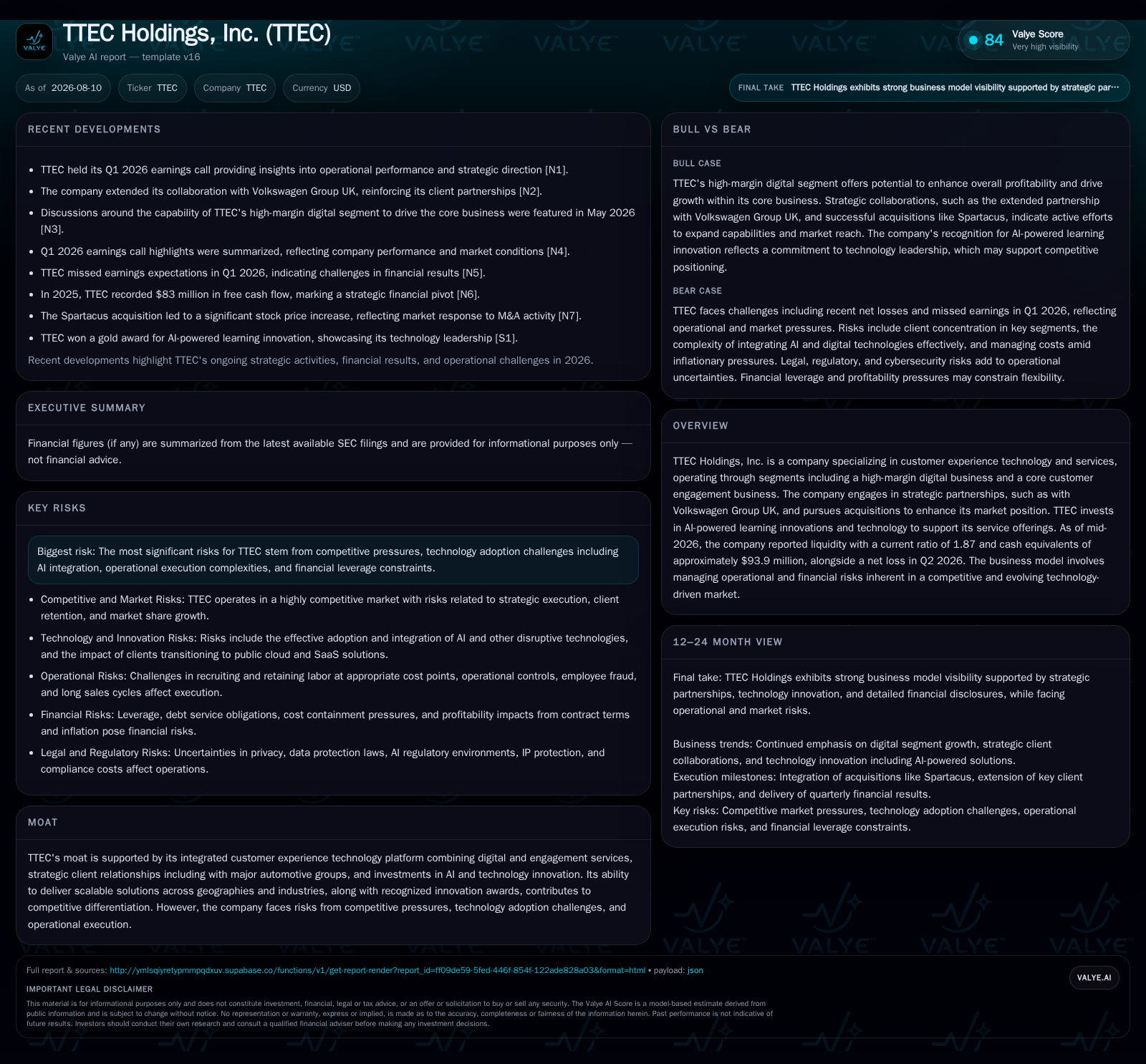
In Q2 2026, TTEC Holdings advanced its integrated customer experience technology and managed services business with notable leadership changes and continued investment in AI-enabled solutions. The company maintains a dual-segment model comprising a high-margin digital technology segment and a core customer engagement segment, pursuing strategic partnerships and acquisitions to strengthen its market position. Despite posting a net loss in recent periods, TTEC preserves liquidity with a current ratio of 1.87 and approximately $94 million in cash equivalents, while facing risks around competitive pressures, technology integration, and operational execution.
Latest Operating Update
TTEC Holdings' second quarter 2026 filing discloses significant executive leadership changes aligning with its dual-segment operating structure. John Abou was appointed Chief Executive Officer of the TTEC Engage segment as of August 5, 2026, transitioning from President of that business unit. Concurrently, Christopher J. Brown assumed the presidency of the TTEC Digital segment [S2][S25]. Both executives received enhanced compensation packages featuring increased base salaries, variable incentive plans tied closely to performance outcomes (up to 100% of base), and long-term incentive awards heavily weighted toward restricted stock units (RSUs) and performance-based restricted stock units (PRSUs) contingent on adjusted EBITDA targets through fiscal year 2028. These moves signal management's intent to sharper focus each segment's strategic priorities: engagement services scaling alongside advanced digital platform innovation.
The company also implemented a one-time senior executive retention bonus program to secure continuity during anticipated transformational transactions spanning mergers, acquisitions, restructuring, or divestitures planned between late 2026 and 2027 [S25]. This suggests strategic repositioning efforts are underway during evolving market conditions.
Business Model Overview
TTEC operates at the nexus of customer experience technology platforms and managed engagement services. Its revenue arises from two complementary but operationally distinct segments: TTEC Digital delivering software-as-a-service (SaaS) solutions focused on digital customer journey management and AI-powered analytics; and TTEC Engage providing contact center outsourcing managed services which represent a more asset- and labor-intensive business [S1]
This hybrid model creates a balance between recurring platform subscription/license fees along with volume-based managed services contracts typically characterized by lower margins but consistent cash flow [S1]. Customer payors primarily comprise large enterprises engaging TTEC for both front-end omnichannel support technology as well as human-driven customer engagement operations across industries such as automotive (highlighted by its partnership with Volkswagen Group UK), healthcare, financial services, retail, and telecommunications
Operational KPIs pivotal to revenue growth include contract renewal rates ensuring recurring revenue stability; net retention rate reflecting upsell/cross-sell within existing clients; average contract length impacting visibility; utilization rate of service agents affecting managed service economics; and digital platform adoption rate indicative of technological migration success.
TTEC’s investments in AI-powered learning innovations underpin efforts to both differentiate its offerings and enhance operational efficiency. By integrating machine learning into agent training and interaction analytics, the company aims to reduce costs while improving client satisfaction metrics [S1]. This is critically important given ongoing margin pressure from labor cost inflation in managed services.
Industry Structure and Competitive Position
Operating within the customer experience technology and services sector, TTEC competes alongside diversified BPO providers like Concentrix and Sitel Group; digital transformation consultancies; SaaS-centric players including Zendesk; customer experience platform vendors such as Genesys; and major CRM ecosystems exemplified by Salesforce Service Cloud.
Its competitive moat derives from an integrated end-to-end offering—combining scalable cloud-based software platforms with global delivery capabilities—which few peers match fully. Strategic enterprise partnerships reinforce customer stickiness while ongoing investments in AI-driven tools contribute to innovation differentiation recognized by industry awards previously disclosed.
However, elevated competition drives pricing pressure particularly on commoditized engagement services amid macroeconomic headwinds. Client concentration risks persist notably within the TTEC Engage portfolio where larger accounts disproportionately impact revenues. Regulatory compliance complexity across geographies further adds operational overhead.
Growth Drivers
Multiple secular trends favor TTEC's growth path:
- Accelerated enterprise demand for digital-first customer experience strategies propels adoption of integrated SaaS platforms supporting omnichannel journey management.
- Continued migration toward outsourcing non-core contact center functions fuels expansion of managed service contracts worldwide.
- Growing e-commerce penetration heightens complexity in customer interactions necessitating more sophisticated backend support systems.
- Rising regulatory scrutiny incentivizes compliance-related service offerings embedded within client engagements.
- Strategic acquisitions enhance service breadth and geographic reach augmenting cross-selling opportunities [S1].
- AI investments unlock potential cost savings via automation and improved agent effectiveness translating into margin improvement over time.
Success hinges on smooth integration of technology deployments coupled with maintaining high contract renewal rates amid competitive bidding cycles.
Risks and Watchpoints
Several material risks loom for TTEC:
- Competitive intensity may compress pricing on managed engagements reducing adjusted EBITDA margins absent offsetting efficiency gains.
- Adoption lags or missteps integrating AI-driven technologies could impair promised operational enhancements risking client churn.
- Execution complexities inherent in managing large-scale workforce distribution expose exposure to labor cost inflation and retention challenges [S6].
- Financial leverage constrained by credit facility terms may limit agility in funding acquisitions or absorbing cyclical shocks.
- Client concentration within core segments enhances vulnerability should key accounts not renew or scale back spending abruptly.
- Compliance failures relating to data privacy or labor regulations could result in fines or reputational damage impacting new business development [S6].
- Macro-economic volatility influencing discretionary IT/outsourcing budgets bears watching for shifts in demand patterns.
Monitoring contract pipeline health alongside net retention trends offers early insight into demand sustainability. Additionally, margin progression correlated with AI automation rollout will be a critical metric to assess scale benefits realization.
What To Watch Next
Investors should track quarterly disclosures for:
- Changes to segment revenue mix illuminating relative traction between digital SaaS offerings versus traditional managed services.
- Adjusted EBITDA margin trends clarifying if efficiency programs offset cost inflation sustainably.
- Updates on transformational transactions including acquisitions or divestitures completing under the announced executive retention framework.
- Contract renewal rates reported at segment levels providing indication of client loyalty amidst competitive pressures.
- Progress reports on AI deployment timelines influencing platform adoption rates which drive long-term upsell potential.
- Liquidity evolution against capital expenditure requirements signaling capacity for organic growth investment or debt reduction.
These markers collectively will demonstrate whether TTEC can effectively navigate the transition towards a digitally driven hybrid revenue model without sacrificing profitability or client relationships.
Financial Profile Discussion
As of June 30, 2026, TTEC maintains a solid liquidity position anchored by $93.9 million in cash and equivalents supported by a current ratio of approximately 1.87 based on total current assets of $592.2 million versus current liabilities totaling $317.3 million [F1]
The lack of recent explicit leveraging disclosures prevents precise leverage ratio analysis; however, historical filings indicate credit facilities subject to covenants potentially constraining capital allocation flexibility [S26].
Adjusted EBITDA margins have faced pressure amid labor cost inflation typical across BPO providers but are partially mitigated by efficiencies gained through platform integrations and automation efforts implemented within its global delivery network [S1]. Continued margin expansion is contingent upon successfully scaling digital offerings which benefit from higher gross margins relative to legacy contact center outsourcing contracts.
In summary, while near-term profitability challenges persist largely due to transition costs and investment spend, robust liquidity supports operational stability during ongoing transformation towards an AI-enhanced hybrid service delivery model.
This analysis synthesizes publicly filed SEC disclosures to provide an informed perspective on TTEC Holdings' operational trajectory without investment research views. Observers should review forthcoming earnings releases for updated financial data reflecting these strategic shifts.
Disclaimer: This is research-only, informational analysis and not investment advice. It may include AI-generated interpretation and general industry context. Always verify important details using primary sources.

Comments