
ALICO INC’s Strategic Shift to Real Estate Amplifies Asset Value and Operational Flexibility
ALICO's latest quarterly results highlight a material pivot from traditional citrus farming toward expanding its Florida land portfolio, reshaping revenue streams and operational risk.
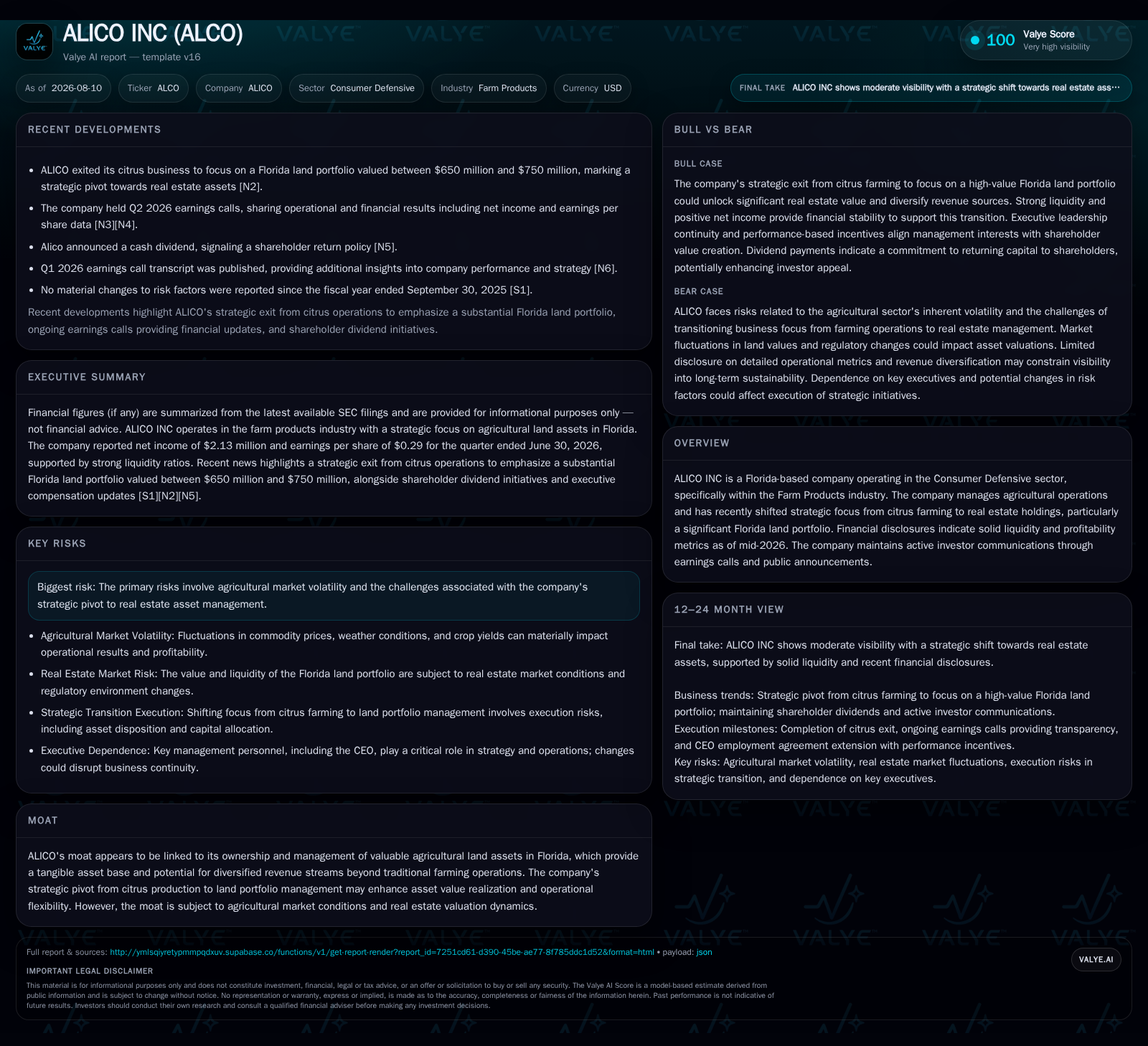
In its Q3 2026 filing, ALICO INC confirmed that its strategic transition from primarily citrus-focused agriculture to land management and real estate monetization is gaining traction, evidenced by stronger-than-expected earnings and evolving revenue composition. This pivot reduces dependency on volatile agricultural commodity markets, introduces new capital allocation priorities favoring land asset development, and positions ALICO more as a land management entity with diversified income potential. The company’s liquidity remains robust with a strong current ratio, supporting ongoing investments amid inherent weather risks and real estate market sensitivities.
Q3 Results Signal Strategic Transition’s Tangible Impact
ALICO INC’s Q3 2026 filing dated August 10 confirms the tangible impact of its ongoing strategic pivot away from classical citrus farm operations towards enhanced real estate asset management centered on its extensive Florida land holdings [S2]. The company reported better-than-expected earnings performance highlighted by a favorable shift in revenue drivers that now increasingly reflect land-based income streams such as leases and potential sales options rather than pure crop sales alone. This transition marks a critical inflection point in ALICO's operating profile: profits are becoming less linked to uncertain agricultural commodity prices and seasonality, instead anchored partly on more stable land asset valuations and lease contracts [N1]. The updated operating results clarify that while crop production remains part of the business mix, its relative scale is diminishing with correspondingly lower agricultural input costs and expense volatility.
From Crop Production to Land Portfolio: Redefining Revenue Streams
Historically rooted in Florida citrus farming, ALICO’s business model has evolved to integrate two complementary revenue sources: residual crop sales from managed acreage plus income from its growing real estate portfolio [S18]. The latest disclosures show acreage actively managed remains purposefully curated as part of a broader land stewardship strategy that includes agricultural leases — exemplified by a recent agreement leasing approximately 3,280 acres to U.S. Sugar Corporation with defined purchase options exercisable within several years at pre-agreed price points reflecting a $9,000 per acre baseline subject to escalation clauses
This dual-focus approach reduces direct exposure to weather-driven crop yield fluctuations (a key KPI in agricultural sectors) while leveraging appreciable land valuation gains intrinsic to Florida markets. Consequently, operating margins now benefit from improved cost control given less reliance on traditional agri-inputs such as fertilizers or labor-intensive harvesting activities. This shift underscores a strategic reallocation of capital expenditures away from farm equipment towards land maintenance and sustainable development initiatives that anticipate diversified monetization pathways including leasing revenues and eventual parcel sales [S2], [S1].
Competitive Structure & Peer Benchmarking: Capital Allocation under Spotlight
Within the broad Farm Products industry context, ALICO's emerging profile parallels peers like Limoneira Company or Calavo Growers — firms that blend agriculture with significant real estate asset management to stabilize earnings against seasonal commodity market swings. Unlike pure crop producers whose earnings are highly cyclical based on harvest volume and commodity prices, entities managing sizable agricultural real estate portfolios often enjoy stronger operational resilience through diversified cash flow sources.
A defining competitive variable for ALICO now lies in effective capital allocation between maintaining productive acreage and optimizing land asset value through leasing or sale transactions. Peer benchmarking indicates firms successfully navigating this balance improve long-term shareholder value by insulating profitability against adverse weather or price shocks otherwise impacting farm productivity. Additionally, the regulatory environment around land use in Florida introduces localized risks and opportunities influencing comparative advantage versus other geographical operators without similar strategic flexibility.
Key Growth Drivers: Expanding Land Assets and Valorization Opportunities
ALICO's prospects hinge largely on several measurable growth drivers. Foremost is the expansion or optimization of acreage under strategic management—either by acquiring additional farmland or increasing leased-in parcels generating steady rental income [S18]. Coupled with positive trends in Florida real estate valuations, these factors enhance the company's asset base valuation and open avenues for sizable discretionary monetization events such as option-triggered sales mentioned in recent lease contracts
Moreover, increased functionality of land assets outside strict crop production cycles offers optionality—reducing seasonality impacts while providing more consistent cash generation potential. In addition to acreage growth metrics, KPIs like land utilization rate (proportion of owned acres under active lease or cultivation), combined with capital expenditure deployment aimed at enhancing land quality or compliance with regulatory requirements (e.g., environmental sustainability), will be critical indicators of execution progress over coming quarters [S2], [S1].
Risks & Watchpoints: Agricultural Volatility Meets Real Estate Sensitivities
Despite the strategic benefits of diversification into land portfolio management, ALICO continues facing a dual risk framework directly tied to sector fundamentals. Crop production remains vulnerable to weather events (hurricanes, droughts), pests, disease outbreaks, and fluctuating commodity prices—all of which affect harvest volumes and realized average product prices that ultimately impact partial farming revenues.
Simultaneously, real estate activities expose the company to market downturns in land valuation driven by zoning changes, environmental regulations impacting permitted uses or water resource constraints common in Florida agriculture zones; these factors could dampen sale proceeds or lease renewals. Labor availability pressures also remain relevant within both farming operations and land upkeep functions given regionally competitive employment markets [S1], [S14]. Successful navigation requires vigilant monitoring of regional regulatory shifts and proactive risk mitigation via diversification within the land portfolio.
Monitoring Milestones: What Investors Should Look for Next
Key upcoming milestones investors should track include quarterly segment disclosures differentiating crop-based revenues from earnings attributable to leases or sales of property rights. Detailed updates on acreage expansions or reductions via acquisitions/disposals will illuminate trajectory consistency behind the pivot strategy outlined. Further clarity on operating margin trajectories is essential to verify if reduced agricultural input intensity materially improves profitability sustainably.
Additionally, communications regarding new leasing contracts with embedded purchase options (similar to the U.S. Sugar agreement) will reflect expanding monetization optionality within the favored Florida geography. Contract renewals/extensions timing around mid-2027 through early 2030 for leased parcels are also important event windows affecting future cash flows and valuation benchmarks [S2], [N1].
Financial Profile Discussion: Liquidity Resilience Supports Transition
As of June 30, 2026, ALICO exhibits solid financial resilience supporting its strategic transition phase. The company maintains $55.58 million in cash and equivalents paired with current assets totaling approximately $57.86 million against current liabilities near $7.27 million — yielding a strong current ratio around 7.96 which underscores ample short-term liquidity capacity [F1]. Total debt stood near $83 million as of September 30, 2025; net debt after cash balances approximates $27.46 million hinting at manageable leverage amid capital reallocation from farming-centric equipment to real estate asset investment.
This analysis synthesizes recent SEC filings (primarily the August 10th Q3 report) alongside sector-specific nuances characteristic of mixed agriculture/real estate operators within the Farm Products industry context to delineate ALICO INC’s strategic repositioning outcomes without providing investment advice.
Disclaimer: This is research-only, informational analysis and not investment advice. It may include AI-generated interpretation and general industry context. Always verify important details using primary sources.

Comments