
Keurig Dr Pepper Boosts Growth with JDE Peet's Integration and Innovation Push
Keurig Dr Pepper’s latest quarterly results reveal early gains from the JDE Peet's acquisition, supported by its diversified beverage portfolio, direct store delivery advantages, and brewing innovation.
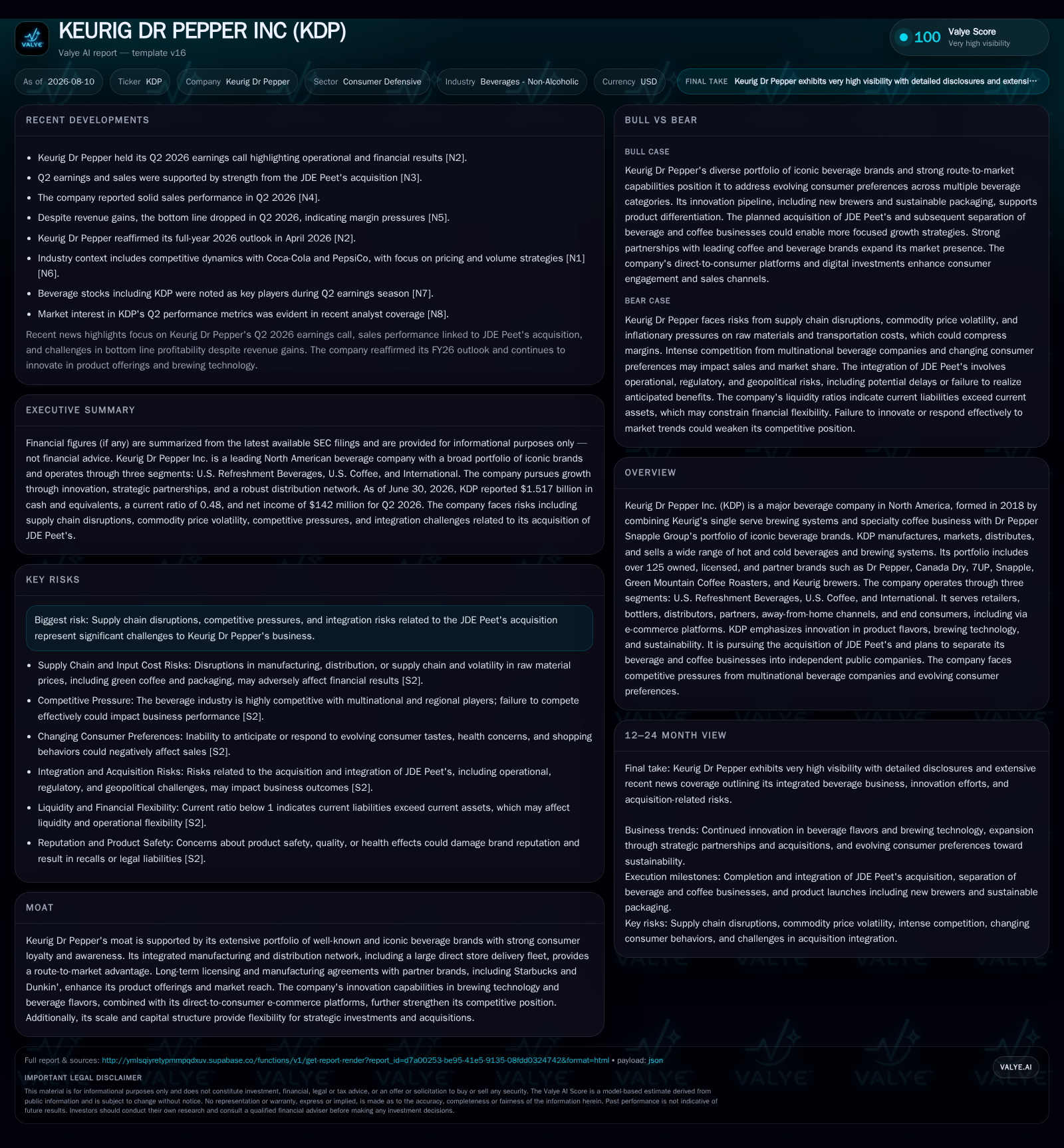
In Q2 2026, Keurig Dr Pepper (KDP) showcased volume-driven revenue growth fueled partly by the recent JDE Peet's acquisition despite integration complexities and supply chain challenges. The company's multi-channel business model spans U.S. Refreshment Beverages, Coffee (including single-serve brewers), and International operations, each with distinct economics and growth drivers. KDP’s integrated direct store delivery (DSD) network remains a key competitive moat by enabling route-to-market control and distribution efficiency. Brewing innovation aligned with premium coffee trends, coupled with sustainability initiatives, further bolster product relevance. However, supply chain disruptions, pricing pressures from retail consolidation, and acquisition integration risks remain near-term watchpoints.
Q2 Results Signal Early Benefits Amid JDE Peet's Integration Challenges
Keurig Dr Pepper Inc.'s Q2 2026 financial disclosures report continued momentum from the August 2025 acquisition of JDE Peet's, which has materially expanded KDP's coffee portfolio and international footprint [S2], [S3]. The combined entity reported net sales growth fueled both by core organic volume gains across U.S. Refreshment Beverages and contributions from acquired brands in coffee segments [N2], [S2]. While reported operating income showed pressures in some segments due to input cost inflation and integration expenses, management emphasized ongoing execution of integration plans expected to unlock synergistic efficiencies over time [N1], [S2]. This combination reshapes KDP’s competitive positioning by incorporating one of the world’s largest pure-play coffee companies with complementary product sets.
Volume growth analysis indicates higher case sales across beverage concentrates and packaged beverages in North America alongside rising K-Cup pod shipments driven by expanding direct-to-consumer sales via Keurig.com [S1], [S2]. Price/mix effects remain positive but encumbered somewhat by retailer pricing pressure stemming from intensified customer consolidation noted in the filing [S8]. The segment-level breakdown highlights strength in Refreshment Beverages with near double-digit net sales increase, offset partially by modest contraction in U.S. Coffee operating income due to elevated costs [S15]. These dynamics underscore the complexity of merging diverse channel economics while pursuing an expansive 'total beverage' strategy.
Hybrid Portfolio Drives Multi-Channel Revenue Streams With Distinct Economics
Keurig Dr Pepper's multi-faceted business model encompasses three principal segments: U.S. Refreshment Beverages (concentrates, syrups, finished beverages), U.S. Coffee (single-serve pods, brewers), and International markets inclusive of both beverage concentrates and coffee products [S1]. Each exhibits unique monetization mechanics: Refreshment Beverages primarily sell concentrates to bottlers under long-term contracts enabling scalable volume production; Coffee revenue includes finished goods sold directly to retail partners and consumers via e-commerce platforms like Keurig.com.
The portfolio integrates owned iconic brands such as Dr Pepper, Canada Dry, Snapple alongside licensed brands including Starbucks K-Cups under long-term arrangements that offer steady licensing fee streams. Complementary brewing equipment sales contribute higher margin revenue relative to beverage consumables [S1]. This combination allows agility in capturing diverse consumer occasions—from soft drinks at grocery channels to premium single-serve coffee moments at home—while also leveraging cross-segment promotional synergy. Notably, KDP’s strategic partnerships expand shelf space reach without heavy capital investment.
Leveraging Direct Store Delivery Network As a Defensible Route-to-Market Moat
A core competitive advantage lies in KDP’s extensive direct store delivery fleet comprising approximately 8,100 owned/leased vehicles in the U.S. plus another 2,200 in Mexico [S16]. This DSD network enables real-time control over inventory replenishment at retail locations including grocery chains, convenience stores, clubs, mass merchandisers, and e-commerce fulfillment centers [S1]. Compared to multinational peers often reliant on third-party bottlers or distributors for beverage delivery (e.g., Coca-Cola or PepsiCo), KDP’s DSD affords superior responsiveness to demand fluctuations and promotional activity timing.
This control supports higher distribution coverage rates which correlate strongly to market share gains in packaged beverages categories where immediate shelf presence translates into consumer purchasing decisions. Moreover, ownership of transportation mitigates risks of supply chain disruptions prevalent during economic disturbances or commodity shortages observed recently [S10]. Efficiency gains here underpin margin resilience despite ongoing inflationary cost pressures.
Innovation in Coffee Brewing Technology Aligns with Premiumization Trends
Keurig Dr Pepper continues investing significantly in R&D focused on enhanced brewing technology innovations designed to address the growing consumer shift toward premium specialty coffees and sustainable product formats [S1], [N1]. New developments include single-serve machines compatible with multiple pod types enriched with advanced flavor extraction capabilities as well as eco-friendly pod materials aimed at reducing plastic waste—a critical regulatory compliance driver especially in EU markets.
The alignment of this pipeline with consumer trends toward convenience paired with quality supports a positive outlook for top-line growth within the Coffee segment beyond legacy hardware sales alone. Specialty coffee demand can justify pricing premiums without commoditizing K-Cup pods or brewers given KDP’s established brand equity combined with exclusive licensing agreements enhancing SKU breadth.
'Total Beverage' Strategy Enhances Consumer Relevance Across Occasions
KDP articulates its strategic vision as becoming a "total beverage" leader offering products for every occasion—hot or cold—to maximize consumption frequency across dayparts and locales [S1], [S2]. The portfolio is designed to capture carbonated soft drinks (CSD), energy drinks like GHOST acquired recently, juices/Mott's variants, RTD teas/coffee under licensed brands alongside Keurig single-serve systems.
This expansive assortment targets health-conscious innovation such as low/no-calorie options or functional hydration products like Core Hydration water to meet evolving consumer choices. Acquisitions complementing owned brands enable swift penetration into whitespace categories without diluting existing brand identities. Cross-selling via DSD channels further enhances velocity across formats.
Sustainability Initiatives Increasingly Influence Customer Decisions & Costs
Regulatory intensification surrounding plastic use and packaging sustainability has driven KDP toward developing recyclable/reusable pod innovations plus reduced packaging weight across bottled products [S1], [S10]. While these initiatives support growing environmental-conscious consumer preferences—which influence purchasing behaviors—they also introduce additional costs that compress gross margins absent effective productivity offsets.
Consequently, sustainability must be balanced against pricing strategies considering retailer pressure for cost containment amid buyer consolidation trends that favor private-label alternatives. Continued innovation here could become an important differentiation layer benefiting loyalty among millennials and Gen Z demographics known for ethical consumption patterns.
Growth Engine Drivers: Organic Progress vs Acquisition Synergies
Organic revenue progression is led by flavor innovation cycles stimulating repeat purchases within core beverages categories combined with digital commerce expansion offering higher margin direct-to-consumer transactions particularly for Coffee pods and brewers through Keurig.com platforms [S2], [N3]. Geographic expansion outside North America via international segment contributes incremental volume although FX risks persist.
Inorganic growth is focused on integration of transformative acquisitions like JDE Peet's which offers global footprint expansion albeit at elevated capital cost levels requiring careful synergy realization execution emphasized repeatedly by management during forward guidance discussions [S3], [N1]. Success in streamlining overlapping distributions or combining procurement volumes will be key margin drivers next quarters.
Watchpoints on Supply Chain Disruptions, Pricing Pressure & Integration Risks
Management flags notable risks including lingering supplier constraints affecting ingredient availability (coffee beans, sweeteners), escalating commodity prices exacerbating input cost inflation exposure beyond earlier forecasts [S2], [S10]. Rising transportation expenses imperil distribution efficiency savings especially if diesel costs climb further.
Consolidation among retail customers intensifies pricing negotiations; larger buying groups leverage scale to extract concessions or increased promotional investment commitments placing downward pressure on realized prices thereby squeezing margins despite implementation of productivity initiatives aimed at cost absorption [S8]
Finally integration risks around cultural alignment between legacy units following acquisitions plus IT/human capital systems harmonization remain inherent execution uncertainties potentially compromising short-term operating performance if not swiftly addressed.
Outlook Commentary and Milestones for Next Quarter Execution Assessment
The company reaffirmed full-year guidance reflecting confidence in balancing persistent macroeconomic headwinds with controlled spending discipline plus anticipated synergy capture timelines from JDE Peet's acquisition integration now materially underway [S3], [N1]. Key forthcoming milestones include measurable improvement in volume mix metrics within Coffee segment alongside normalized input cost trend exposures paralleling expected logistic stabilization.
Ongoing innovation rollouts scheduled involve product upgrades both hardware/software components of brewing systems plus new package formats targeting premium segments forecasted to enhance price/mix realization progressively throughout FY2026 commitment horizon.
Financial Profile Discussion: EBITDA Strength Amid Capital Structure Complexity
As of June 30, 2026, KDP held approximately $1.52 billion in cash equivalents supporting operational liquidity despite a current ratio below unity (0.48) given sizeable current liabilities totaling nearly $19.7 billion compared to current assets around $9.46 billion per latest data available [F1]. The company reports total debt best estimated around $4.23 billion netting approximately $2.7 billion after cash adjustments indicating moderate leverage levels sustained post-acquisition financing requirements.
Overall free cash flow generation capacity remains crucial for deleveraging optionality while preserving capital deployment flexibility toward marketing investments or bolt-on acquisitions bolstering long-term growth potential amidst dynamic consumer demand conditions.
This analysis serves informational purposes only evaluating Keurig Dr Pepper Inc.’s recent operating developments within the context of its industry positioning without providing any investment advice or research views.
Disclaimer: This is research-only, informational analysis and not investment advice. It may include AI-generated interpretation and general industry context. Always verify important details using primary sources.

Comments