
Esquire Financial’s Strategic Expansion and Portfolio Growth Following Signature Bancorporation Merger
The merger with Signature Bancorporation expands Esquire Financial’s balance sheet and diversifies its asset base while driving growth in core lending and payment processing activities.
Esquire Financial Holdings recently closed its merger with Signature Bancorporation, significantly scaling its assets, loans, and deposits as of mid-2026. The company reports solid loan growth, stable credit quality, and resilient fee income from its payment processing business. Its unique focus on litigation-related lending coupled with a strong deposit base underpins attractive net interest margins amid a challenging interest rate environment. Moving forward, integrating Signature’s operations and realizing merger synergies are key milestones to monitor alongside continued loan portfolio expansion and fee income diversification.
Recent Operating Update: Merger Completion and Scale Expansion
Esquire Financial Holdings finalized its previously announced merger with Signature Bancorporation on August 1, 2026 [S2][S3]. This transaction more than doubles several balance sheet metrics. As of June 30, 2026 pro forma for the merger, the combined entity reported total assets of approximately $4.8 billion and loans totaling $3.3 billion alongside about $4.0 billion in total deposits [S2]. The consolidated scale positions Esquire among larger regional banks with enhanced lending capacity and deposit franchise.
The merger consideration of roughly $466 million was paid through Esquire's common stock issuance, options, and cash in lieu of fractional shares [S2]. Although initial purchase accounting remains preliminary and goodwill values undisclosed currently, this transformational deal shifts Esquire's profile from a focused specialty lender toward a broader regional banking platform incorporating Signature’s complementary commercial loans and core deposits.
Merger-related expenses incurred during the first half of 2026 amounted to about $2.3 million including advisory and legal fees [S2]. These are non-recurring charges that will not affect ongoing profitability but reflect transactional costs inherent in scaling through acquisition.
Business Model: Litigation-Focused Lending Backed by Deep Depositor Relationships
Esquire operates primarily as a bank holding company through its subsidiary Esquire Bank, delivering tailored financial services centered on the legal community nationwide alongside small business payment processing [S1][S5][S10]. The company's key value proposition lies in its specialized underwriting expertise in litigation-related commercial loans which constitute about two-thirds of its loan portfolio.
These litigation loans are extended predominantly to plaintiff law firms managing contingent client case portfolios with longer cash flow horizons (typically spanning two to four years) compared to traditional commercial lending [S4]. Unlike typical receivables financing, these loans leverage the valuation of pending claims settled in future proceeds securing low default risk when rigorously underwritten. The high average yield on these loans (around 9% asset yield reported for full year 2025) reflects both the niche risk profile and limited competition in the segment [S11].
Funding this loan book is a stable deposit base highly concentrated in operating and escrow accounts held by the legal community representing about 78% of total deposits at year-end 2025 [S5][S11]. These deposits have low cost characteristics (cost near 1%) due to their fiduciary nature (escrow accounts held in trust for claimants) providing Esquire a durable funding advantage that supports favorable net interest margins (NIMs) around 6% annually [S11].
Complementing this core banking business is a growing payment processing platform supporting over 93,000 small business merchants across all U.S states primarily via third-party ISO relationships [S5][S12]. This fee income stream contributes roughly 14% of revenues on a stable basis and benefits from industry-leading technology enabling compliance across major card brands while managing daily transaction risk [S1]. The fee income enhances revenue diversification beyond net interest income which is critical given interest rate volatility risks.
Industry Context: Regional Banking with Specialty Finance Nuances
Within the broader regional banking and specialty finance sector, Esquire straddles two distinct roles — acting both as a lender focused on specialized commercial segments (litigation law firms) and as a service provider via payment processing technologies. This hybrid model draws parallels with peers such as community banks emphasizing relationship-based deposits but also specialty finance companies that prioritize niche underwriting expertise.
Its high net interest margin compares favorably to many traditional regional banks which have faced margin compression amid rising funding costs; the asset sensitivity created by variable rate loan components tied mostly to prime (with floors on about 90% of these loans) provides some cushion against interest rate fluctuations [S11]. Fee income diversification through payments contributes stability seen less often in pure-play lenders.
Peer institutions including Signature Bank before merger exhibited similar dual focuses on specialized commercial clients alongside broad financial product offerings enhancing cross-sell opportunities; Esquire’s acquisition effectively consolidates such strategic positioning within a larger franchise footprint extending from New York metropolitan areas into California and Texas markets [S5].
Growth Drivers: Portfolio Expansion & Fee Income Diversification
Post-merger growth levers at Esquire are multi-faceted:
Loan Portfolio Growth: Robust pipeline rooted in high-yield litigation loans supported by national branchless platform targeting law firms leveraging proprietary CRM and AI-enabled personalized marketing tools facilitates scaled customer acquisition outside legacy geographies [S5][S6]. The addition of Signature's complementary loan book widens market reach while preserving credit discipline given rigorous underwriting models adapted specifically for contingent litigation collateral.
Deposit Base Strengthening: Escrow account growth aligned with increased settlement volumes from plaintiff cases combined with operating accounts enhances stable funding thereby reinforcing asset-liability matching advantages critical to maintaining NIMs [S11].
Fee Income Through Payment Processing: Scaling the transaction volume processed across tens of thousands of small businesses driving incremental service revenues while improving stickiness via integrated fintech capabilities underpins noninterest income expansion potential [S12][N1]
Operational Efficiency & Technology Investment: The firm's investments in Salesforce-based CRM systems integrated with nCino loan platforms represent foundational infrastructure enabling smarter client servicing and precision marketing which should improve efficiency ratios over time vis-à-vis peers relying on legacy systems [S5][N1].
Regulatory Capital Optimization: Leveraging scalability post-merger allows management flexibility in capital management actions including potential future acquisitions or product line expansions subject to regulatory constraints impacting tier-1 capital ratios.
Risks & Watchpoints: Integration, Credit Quality & Regulatory Landscape
Key challenges facing Esquire now center around:
Merger Integration Execution: Successfully consolidating Signature’s loans, deposit operations, technology stacks, and personnel represents significant operational risk. Any integration delays or client attrition could impair synergy targets.
Credit Risk Under Economic Stress: Despite historically low delinquency rates within litigation lending segments due to collateralized case valuations, macroeconomic downturns or changes in tort reform could impact case settlement values or durations delaying repayments thereby stressing credit metrics.
Interest Rate Volatility: While Esquire benefits from asset sensitivity through variable rate loans largely tied to prime rates with floors protecting against downside yields, rapid rate fluctuations can still compress spreads on fixed-rate securities holdings or disrupt customer demand dynamics affecting earnings stability.
Regulatory Compliance Pressures: Post-merger regulatory capital requirements may tighten scrutiny over combined entity risk-weighted assets impacting lending capacity; evolving state or federal regulations governing escrow accounts or payment processing activities can introduce compliance complexity.
Competition From Larger Banks & Fintech Disruptors: While Esquire competes effectively within the litigation niche thanks to domain expertise, growth outside this vertical faces competition from well-capitalized regional banks leveraging scale advantages alongside emerging fintech platforms offering alternative financing products or treasury solutions threatening traditional deposit bases.
What To Watch Next: Milestones & Operating Markers
Investors and analysts should closely monitor:
Finalization Of Purchase Accounting And Goodwill Figures: Clarity here will shed light on balance sheet leverage implications post-merger.
Loan Portfolio Performance Metrics: Trends in new loan originations volume, utilization rates among law firm clients, non-performing asset ratios especially within acquired portfolios will indicate credit health.
Deposit Growth Composition: Measurement of escrow versus operating deposit growth alongside cost of funds dynamics will reveal funding stability supporting margin sustainability.
Payment Processing Volume And Fee Income Trajectory: Expansion or contraction here will signal success of fintech platform scaling initiatives.
Efficiency Ratio Improvements Or Declines: Effectiveness in integrating operations post-merger without undue expense inflation directly affects profitability scalability.
Financial Profile Discussion
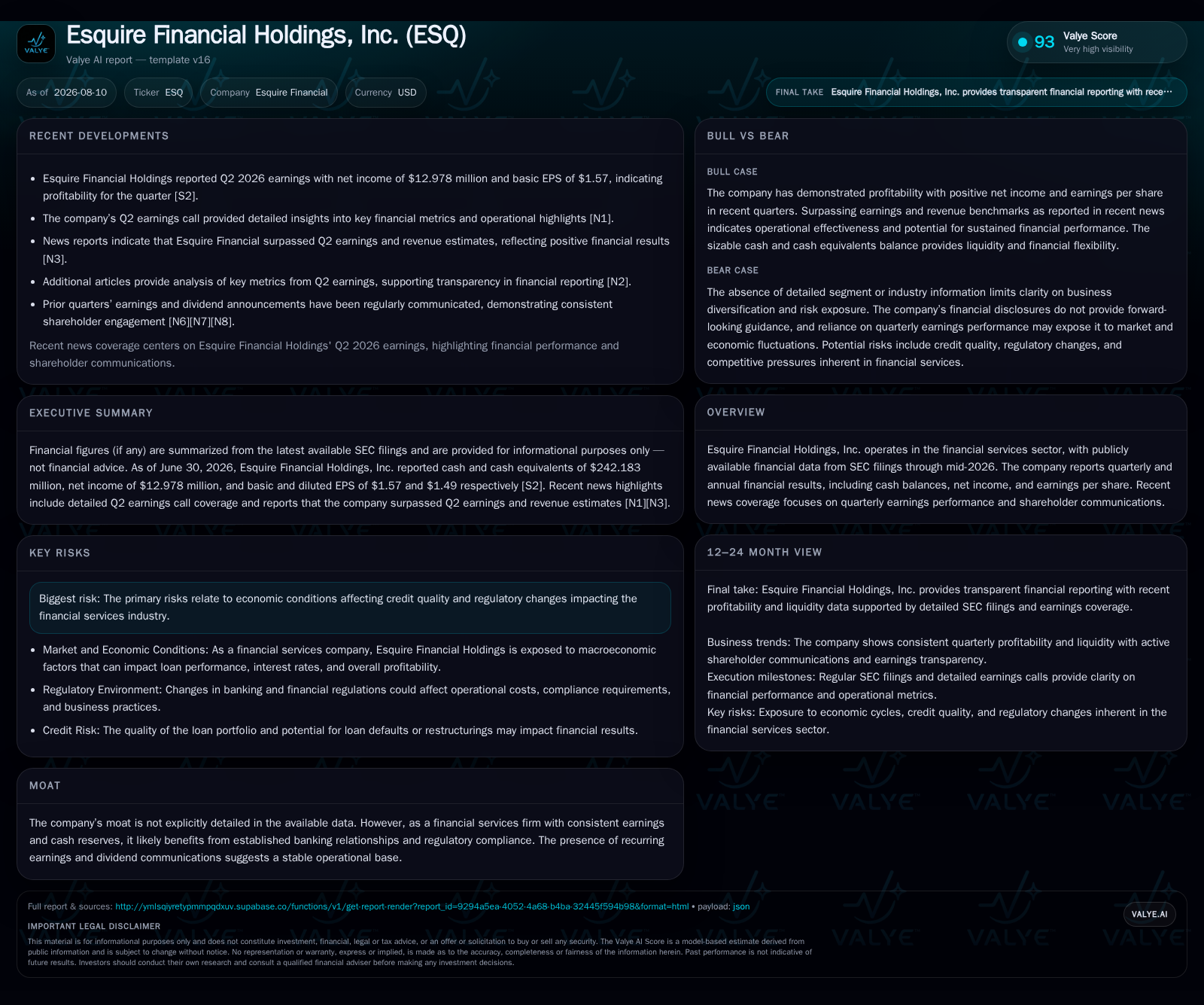
At June 30, 2026, Esquire reported cash and cash equivalents totaling $242 million reflecting solid liquidity buffers supportive of ongoing merger-related operating needs plus regulatory compliance thresholds [F1][S2]. Historically low cost core deposits were approximately $2.06 billion at December 31, 2025 backing the company’s lending activities while delivering a notably low overall deposit cost near one percent [S11][F1].
Net income attributable to shareholders was $25.2 million for the six months ended June 30, 2026 versus roughly $23.3 million for prior-year comparable periods indicative of underlying earning power resilience through expanding scale despite modestly higher merger costs [F1][S2]. Loan growth was strong with loans held for investment rising materially by about $15 million sequentially reflecting healthy origination appetite even prior to full integration impacts being realized [F1][S2].
These factors collectively sustain an industry-leading net interest margin above six percent driven by premium yields in niche lending balanced against cost-effective deposit funding complemented by non-interest fee revenues approximating mid-teens proportionally contributing to total revenue streams signaling good diversification relative to peers focused solely on interest income pools [S11].[F1]
This analysis is based solely on publicly available filings and industry context without any investment research view.
Disclaimer: This is research-only, informational analysis and not investment advice. It may include AI-generated interpretation and general industry context. Always verify important details using primary sources.

Comments