
Synaptics Expands AI Edge and IoT Leadership with Strategic Growth and Pending ON Semiconductor Merger
Synaptics reports solid fiscal 2026 growth driven by Core IoT unit expansion and wireless IP integration, while managing supply chain risks and merger execution.
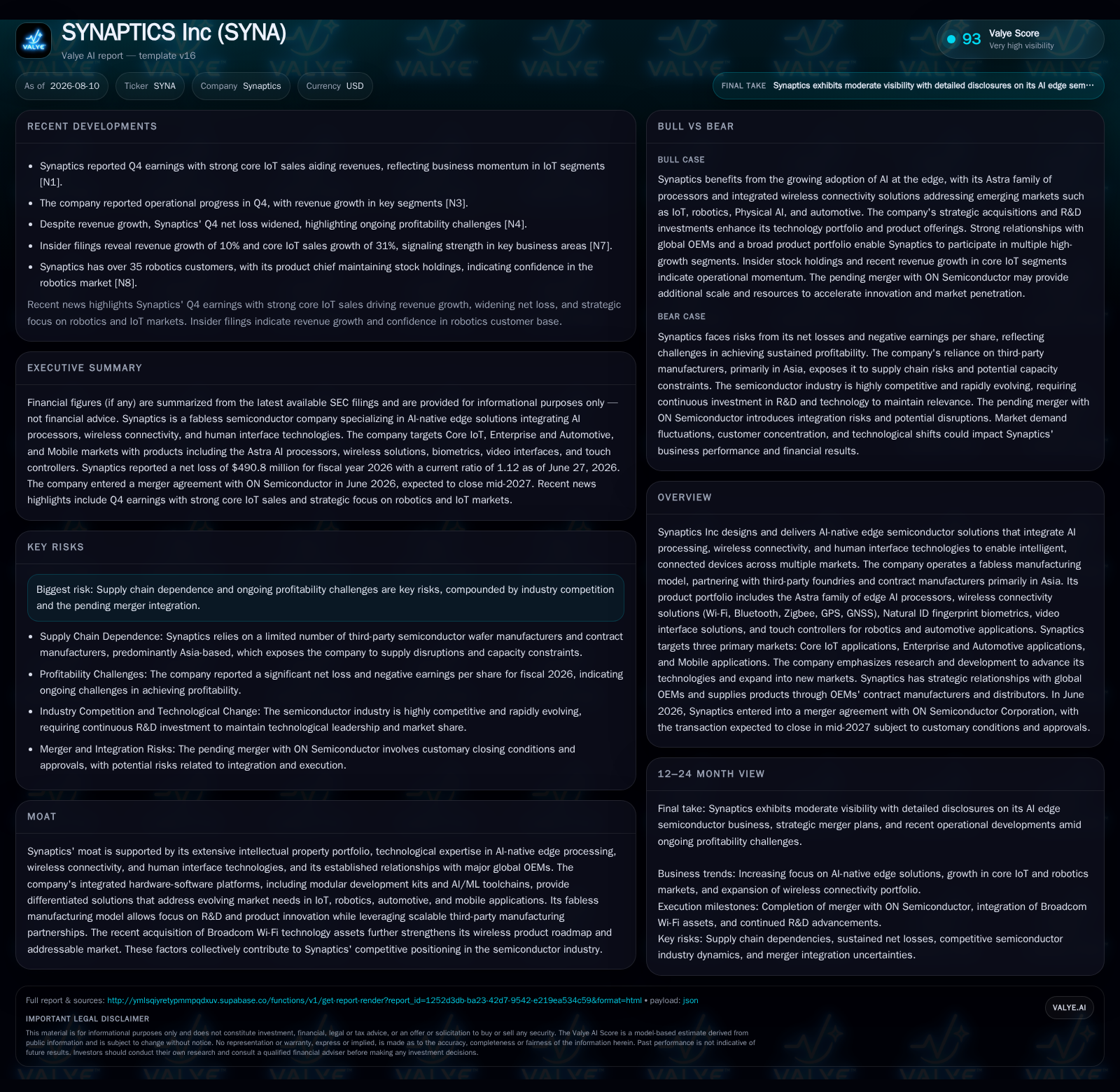
In its latest fiscal year ending June 2026, Synaptics demonstrated an 11.4% revenue increase, led by a 43.1% surge in Core IoT product sales—boosted by increased unit shipments and improved average selling prices. The company's fabless semiconductor model allows focused R&D on AI-native edge processors and wireless connectivity, targeting diverse markets such as IoT, automotive, and mobile devices. Despite top-line growth, the firm faces profitability pressures amid wider net losses and elevated debt following strategic acquisitions. A pending merger with ON Semiconductor aims to combine complementary portfolios but introduces integration risk. Key growth drivers hinge on expanding OEM adoption in intelligent edge devices, while risks stem from supply chain dependencies and intense competitive dynamics.
Recent Operating Update
Synaptics reported its fiscal year ended June 27, 2026 with robust top-line momentum: net revenue reached $1.197 billion representing an 11.4% increase over fiscal 2025 driven mainly by a significant surge in Core IoT applications revenue which rose 43.1% to $389.7 million [S1]. This segment benefitted from increases both in unit shipments and average selling prices (ASPs) enabled by favorable product mix enhancements including contributions from recently acquired Broadcom wireless assets. Enterprise & Automotive applications showed steady growth as well (+5.1%) reaching $641.1 million through higher volume shipments combined with improved IP licensing revenues. Conversely, Mobile revenues declined by 13.2% attributed principally to lower ASPs and reduced licensing income which reflected cyclical softness in certain mobile device categories [S1].
Notably, Synaptics’ latest quarter reflects continued focus on expanding its AI-native edge processor portfolio—the Astra™ family—which integrates embedded compute alongside multimodal sensing and wireless connectivity such as Wi-Fi, Bluetooth, Zigbee, GNSS positioning among others into single silicon solutions designed for next-generation interconnected devices in IoT ecosystems, automotive infotainment/ADAS systems, robotics, and mobile platforms [S1]. Its broad customer base comprises global OEMs who seek modular hardware-software platforms facilitating seamless adoption of AI-enabled capabilities with secure user interaction through biometric fingerprint sensors and intuitive touch/vision/audio interfaces.
Business Model
Synaptics operates as a fabless semiconductor company concentrating on the design of integrated circuits (ICs) such as system-on-chip (SoC) AI processors combined with application-specific integrated circuits (ASICs) delivering wireless connectivity modules and human interface technologies. Its business model generates revenues primarily through direct product sales of these chipsets embedded into customer devices along with licensing income derived from intellectual property portfolios tailored for high-value industrial segments.
The firm outsources manufacturing operations including wafer fabrication to third-party foundries mainly in Asia while relying on contract manufacturers for assembly or distribution of finished modules or standalone IC products tightly integrated with customer specifications—maintaining a flexible variable cost structure that mitigates capital intensity typical of semiconductor fabs [S1]. This fabless approach enables Synaptics to allocate more resources toward expansive research & development (R&D) efforts critical for sustained innovation in rapidly evolving areas such as AI edge processing architectures, low-latency wireless connectivity complying with emerging standards (Wi-Fi 6/7), and encompassing physical AI modalities like biometrics or multimodal sensing.
Product monetization hinges on volume shipments increasing with new design wins among OEM clients alongside ASP improvements driven by progressive feature incorporation and shift towards higher-margin custom silicon implementations rather than commodity offerings alone. License fees provide supplemental recurring revenues linked to proprietary technology embedded not only within Synaptics chips but also in broader device ecosystems.
Industry Structure and Competitive Position
Synaptics sits within the semiconductor value chain as a specialized design house catering predominantly to high-growth AI-native edge processing needs combined with connectivity solutions addressing IoT expansions spanning consumer electronics to automotive sectors—areas characterized by fierce competition alternating between platform providers focusing on scale (e.g., Qualcomm), vertical integration (Broadcom), or niche innovation (Cirrus Logic).
Its moat derives significantly from a rich intellectual property portfolio alongside software-hardware co-development —including development kits and AI/ML toolchains—that reduce customer time-to-market barriers while encouraging ecosystem lock-in through differentiated secure biometrics and seamless user interfaces [S1]. The fabless manufacturing leverages capacity scalability without direct capital expenditure risks but remains exposed to foundry constraints common across peers.
Recent acquisition of Broadcom’s Wi-Fi technology portfolio strategically expands its wireless roadmap positioning Synaptics closer to peer breadth seen in firms like Broadcom or ON Semiconductor who have diversified across connectivity plus power management domains targeting automotive electrification trends.
Growth Drivers
Several structural factors undergird Synaptics’ optimistic growth outlook:
- The proliferation of AI intelligence at the device edge creates increasing design demand for efficient embedded processors versus cloud-dependent models; Synaptics’ Astra SoC lineup targets this niche accelerating OEM adoption.
- Core IoT device deployments continue robust expansion fueled by smart home automation needs along with commercial-industrial sensor networks requiring secure seamless connectivity interoperable across multiple protocols like Wi-Fi/Bluetooth/Zigbee.
- Automotive electronics sees rising penetration with ADAS features increasingly dependent on multi-sensor fusion supporting Autonomous Driving levels necessitating integrated SoCs combining compute plus sensing input capabilities.
- Biometric authentication mandates across consumer mobiles plus robotics add requirements met uniquely by combined hardware-software IP stacks architected by Synaptics.
- New markets such as robotics platforms looking for human-machine interfaces or speech/audio enhancement benefit from Synaptics' diversified product mix enhancing ASP prospects.
- Software platform expansions including AI/ML tooling further entrench client partnerships enabling upsell opportunities that lengthen customer lifecycle value.
Risks and Watchpoints
Several risks remain pertinent:
- Supply chain volatility persists given dependence on external foundries & assemblers predominantly located in Asia exposing production schedules to geopolitical tensions or capacity bottlenecks impacting lead times.
- The highly competitive semiconductor market exerts continuous pricing pressures which can erode ASPs especially notable in Mobile segment declines recently observed despite overall growth elsewhere.
- Rapid technological obsolescence demands sustained R&D intensity; ineffective innovation cycles raise the risk of losing design wins or relevance amid faster moving peers.
- Customer concentration among large OEMs implies bargaining power risks; any major shifts or delayed product cycles can materially affect Synaptics’ shipment volumes.
- The pending ON Semiconductor merger adds integration complexity; synergy realization hurdles plus regulatory approvals represent potential hurdles delaying anticipated benefits or distracting management focus [S1][S3].
- Elevated net losses due partly to acquisition-related expenditures emphasize operational leverage challenges demanding efficiency improvements going forward.
What to Watch Next
Investors and observers should focus keenly on:
- Progress updates related to the mid-2027 closing of the merger with ON Semiconductor including regulatory milestones, merger approval vote outcomes, and integration roadmap clarity.
- Quarterly shipment volumes within Core IoT domains as early indicators of sustained demand trajectory alongside any stabilization tendencies in Mobile segment ASPs.
- Development pipeline announcements highlighting advancements in Astra processor capabilities or new wireless standards support reflecting competitive differentiation maintained through R&D spending.
- Operating margin improvement signaling progress toward profitability despite recent net loss widening.
- Intellectual property license fee trends providing insight into IP portfolio monetization beyond pure product sales channels.
- Supply chain stability including foundry allocation status amid persistent industry-wide tightness influencing time-to-market dynamics.
Financial Profile Discussion
As of the end of fiscal 2026, Synaptics maintains cash and equivalents totaling approximately $442.5 million paired against total debt near $850 million resulting in net leverage around $407 million [F1]. This level reflects financing raised largely connected to recent acquisitions aimed at broadening technology scope but also presents interest expense obligations that weigh against operating losses which stood at negative $67 million while net income plunged further negative toward -$491 million during this period [F1]. The current ratio rests at a moderate 1.12 indicating reasonable near-term liquidity sufficiency although working capital is constrained given sizeable current liabilities [$701 million vs $787 million current assets] [F1].
This analysis is based solely on publicly available filings dated up to August 2026; it does not constitute investment advice nor research views regarding securities transactions.
Disclaimer: This is research-only, informational analysis and not investment advice. It may include AI-generated interpretation and general industry context. Always verify important details using primary sources.

Comments