
PAMT CORP Navigates Litigation Costs and Cross-Border Freight Challenges Amid Operational Focus on High-Density Lanes
Latest quarterly filings highlight PAMT CORP's strategic focus on utilization and customer relationships while managing significant litigation exposure and cross-border tariff risks.
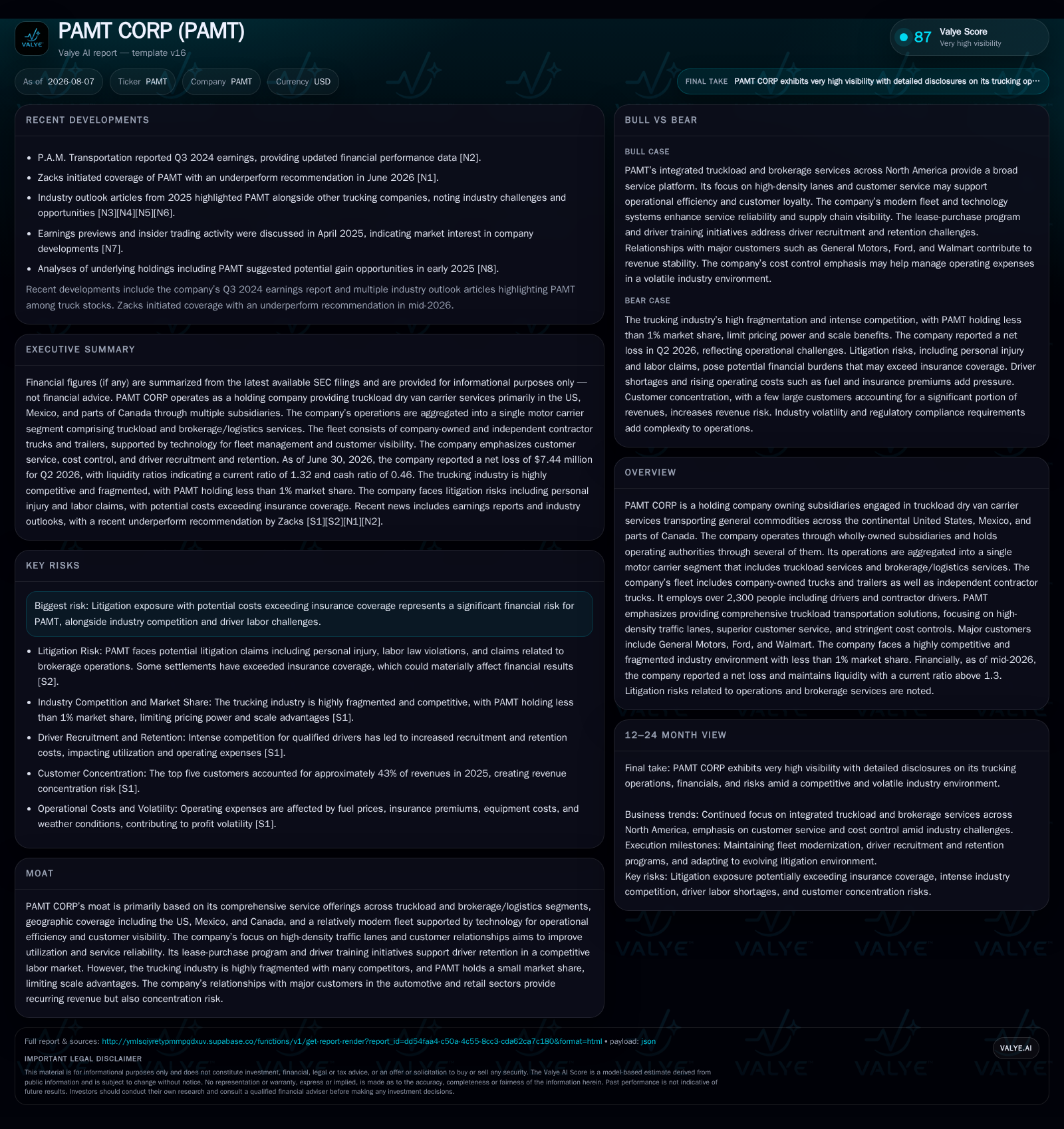
PAMT CORP reported ongoing challenges from a large vehicle accident settlement that exceeded insurance coverage, which materially affected its recent financial results. The company maintains its core strategy of serving high-density freight lanes and key customers like General Motors, Ford, and Walmart through a mix of truckload dry van operations and brokerage services across the US, Mexico, and Canada. While its strategy aims to improve fleet utilization and service reliability, PAMT faces industry headwinds including fragmented competition, driver retention pressures, fuel cost volatility, and uncertainties around cross-border trade tariffs. Monitoring operating ratios, litigation developments, and cross-border freight volumes will be crucial to assess the durability of PAMT’s business model.
Recent Operating Update: Litigation Impact and Executive Changes
PAMT CORP’s latest quarterly report filed August 7, 2026 ([S2]) confirms continued material exposure to litigation costs stemming from an accident in late 2024 that led to a $30 million settlement agreed upon by year-end 2025. The company’s net exposure after insurance was $26.5 million—a sum which significantly impacted Q4 2025 earnings ([S1], [S14]). Although no new material risk factors have been reported recently beyond those disclosed last year, the firm explicitly highlights ongoing risks around litigation claims potentially exceeding insurance coverage, especially linked to its brokerage/logistics segment. This vulnerability follows a May 2026 U.S. Supreme Court decision clarifying broker liability for negligent carrier selection (Montgomery v. Caribe Transport II), potentially increasing claim frequency and requiring enhanced carrier vetting resources ([S14]).
Operationally, the appointment of Daniel C. Kleine as Chief Financial Officer in July 2026 reflects a management emphasis on financial discipline and capital stewardship during these pressures ([S3], [S18]).
Business Model: Integrated Truckload Carrier with Brokerage Complement
PAMT is a holding company overseeing subsidiaries engaged primarily in truckload dry van transportation of general commodities across North America—including the U.S., Mexico (via agreements with local carriers), and parts of Canada ([S1], [S24]). The integrated motor carrier segment combines direct asset-based trucking operations with brokerage/logistics services that arrange shipments via third-party carriers under multiple operating authorities ([S27]).
Revenue derives mainly from freight hauling contracts with industrial customers predominantly in automotive parts and retail goods sectors; major customers General Motors, Ford, and Walmart collectively contributed nearly half of total revenues in 2025 ([S25]). This customer base provides recurring volumes essential for load density optimization within targeted traffic lanes.
The fleet comprises approximately 2,094 trucks (including ~493 independent contractor trucks) paired with over 8,000 trailers ([S25]), supporting both dedicated contract freight and spot market opportunities. PAMT emphasizes disciplined deployment of these assets within high-density lanes to maximize revenue per mile while minimizing unproductive empty mileage—a critical factor for operational efficiency in trucking logistics ([S26]).
Brokerage revenues complement trucking services by enhancing geographic coverage flexibility and enabling responsiveness to customer needs without owning all assets directly. However, brokerage also introduces increased liability risks as brokers may face negligence claims related to hired carriers.
Industry Structure and Competitive Position
The truckload transportation sector is highly fragmented with many small-to-mid size operators alongside large integrated peers such as J.B. Hunt Transport Services, Schneider National, Knight-Swift Transportation, C.H. Robinson (brokerage-focused), and Werner Enterprises (). PAMT’s modest scale limits broad scale economies compared with these leaders; however, its focus on targeted regional lanes combined with diversified service offerings creates a niche in service-sensitive freight segments rather than competing solely on price.
Multiple regulatory domains (U.S., Canadian provinces and Mexican federal agencies) impose compliance requirements concerning driver hours-of-service standards (HOS), safety inspections, hazmat regulations where applicable, licensing authorities held by various subsidiaries, drug testing programs, size/weight limits, etc. These add fixed compliance costs that challenge smaller carriers more than large ones able to spread overhead ([S10]).
Customer loyalty is nurtured through service reliability—tracking shipments electronically for visibility—and addressing time-sensitive delivery needs driven by just-in-time manufacturing schedules particularly prevalent in automotive supply chains ([S26]). The company's ability to maintain consistent equipment capacity along key routes supports this service promise.
Growth Drivers
Multiple structural factors support demand growth for PAMT's core offerings:
- Economic activity expansion, especially automotive production cycles and retail distribution demand increases freight volume.
- Cross-border trade growth between the U.S., Mexico, and Canada creates opportunities but also risks tied to tariff regime uncertainty ([S1], [S9]).
- Brokerage/logistics expansion diversifies revenue streams allowing flexible service coverage without proportional asset investment.
- Fleet modernization efforts improve fuel efficiency and uptime critical amidst rising diesel costs.
- Driver retention initiatives, including lease-purchase programs and driving schools like Select CDL Driving School Inc., aim to mitigate labor shortages that inflate driver turnover expenses typical in trucking ([S1]).
- Technology implementation supports route optimization reducing empty miles percentage—a pervasive inefficiency affecting profitability metrics like operating ratio.
Risks / Watchpoints / Growth Constraints
Key risks revolve around PAMT’s exposure to high-cost litigation claims due to operating liabilities inherent in trucking accidents and broker-neglected carrier incidents ([S14], [S9], [S23]). The recent legal environment suggests potential rises in claim frequency or severity could increase insurance premiums or curtail availability.
Concentration risk remains material given five largest customers account for >40% of revenues; downturns or strategic shifts at one or more major clients could significantly impact volume or pricing power ([S25]).
Fuel price volatility directly pressures operating expenses since PAMT does not hedge diesel fuel costs—unexpected spikes compress operating margins unless offset by rate adjustments or improved truck utilization ([S1]).
Industry fragmentation imposes intense competition pressure limiting pricing power; mismatches between capacity supply and demand can cause excess capacity leading to lower rates.
Cross-border tariff policies remain fluid following suspensions of prior U.S.-Mexico/Canada tariffs but looming potential reimposition injects uncertainty into freight volumes tied to manufacturing supply chains crossing these borders ([S1], [S9]).
Debt levels influence financial flexibility; although detailed current debt figures are sparse in recent filings beyond historical data indicating approximately $107 million total debt as of 2012 ([F1]), managing capital structure sensibly is vital amid unpredictable operating cash flows influenced by litigation payouts.
What to Watch Next
Upcoming milestones include final judicial approval of pending settlements related to prior litigations impacting earnings volatility ([S9], [S14]). Monitoring any new disclosures around litigation reserve adequacy will be telling.
Operational markers such as changes in the operating ratio (operating expenses/revenue) provide early readouts on cost control effectiveness amidst fuel price swings or labor cost inflation.
Tracking brokerage revenue contributions vs. asset-based income will indicate successful diversification or rising risk exposure from third-party carrier liabilities.
Customer retention levels among top five clients especially General Motors, Ford, Walmart signal stability or vulnerability from concentrated accounts.
Cross-border freight volume trends responding to tariff enactments or trade policy shifts remain critical given revenue sensitivity highlighted by management discussions ([S1]).
Finally, any updates on fleet renewal plans or new technology deployments impacting fuel efficiency or empty mile reduction would enhance margin prospects.
Financial Profile Discussion
PAMT's liquidity position as of June 30, 2026 shows cash & equivalents of $18.2 million against current liabilities totaling approximately $122.6 million giving a current ratio near 1.32—reflecting adequate short-term asset coverage but limited cushion for unexpected outflows ([F1]). Total debt figures are dated as last confirmed circa 2012 at roughly $107.5 million; approximated net debt considering cash totals about $89 million suggesting elevated leverage relative to its scale.
Operating income challenges have been evident given a recorded operating loss of over $64 million for the full-year ended December 2025 reflecting substantial charges primarily linked to litigation settlement impacts ([F1]). Net income correspondingly reflected a loss exceeding $52 million during that period.
These results underscore how episodic legal costs can overwhelm underlying operational earnings generated from recurring truckload freight activities typically characterized by thinner margins but steady cash flow generation if managed carefully.
DISCLAIMER: This analysis is for informational purposes only based on public filings and industry context as of August 7, 2026. It does not constitute investment advice or an offer to buy/sell securities.
Disclaimer: This is research-only, informational analysis and not investment advice. It may include AI-generated interpretation and general industry context. Always verify important details using primary sources.

Comments