
First Community Bankshares Expands Regional Presence and Payout Amid Stable Operating Foundations
The company leverages strategic acquisitions and employee retention to sustain its community banking franchise in the Southeast US.
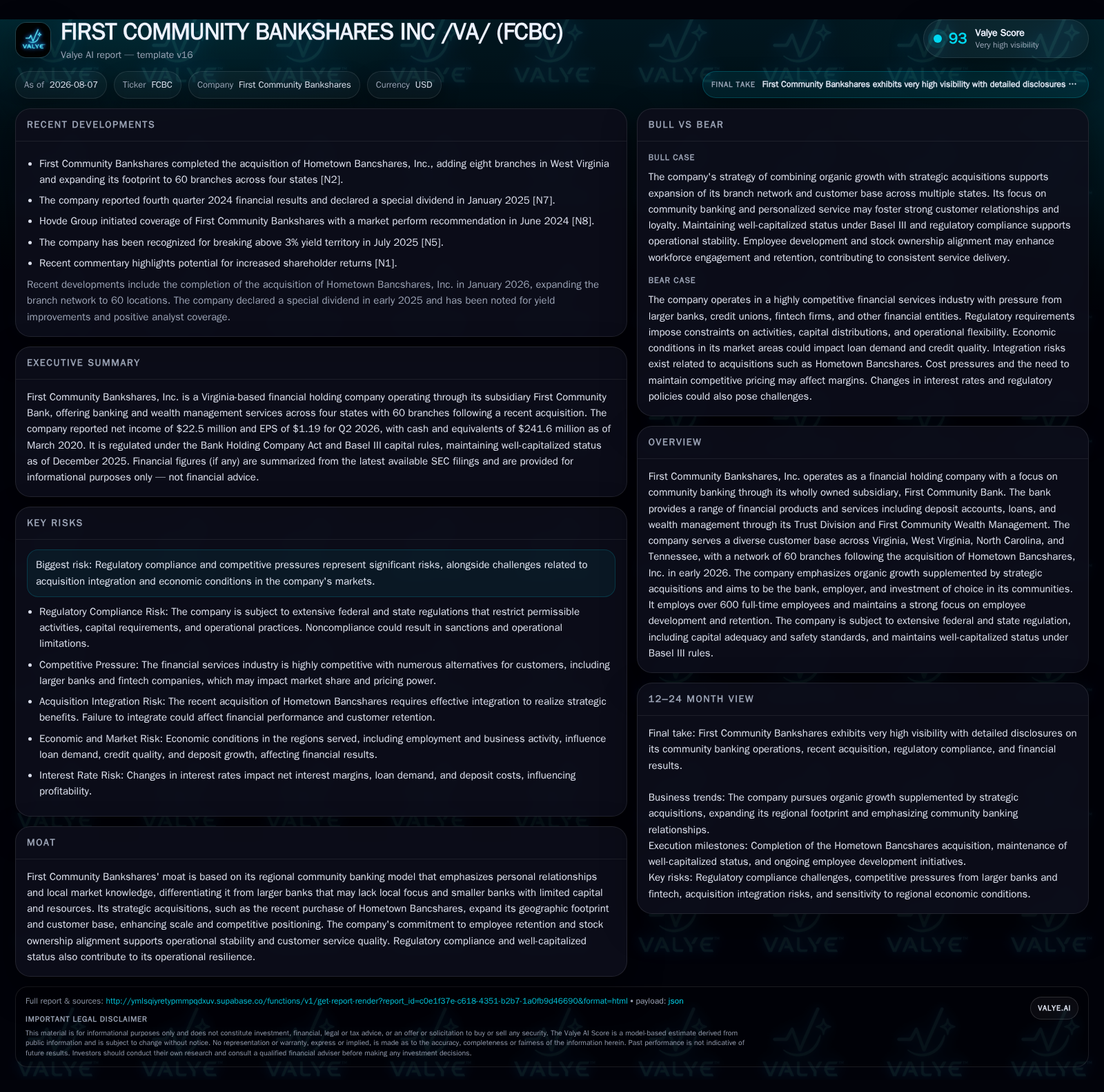
First Community Bankshares, Inc. operates a regional community banking business anchored by its wholly owned subsidiary, First Community Bank, with a recent acquisition increasing branch count to 60 across four states. The August 2026 quarterly filing confirms stable risk factors with no material changes and underscores a balanced mix of organic growth and strategic M&A for geographic expansion. Dividend increases signal confidence in earnings sustainability while regulatory capital levels remain comfortably above required minimums. Key industry headwinds remain focused on credit risk management, regulatory compliance, and economic cycles across its service footprint.
Recent Operating Update
The quarter also marked progress on the strategic front with full integration underway post-acquisition of Hometown Bancshares crowned earlier in January 2026. This transaction added eight West Virginia branches through Union Bank, boosting First Community’s presence to 60 branches across four states: Virginia, West Virginia, North Carolina, and Tennessee [S1]. This acquisition broadens First Community’s market coverage while aligning with their regional community banking strategy.
Business Model Analysis
First Community operates chiefly through First Community Bank, a Virginia-chartered institution offering traditional community banking products—deposit accounts and a range of commercial and consumer loans—augmented by wealth management services via its Trust Division and wholly owned subsidiary First Community Wealth Management [S1]. The bank targets individuals, small-to-medium businesses, and local communities emphasizing personal relationship banking over transactional volume.
Revenue mainly derives from net interest income generated by lending activity funded primarily through customer deposits [S1]. The margin between interest earned on loans versus interest paid on deposits (net interest margin) is critical for profitability. Fee income from wealth management and trust services provides diversification revenue less sensitive to interest rate cycles
Growth is pursued through two avenues: organic loan/deposit expansion driven by local economic activity and strategic acquisitions that extend geographic reach or complement product offerings. The acquisition of Hometown Bancshares exemplifies this dual approach—adding scale without diluting the local relationship focus. Employee retention initiatives including competitive compensation, career development training, and an employee stock ownership plan (ESOP) underpin service quality and institutional knowledge preservation; these support efficient operations and client loyalty [S1]
Regulatory supervision requires substantial ongoing compliance cost commitment but also establishes barriers against aggressive competition while enforcing capital adequacy standards.
Industry Structure and Competitive Positioning
First Community sits within the regional/community banking sector serving Southeastern U.S. markets characterized by moderately stable economies spanning education, government services, manufacturing, coal mining, transportation, retail trade, construction, tourism, and extraction industries [S1]. Local banks like First Community compete strongly on personalized service contrasted against larger national banks' scale-driven models which may lack local focus or responsiveness.
Peers such as Regions Financial Corporation or M&T Bank Corporation offer some parallels due to geographic overlap but tend to operate at larger scales with more diversified commercial portfolios. Smaller competitors include credit unions or boutique community banks focusing narrowly on localized niches but often lack First Community’s capital base for larger loans or technology investments.
The company leverages its expanded branch network post-acquisition to capture more retail deposits—a stable funding source with lower beta relative to wholesale funding—increasing balance sheet resilience amid potential interest rate fluctuations or credit cycles [S1]. Successful integration of acquired operations will be key to realizing anticipated revenue synergies without adverse cost overruns.
Growth Drivers
Key growth catalysts for First Community underpinning future financial performance include:
- Continued organic loan demand fueled by steady regional economic conditions supporting commercial borrowers’ capital needs.
- Deposit gathering through enhanced footprint via branch additions boosting low-cost funds.
- Cross-selling wealth management/trust services leveraging existing client relationships for fee income enhancement.
- Selective acquisitions expanding market share with disciplined underwriting ensuring credit portfolio integrity.
- Employee development programs yielding higher productivity and lower turnover costs sustaining customer service excellence.
- Potential net interest margin expansion if deposit beta remains low amid rate hikes or improved asset pricing power in core lending segments.
These drivers connect directly to KPIs such as loan growth rate, deposit growth rate, efficiency ratio improvements through scale or technology adoption, return on assets/equity stability, and capital adequacy ratios remaining comfortably above regulatory minimums [S1][S2]
Risks and Watchpoints
Despite strengths, First Community faces typical regional bank challenges:
- Economic sensitivity: Local downturns in the Southeastern states could depress loan demand or increase credit losses if borrower repayment capacity weakens.
- Interest rate volatility: Compression of net interest margin may occur if deposit rates rise rapidly (high deposit beta) without commensurate yield pickup on assets.
- Regulatory environment: Compliance costs may rise unpredictably with evolving federal/state rules related to cybersecurity, anti-money laundering (AML), data privacy laws impacting operational expense structures.[S1][S18]
- Acquisition integration risk: Failure to achieve projected synergies post-Hometown Bancshares deal could dilute earnings accretion expectations.[S15]
- Competition from both large banks deploying scale technology solutions or fintech entrants offering alternative financing/wealth management platforms may pressure margins or market share.
- Employee retention risks exist despite current positive HR policies; losing key personnel would impact relationship banking strength.[S15]
What to Watch Next
Investors should focus on several upcoming markers:
- Q3/Q4 operating results releases for loan/deposit growth momentum validation post-acquisition integration.
- Updates on net interest margin changes reflecting current rate environment impact or pricing strategy adjustments.
- Capital adequacy disclosures confirming maintenance above Basel III buffers especially after absorbing acquisition goodwill/intangibles.
- Dividends and payout policy statements indicating confidence levels in earning sustainability amid macro uncertainties.
- Any emerging risk factor disclosures tied to regional economic developments or heightened regulatory scrutiny.
- Progress reports on technology adoption aimed at improving efficiency ratios or client experience enhancements.
These indicators will help gauge whether management’s strategic path toward being “the bank of choice” is delivering durable shareholder value creation consistent with community banking moat execution principles [N1][S1][S3].
Financial Profile Discussion
Dividend increases implemented quarterly with payments rising from $0.31 earlier in Q1/Q2 2026 toward $0.33 suggest manageable payout ratios aligned with earnings capability without straining capital flexibility [S3][N1]
Disclaimer: This analysis is based solely on publicly available information up to August 2026 filings. It does not constitute investment advice nor an offer or solicitation for securities transactions. Readers should conduct independent due diligence before acting on any information presented herein.
Disclaimer: This is research-only, informational analysis and not investment advice. It may include AI-generated interpretation and general industry context. Always verify important details using primary sources.

Comments