
CB Financial Services Surpasses Q2 Expectations Backed by Strong Liquidity and Dividend Growth
The company's robust second-quarter results, highlighted by solid earnings and ample liquidity, underscore operational resilience in a challenging regional banking environment.
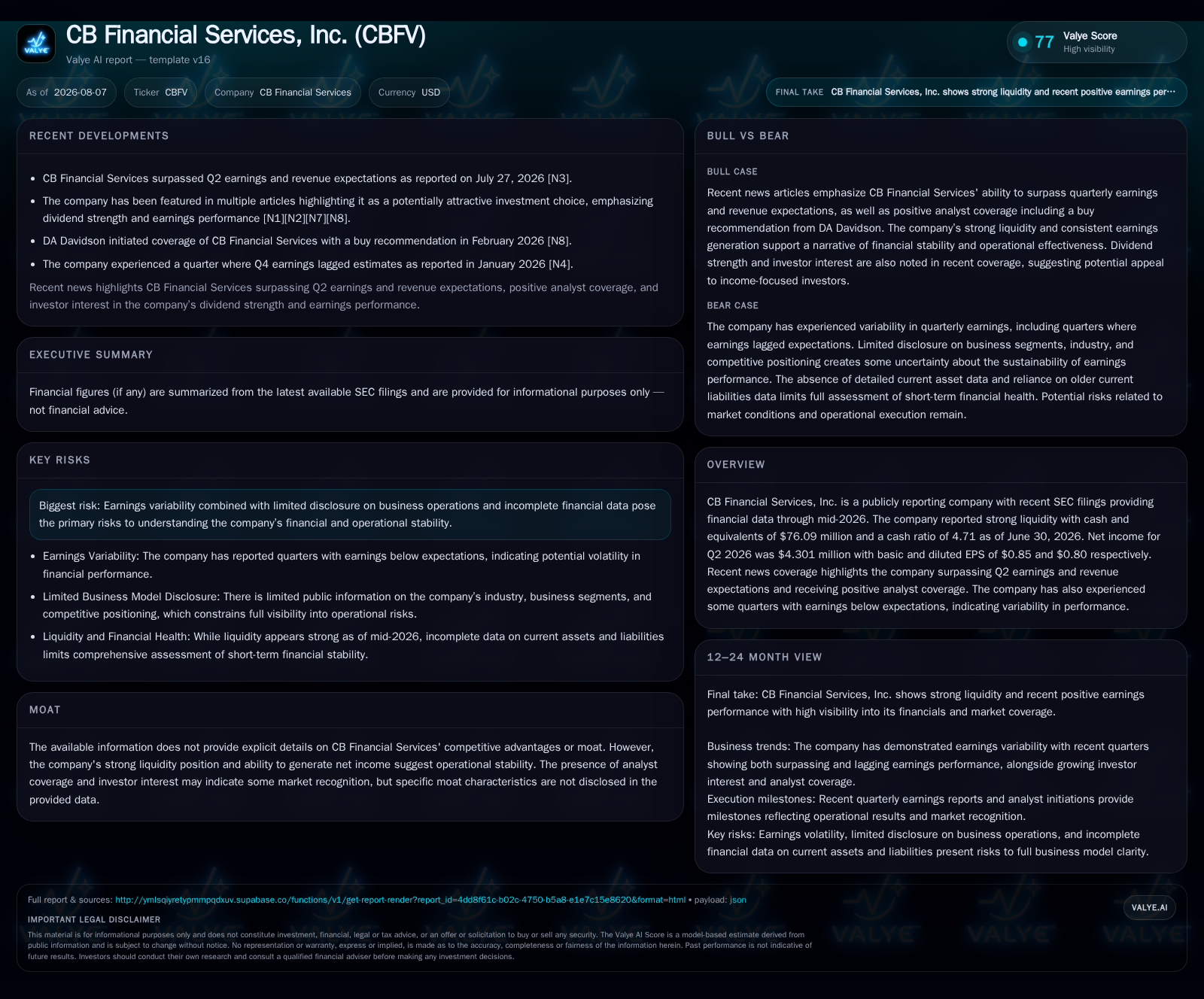
CB Financial Services, Inc. delivered a notable Q2 2026 performance with net income of $4.3 million and EPS surpassing consensus estimates, driven primarily by stable net interest income and disciplined expense management. The bank's strong liquidity position, with $76 million in cash and equivalents against $65 million in debt, supports its capacity to sustain dividends and absorb potential credit volatility. While the regional banking sector faces pressures from fluctuating interest rates and evolving regulatory demands, CB Financial's operational model appears well-positioned for stable growth given its localized lending focus and prudent capital management.
Q2 Performance Accelerates with Earnings Beat and Liquidity Strengthening
CB Financial Services posted a robust financial performance in Q2 2026, reporting net income of $4.301 million with basic EPS at $0.85 and diluted EPS at $0.80, which surpassed market consensus [S2][N1]. This earnings beat was complemented by a strong liquidity profile — the company held approximately $76.1 million in cash and equivalents against about $65 million in total debt as of June 30, 2026, implying a net cash position of nearly $11 million [F1]. Such ample liquidity equips the bank with substantial operational flexibility in an environment marked by increasing interest rate volatility and competitive stress within the regional banking sector.
The Q2 results also included a new cash dividend declaration of $0.28 per common share payable at the end of August 2026, signaling continued confidence in the bank’s capital base and ongoing earnings power despite episodic earnings variability experienced in prior quarters [S3]
This recent quarterly performance update is critical as it indicates CB Financial’s ability to navigate prevailing headwinds while sustaining shareholder returns — an important factor for investor perception given mixed earnings performances seen industry-wide.
Business Model Anchored in Traditional Lending with Auxiliary Fee Revenue Streams
CB Financial operates predominantly as a regional community bank focused on serving local consumers and small- to medium-sized businesses within its geographic footprint [S1]. The core revenue driver remains net interest income generated from lending activities funded primarily through deposits gathered locally. This model relies heavily on maintaining a stable deposit base from lower-cost liabilities to support loan growth sustainably.
Supplementary income streams include fees earned from wealth management services, payment processing products, and loan servicing — all common ancillary offerings that help diversify revenue beyond pure interest spreads [S1][S2]. While specific details on product mix or fee contribution percentages are not explicitly disclosed, these services typically enhance margin resilience across economic cycles.
Interest rate fluctuations directly impact CB Financial’s net interest margin (NIM), which represents the spread between interest earned on loans/investments and interest paid on deposits or borrowings. Given recent tightening monetary policy contexts across regional markets, managing asset sensitivity and deposit beta remains a focal operational challenge influencing profitability stability.
Market Structure: Localized Competitive Pressures Inform Pricing Power and Efficiency
Within its local markets, CB Financial competes alongside other similar-sized community banks as well as larger regional players such as Midland States Bancorp and Northeast Community Bancorp — institutions that operate under comparable regulatory regimes and customer demographics [N3][N2]. Pricing power is constrained by competitive deposit gathering pressures that increase funding costs; this deposit beta effect can compress NIMs when benchmark rates rise unless offset by repricing assets or cost control.
Operational efficiency is another key battleground where firms differentiate themselves. Efficiency ratios measuring operating expenses relative to revenues serve as crucial markers of cost discipline—a metric closely watched by investors for gauging scalable profitability potential amid narrow net interest margins typical in regional banking sectors.
Regulatory compliance obligations also impose incremental expense load components, particularly impacting smaller institutions lacking scale benefits inherent in top-tier banks; thus balance sheet optimization alongside prudent risk management frameworks becomes paramount for sustaining competitive viability.
Growth Drivers Rooted in Local Economic Conditions Plus Expanded Service Offerings
Loan growth remains the primary tangible indicator reflecting demand strength within CB Financial’s served communities [S2]. Robust local economic health typically fuels borrowing needs among consumers for mortgages or autos as well as among businesses seeking capital for expansion or working capital support. Increased loan originations underpin higher interest income generation while maintaining asset quality mitigates volatility risks.
Deposit base expansion goes hand-in-hand with loan growth potential; successful community engagement strategies can expand retail relationships generating low-cost funding enhancing margin leverage channels.
Additionally, judicious development of fee-based service lines such as payment systems or wealth advisory can offer modest but steady contributions that smooth revenue cyclicality inherent to interest-sensitive lending portfolios [S1][S2]
Although there are no explicit disclosures regarding technological initiatives or acquisitions enhancing this evolution recently, broader sector adoption trends point toward ongoing digitization efforts aimed at improving customer experience metrics—an increasingly relevant factor for retention amid rising fintech competition.
Risk Factors Emphasize Credit Quality Variability and Macro Environment Sensitivities
CB Financial acknowledges risks typical to community banks including credit risk fluctuations directly impacting allowance for loan losses provisions [S1][S2]. Earnings variability noted historically is consistent with cyclical influences on credit performance — restrictions related to non-performing assets or increased provisioning can dampen profitability unexpectedly.
Interest rate risk stemming from asset-liability mismatches further complicates margin stability under monetary tightening phases. Additionally, regulatory rule changes may incrementally increase compliance costs or capital requirements thereby constraining strategic deployment of capital toward growth initiatives.
Emerging competition from non-bank financial technology firms challenges traditional customer acquisition approaches necessitating active business model adaptation strategies over time [S1].
Limited granular disclosure on detailed credit metrics like non-performing loan ratios constrains comprehensive risk quantification; however absence of material distress signals in filings implies manageable exposure currently.
Financial Profile Discussion: Capital Adequacy Supports Modest Dividends With Operational Cash Cushion
From a balance sheet perspective as of June 30, 2026, CB Financial maintains roughly $76 million in liquid assets versus approximately $65 million total debt obligations resulting in an approximate net cash position near $11 million—an uncommon position among many regional peers struggling with leverage management [F1]. This liquidity buffer strengthens funding flexibility.
Net income generation during recent quarters supports dividend payment sustainability illustrated by declared dividends totaling $0.28 per share each quarter through mid-2026 reinforcing investor return commitment backed by consistent positive cash flow from operations [S3][F1]
No indications of capital adequacy deterioration surfaced within latest filings suggesting regulatory capital ratios remain within acceptable thresholds protecting solvency while enabling measured growth capacity.
Upcoming Milestones And Key Metrics To Monitor For Execution Consistency
Future monitoring should emphasize loan portfolio growth trajectories alongside credit loss provisioning expense trends to assess if upward earning pressures are sustainable or transitory given current economic conditions [S3][N1]
Watch-list includes next quarterly report releases detailing potential shifts in deposit composition or funding cost structures amidst volatile market interest rates.
Dividend announcements remain vital indicators reflecting board confidence levels supporting shareholder value return philosophies aligned with earnings prospects.
Subsequent disclosures connected to cybersecurity safeguards following recent incident investigations may also impact reputational risk assessments important for long-term client retention dynamics [S25]
Overall, CB Financial’s trajectory warrants attention regarding how consistent operational execution will navigate external pressures balancing localized market nuances with evolving fintech threats.
Disclaimer: This is research-only, informational analysis and not investment advice. It may include AI-generated interpretation and general industry context. Always verify important details using primary sources.

Comments