
George Risk Industries Advances Custom Security Hardware Amid Rising Costs and Market Dynamics
RSKIA reports steady sales growth driven by product customization and key distributor partnerships while managing input cost pressures and operational efficiency.
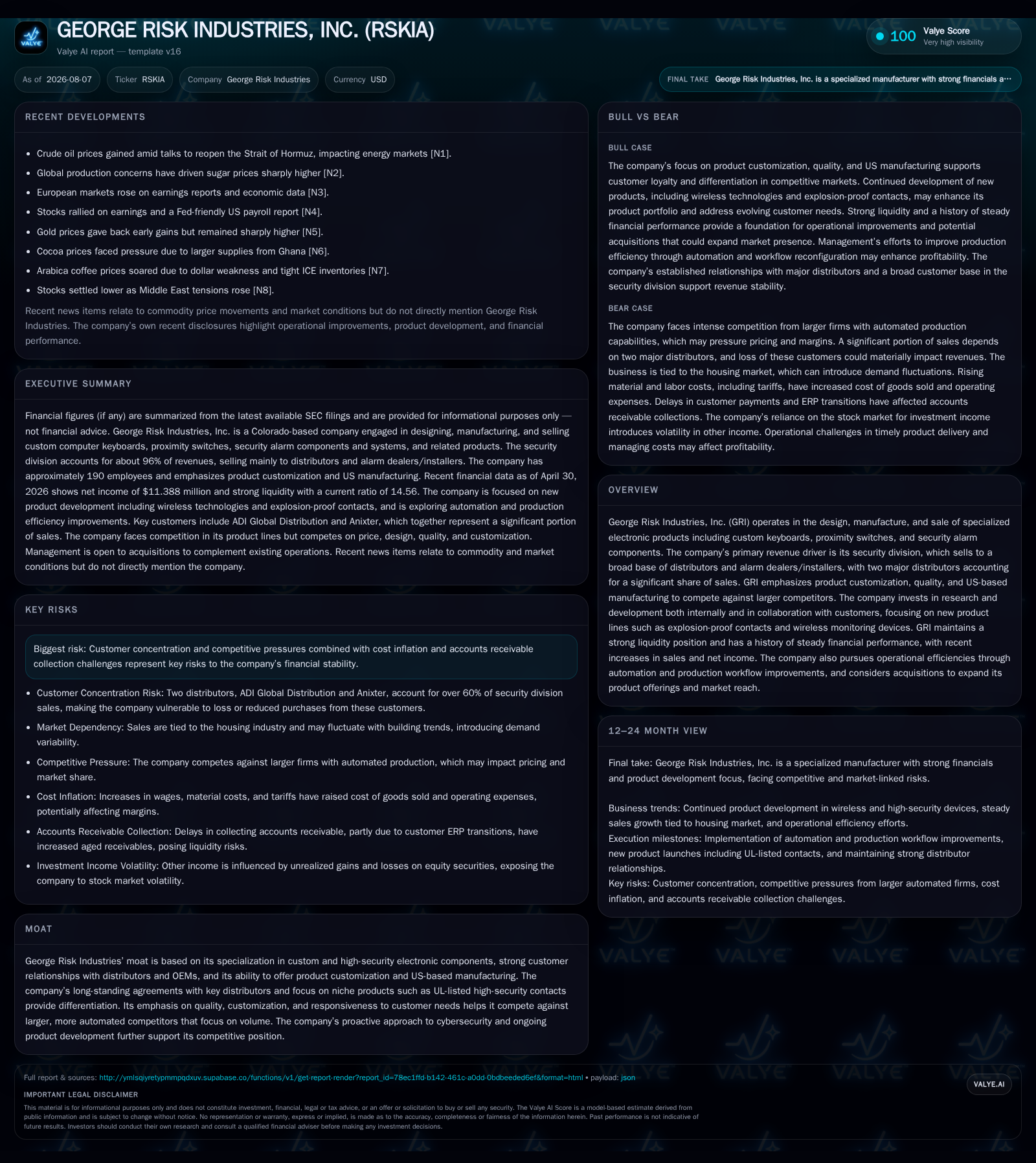
George Risk Industries, Inc. (GRI) has delivered a solid quarter with net sales up 15.2% year-over-year, supported by its focus on product customization and strong relationships with major security distributors. Despite rising costs in wages and materials pushing cost of goods sold above targeted thresholds, the company partially offset this through pricing actions and ongoing operational improvements including automation initiatives. GRI's customer concentration presents a revenue risk, but long-term distributor agreements and niche product offerings underpin its competitive positioning. Continued investment in R&D for specialized UL-certified products and wireless security devices highlights the company’s growth strategy within a housing-market correlated industrial hardware space.
Recent Operating Update
George Risk Industries reported net sales of $5.66 million for the quarter ended January 31, 2026, marking a robust 15.21% increase from the same period last year [S2][S3]. This growth is attributed primarily to ongoing expansion of market share within its core industrial electronic components sectors and effective resolution of backorders, underscoring strong demand recovery after pandemic-related disruptions. The company recognizes that sales remained slightly lower than the preceding quarter due largely to seasonal softness linked to the housing market downturn typical during winter months—a key demand driver for its products [S2][S16].
Business Model Analysis
George Risk Industries operates across two principal segments: a security division comprising specialized alarm components that generate approximately 96% of revenues, and a secondary keyboard/proximity switch division serving OEMs and distributors with custom electronic components [S1]. The company's business model hinges on designing highly customizable products catering to security alarm systems—specifically proximity switches and magnetic contacts—and selling predominantly through distribution networks that include installation specialists.
A notable aspect of GRI’s model is its focus on small custom order volumes often declined or deprioritized by larger players equipped with automated facilities focused on scale optimization. GRI capitalizes on US-based manufacturing operations facilitating responsive product customization, quality assurance, quick design iteration cycles, and compliance certifications such as UL listings essential for high-security applications [S1][S9][S28]. These factors contribute to differentiation against peers whose competitive advantages derive from large-scale automation rather than bespoke engineering.
Revenue mechanics are tightly linked to distributor relationships; business is substantially dependent on legacy agreements particularly with ADI Global Distribution LLC accounting for roughly 37%, complemented by Anixter at about 23.5%, together constituting nearly 60% of security division revenue [S1]. These contracts establish recurring purchase volumes but also concentrate risk in case of distributor attrition or shifts in purchasing strategies.
Operationally, GRI balances labor-intensive manufacturing costs against price realization strategies including incremental price adjustments designed to mitigate input cost inflation without substantial volume erosion—a dynamic continuously monitored via KPIs like COGS percentage relative to sales and operating margin trends [S9][S28]. Investment in product development facilitates lifecycle extension through innovations such as explosion-proof magnetic reed switches suited for hazardous environments or high-security UL Level 2 rated sensors targeting critical infrastructure sectors like government buildings or nuclear sites—a clear moat element built on compliance barriers
Industry Structure & Competitive Positioning
Within the industrial electronic components and security hardware industry, George Risk occupies a specialized niche emphasizing customization over mass production automation prevalent among larger competitors such as Honeywell’s security hardware division or Allegion plc within access control solutions. While these peers leverage scale economies facilitated by offshore manufacturing footprints and advanced automation driving low unit costs, GRI leverages agile domestic manufacturing enabling rapid design tweaks aligning with complex OEM specifications.
This two-tiered competitive approach yields trade-offs: GRI faces cost challenges due to labor intensity but commands premium pricing linked to customization capabilities absent from automated producers’ portfolios. Its emphasis on US-based production also appeals amidst growing geopolitical shifts favoring reshoring efforts to secure supply chains post-pandemic—a structural trend supporting GRI’s positioning.
Customer concentration remains a critical watchpoint in this distribution-reliant market given ~60% dependence on two entities; however, longstanding multi-decade relationships coupled with written contracts provide stability mitigating abrupt revenue fluctuations though not eliminating concentration risk entirely. Operational KPIs such as customer retention rates within these accounts alongside order backlog tracking will serve as early indicators should distributor commitment weaken.
Growth Drivers
Growth at George Risk is structurally underpinned by multiple converging industry dynamics:
- Increasing demand for security alarm systems particularly in residential housing markets where construction activity has stabilized post-pandemic supports consistent baseline demand; however, GRI experiences seasonal variability related to this sector’s seasonal cycles [S2][S16].
- Expansion in smart wireless security technologies provides new product categories that enable cross-selling opportunities leveraging existing distribution channels.
- Strong OEM partnerships seeking highly customized components foster incremental sales beyond standard offerings.[S1]
- Infrastructure investments amplifying retrofit demand in commercial buildings fuel adoption of advanced high-security magnetic sensors meeting UL Level requirements.
- Regulatory trends worldwide are progressively tightening security standards elevating requirements for certified explosion-proof contacts—a growth vector currently exploited through ongoing development projects.
- Strategic moves towards more automation on production floors aim to improve throughput capacity enabling better order backlog management while controlling unit costs amid rising wage pressures.
- Management openness towards targeted acquisitions funded internally creates optionality for expanding product lines or distribution footprints without dilutive financing risks leveraging cash reserves effectively [S2].
Risks & Constraints
Several risks constrain George Risk’s growth trajectory:
- Concentration of revenue among two large distributors poses significant risk case if purchasing priorities shift or contracts lapse unexpectedly; mitigation leans heavily on maintaining close customer relationships and contractual safeguards.
- Competitive pressure intensifies from larger firms deploying automated mass-production facilities capable of competing aggressively on price outside customized niches.
- Inflationary pressures persistently increase raw material costs (e.g., metals used in reed switches) along with escalating labor wages challenging margin maintenance despite pricing adjustments.
- Supply chain disruptions continue creating uncertainty around timely availability of certain specialized materials impacting delivery schedules and customer satisfaction metrics requiring enhanced inventory management discipline.
- Product obsolescence risk mandates continuous R&D investment especially as wireless technologies evolve rapidly demanding agility beyond traditional mechanical switches.
- Collection delays affecting accounts receivable have been noted linked partly to larger customers transitioning ERP systems; aging receivables beyond 90 days spiked temporarily but reportedly improved thereafter signaling an operational watchpoint for working capital efficiency [S7].
- Regulatory compliance complexities involving product certifications necessitate sustained resource allocation reinforcing barriers but constraining scaling speed.
What To Watch Next
Key milestones influencing near-term outlook include:
- Improvement in inventory turnover rates and backlog reductions as modernization plans including factory floor reconfigurations progress toward enhancing fulfillment timeliness [S2][S16].
- Adoption rate of newly launched UL listed explosion-proof contacts within targeted government/military verticals reflecting successful commercialization beyond R&D phase.[S9][S28]
- Further deployment of wireless-enabled contact switches expanding product portfolio relevance aligned with IoT trends.[S9][S28]
- Monitoring accounts receivable aging profile post-February collections confirming restoration of normal customer payment behavior.[S7]
- Additional acquisitions or complementary product line expansions funded via strong cash reserves signaling strategic growth initiatives beyond organic avenues.[S2]
- Pricing power sustainability amid persistent raw material cost inflation evidenced by future COGS percentage trends relative to net sales metrics indicating successful cost pass-through capability.
Financial Profile Discussion
As of April 30, 2026, George Risk Industries maintained a robust liquidity position highlighted by cash and equivalents totaling approximately $5.16 million alongside current assets amounting to $68.42 million against modest current liabilities near $4.7 million yielding an exceptionally strong current ratio around 14.56—an indicator of solid short-term solvency supporting operational flexibility without reliance on external financing sources [F1][S2]. This liquidity buffer underpins management's stated intention to pursue opportunistic acquisitions internally funded without dilution or borrowing costs.
This analysis leverages publicly available SEC filings as primary evidence sources combined with sector-specific expertise relevant to industrial electronic components and security hardware manufacturing dynamics.
Disclaimer: This is research-only, informational analysis and not investment advice. It may include AI-generated interpretation and general industry context. Always verify important details using primary sources.

Comments