
SkyWater Technology Faces Liquidity Pressure Amid Modest Revenue and Operating Losses
Latest quarterly results underline capital intensity and operational challenges in specialty semiconductor fabrication.
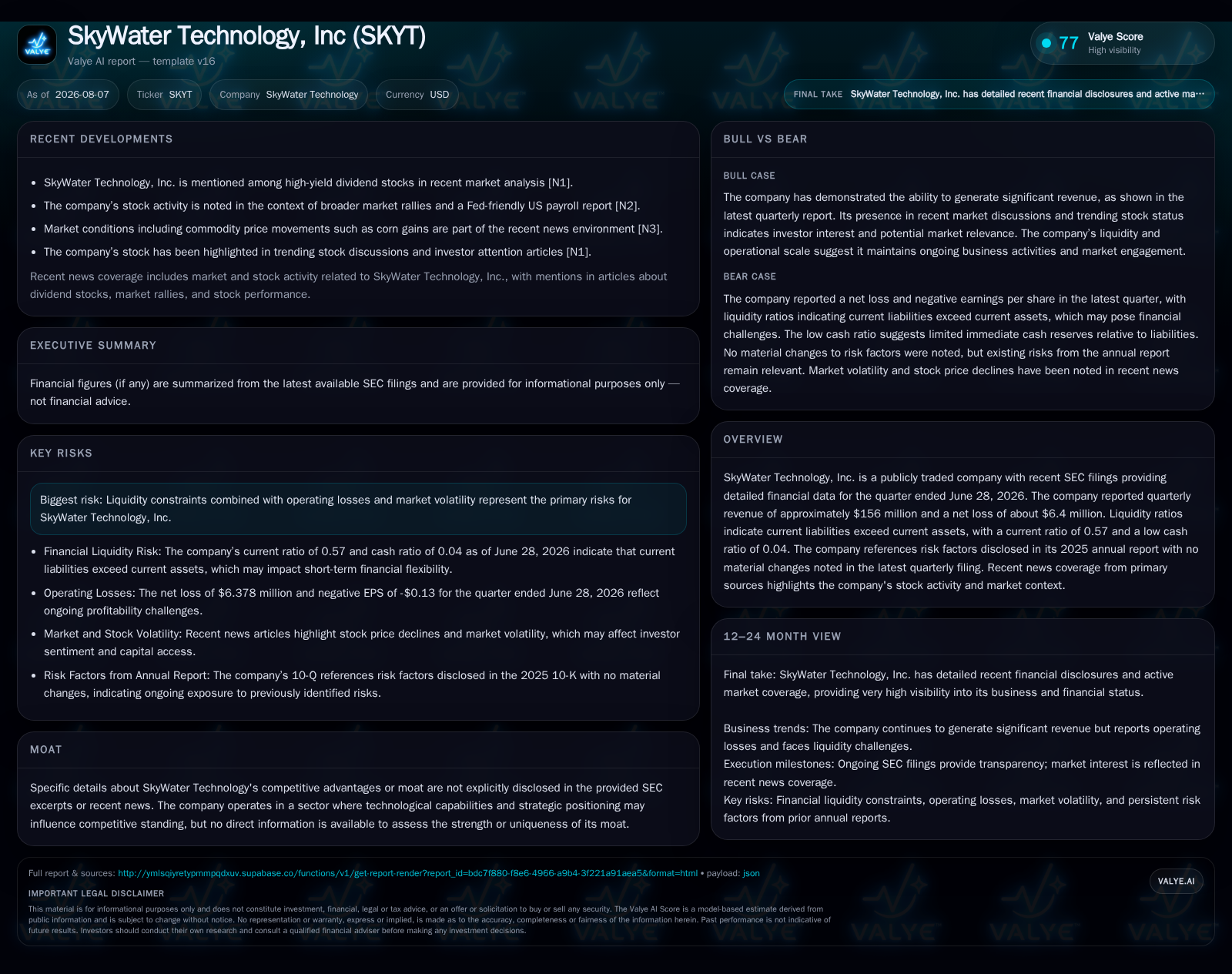
SkyWater Technology reported $156 million in revenue for Q2 2026 along with a net loss of approximately $6.4 million, reflecting ongoing operational pressures typical of capital-intensive semiconductor fabs. The company's current ratio stands at a weak 0.57, signaling liquidity constraints despite terminating its revolving credit facility recently. Positioned as a specialty and government-serving wafer fab, SkyWater’s growth depends on capacity utilization, technology adaptation, and navigating supply chain and capital structural risks. Monitoring backlog development, design wins, and cash flow will be critical as the firm integrates its newer facilities and prepares for competitive and technological shifts.
Recent Operating Update
is liquidity profile underscores pressure from short-term obligations during negative earnings.
Business Model Analysis
SkyWater Technology operates as a specialty semiconductor fabrication services provider focusing on manufacturing integrated circuits based on customer designs. Unlike large pure-play foundries such as TSMC that offer cutting-edge process nodes at scale across broad markets, SkyWater targets more specialized wafers often serving industrial electronics, defense contractors requiring secure sourcing channels, and other niche sectors critical to U.S. government programs [S1]. The company generates revenue mainly by utilizing its wafer fab capacity—measured by fab utilization rates—with price realization driven by process complexity and customization level. Key revenue drivers include ability to win design-ins with customers’ chip projects (design wins), maintain high yield rates through effective photolithography and process controls in cleanrooms, and optimize cycle times per wafer batch.
SkyWater's business model exposes it to customer concentration risks because it relies heavily on a few large contracts that are often subject to government funding cycles or industrial application demand swings. Revenue recognition mechanics depend on customer purchase commitments under fabrication service agreements or task orders rather than direct unit sales alone.
Industry Structure and Competitive Position
The semiconductor fabrication services industry is highly capital intensive with rapid technology node turnover. Firms like TSMC lead with advanced nodes (sub-5nm), but SkyWater operates primarily in specialty analog/mixed-signal processes or mature nodes aligned with defense-grade reliability requirements rather than the leading-edge digital logic market segment. Competitors in the specialty foundry space include Tower Semiconductor and X-Fab who similarly cater to niche analog/power applications.
This positioning shields SkyWater somewhat from direct head-to-head competition with mega-foundries but subjects it to margin pressure from smaller-scale volumes coupled with significant fixed costs tied to fabs' infrastructure like tool maintenance and cleanroom environments.
Customer switching costs can be high given the technical certification needed for secure or mission-critical uses; however, maintaining differentiated capabilities across evolving technology nodes remains essential in preventing commoditization.
Growth Drivers
Growth catalysts for SkyWater revolve around secular increases in semiconductor content beyond consumer electronics into automotive electronics (e.g., EVs), industrial IoT devices requiring customized chips, AI hardware accelerators needing specialized mixed-signal ICs, as well as increased U.S. government spending aimed at domestic semiconductor supply chain resilience.
Technology migration toward moderately advanced nodes enables some margin expansion if SkyWater can demonstrate reliable yields higher than peers operating at similar scales. Additionally, reshoring trends amid geopolitical tensions create opportunities for fabs domestically based like SkyWater to capture demand otherwise directed offshore.
Enhanced backlog levels or book-to-bill ratios above one would validate growing demand visibility; however, detailed data on these KPIs remain undisclosed publicly. Expanding design wins—secured via customer relationships supported by flexible production economics—is another measure that could signal successful growth execution.
Risks and Watchpoints
Primary risks include liquidity constraints amplified by ongoing operating losses coupled with substantial fixed debt repayment schedules totaling nearly $72 million against very limited cash reserves [$12.6 million cash vs. $179 million current assets vs $318 million current liabilities at quarter-end] [F1]. This gap raises concern over runway without additional financing or improved cash flow.
Operationally, capacity underutilization during weaker demand periods can rapidly erode margins given high fixed overheads.
Supply chain disruptions affecting critical materials (e.g., photolithography chemicals or equipment parts) may cause cycle time delays or quality yield setbacks.
Regulatory environment changes impacting U.S.-based government contract eligibility or tariffs also pose risks.
While merger activity completed preliminary stages recently with IonQ acquiring SkyWater’s parent structure [S25], integration complexities could distract management focus short term.
What to Watch Next
Key near-term milestones include monitoring whether SkyWater's cash burn improves sustainably post-termination of the revolving credit facility [S3], alongside any indications of successful ramp-up of recent fab acquisitions or technological upgrades enhancing yield rates.
Backlog growth or favorable book-to-bill ratios would signal strengthening demand.
Updates on design wins—especially those tied to emerging AI/IoT applications—and any expansions in government contract awards represent critical growth markers.
Financial metrics capturing free cash flow generation improvements versus past quarters will indicate progress toward mitigating liquidity risk.
Finally, observing management’s commentary on capacity utilization trends relative to peer specialty fabs will help gauge competitive positioning trajectories.
Financial Profile Discussion
At quarter end June 28, 2026, cash & equivalents stood at approximately $12.6 million against current liabilities exceeding $318 million yielding a constrained liquidity position reflected by a current ratio near 0.57—the sector's capital intensity typically demands robust working capital buffers often not evident here [F1]. Total debt approximated $72.5 million net of cash equates to a net debt position near $59.9 million emphasizing ongoing leverage burden [F1].
The company’s termination of its revolving credit facility as of July 31 suggests an attempt to deleverage but also removes access to flexible financing just as operational losses persist [S3]. Given sector norms sustained losses can be temporarily manageable if offset by growing fab utilization translating into higher gross margins; however delays can impair ability to cover ongoing interest/rent payments related to leased equipment/facility obligations commonly present given sale-leaseback financing noted previously in filings.
Overall finance metrics portray risk converging around short-term liquidity stress coupled with medium-term reliance on top-line demand recovery improvement alongside possible equity/debt raises needed for sustaining capex programs vital in keeping up with technology migration requirements inherent in semiconductor fabs’ competitive dynamics.
This analysis is based solely on publicly available SEC filings and sector knowledge without recommending any investment action.
Disclaimer: This is research-only, informational analysis and not investment advice. It may include AI-generated interpretation and general industry context. Always verify important details using primary sources.

Comments