
Dine Brands Advances Franchise Expansion While Balancing Leverage and Cost Pressures
Dine Brands reports mixed Q2 results as franchise royalties grow but operating margins face inflation and debt service constraints.
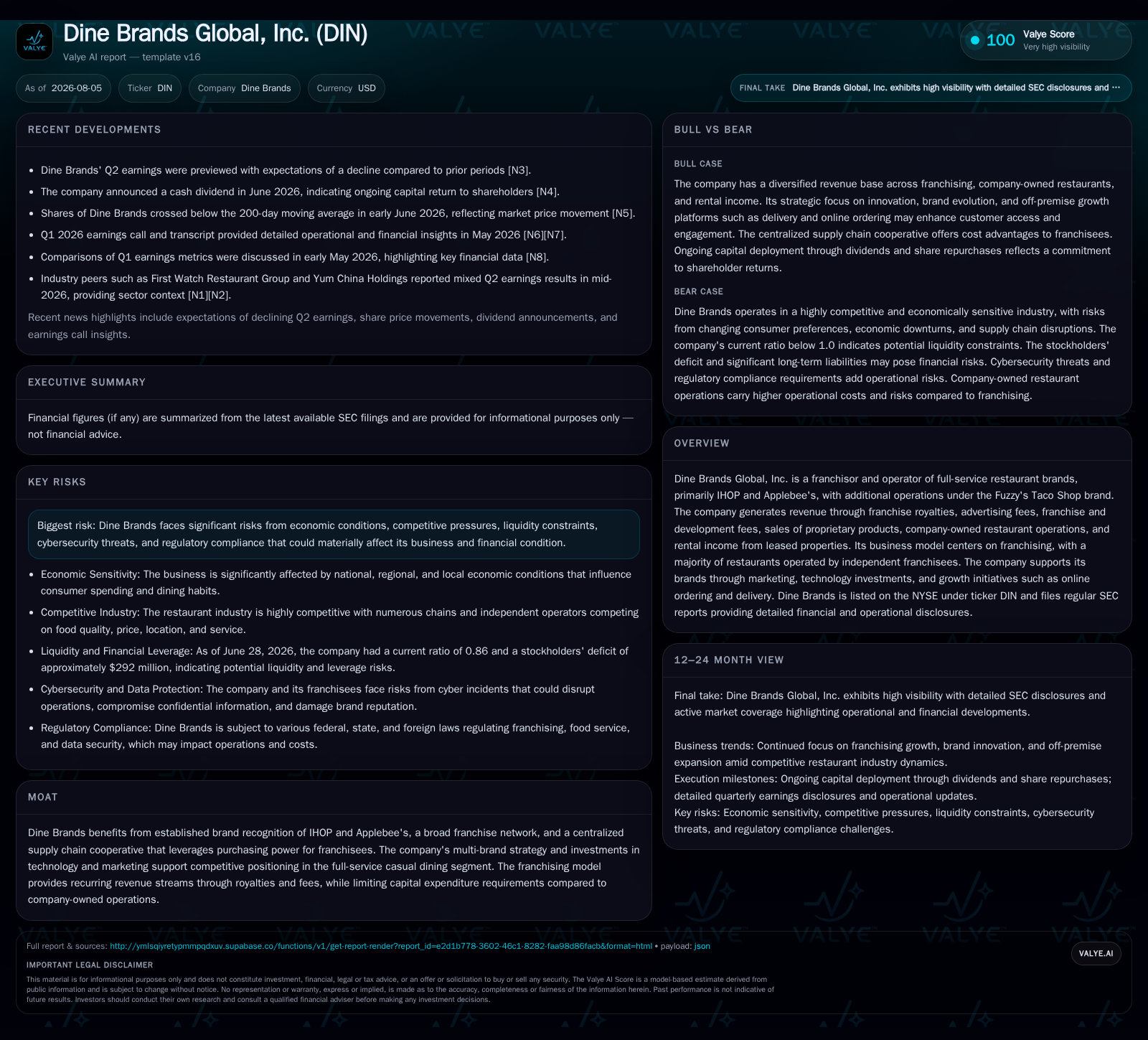
In Q2 2026, Dine Brands Global, Inc. saw continued revenue contribution from its franchising segments with modest same-store sales growth but faced margin headwinds from rising commodity and labor costs. The company expanded its portfolio via acquisition of Applebee's franchise locations to strengthen regional presence. Operating leverage remains restrained by high debt levels and cost inflation, while digital initiatives continue to drive engagement. Franchisee financial health and evolving consumer preferences remain critical watchpoints.
Latest Operating Update: Q2 2026 Results Reflect Mixed Dynamics
Dine Brands Global reported its second quarter performance with incremental progress on system-wide franchise revenues offset by operational margin pressures at company-operated stores [S2]. The company maintained positive momentum in royalty and franchise fees as both IHOP and Applebee's brands delivered moderate same-store sales growth supported by ongoing marketing efforts. However, rising costs for commodities, labor, utilities, and healthcare services weighed on operating margins primarily within the company-operated segment.
Within the first half of 2026, Dine Brands strategically acquired 60 Applebee’s restaurants through two separate transactions: initially a cluster of 12 units in Virginia and North Carolina followed by a larger acquisition of 48 restaurants across Florida, Georgia, and Alabama for approximately $9.6 million combined consideration including cash and non-cash components [S14]. These acquisitions signal a targeted approach to enhance market penetration by absorbing select franchised stores with potential operational upside.
Business Model: Franchise-Centric with Strategic Company-Operated Exposure
Dine Brands operates predominantly as a franchisor of two legacy full-service casual dining brands—IHOP and Applebee's—generating the bulk of revenues via recurring franchise royalties tied to system sales volume alongside advertising contributions funded through fee programs [S1]. This model leverages brand recognition to expand the restaurant footprint without proportionate capital expenditure risks common to wholly owned operators. Franchisees bear the majority of operational responsibility while benefiting from centrally coordinated supply chain programs that deliver scale economies and operational standards enforcement.
Despite the franchisor dominance in revenue streams, Dine Brands maintains a meaningful number of company-operated restaurants which expose it to direct margin volatility influenced by food costs, labor efficiency, and utility expenses. Proprietary product sales to franchises add a secondary revenue channel while rental income from leased properties supplement cash flow [S1]. Monetization depends on factors such as guest traffic levels, average check sizes influenced by pricing power and menu innovation, plus franchise renewal rates reflecting network stability.
Industry Structure and Competitive Positioning
The full-service restaurant space contends with heightened competition from emerging fast casual concepts and evolving consumer preferences favoring convenience and value. Within this environment, Dine Brands differentiates through well-established brand equity in IHOP’s breakfast niche and Applebee’s broad family dining appeal. Centralized marketing funded by advertising fee revenues supports promotional campaigns deployed across franchises to stimulate foot traffic.
Peers such as Darden Restaurants (Olive Garden), Brinker International (Chili's), and Bloomin' Brands (Outback Steakhouse) also balance franchised units with company-owned stores but often operate larger scales or more diverse brand portfolios. Dine Brands’ somewhat smaller scale paired with its focused brand base presents both an opportunity for concentrated brand investment but also risk if consumer engagement wanes relative to faster-growing entrants in the out-of-home dining sector.
Technology investments notably in digital ordering platforms represent critical capability enhancements enabling better customer engagement through loyalty programs and expanding delivery channel penetration—both important levers to offset some market share pressures from fast casual rivals [S1].
Growth Drivers Analysis
Unit expansion strategies combine organic franchise development supplemented by opportunistic acquisition of franchised stores showing strategic promise or operational underperformance where Dine Brands can unlock value directly [S14]. This hybrid approach aims to stabilize unit count while enabling selective modernization initiatives at acquired locations.
Same-store sales growth remains an essential KPI reflecting consumer demand resiliency [S1]. Initiatives such as menu refreshes, price optimization, promotions tied to loyalty engagement programs drive average check increases. Digital channel adoption enhances accessibility amplifying guest traffic especially among younger demographics accustomed to online ordering convenience
Supply chain cooperative efforts reduce cost pressure impact partially by securing contracted ingredient prices leveraging combined franchise volumes. However, input cost inflation remains a key challenge amid broader industry headwinds exacerbated by wage inflation in restaurant labor markets [S5].
Risks and Constraints
Significant financial leverage with approximately $100 million drawn on a credit facility that extends into mid-century but subject to rapid amortization starting in 2030 places timing pressure on refinancing strategies or proactive deleveraging measures [S2]. High debt servicing demands constrain free cash flow available for reinvestment or shareholder returns under adverse conditions.
Franchisee financial health is pivotal given concentration risk especially within Applebee’s network where a few large multi-unit operators could pose credit exposure risks if experiencing liquidity stress or operational challenges exacerbated by economic downturns or competitive shifts [S5]. Operational missteps or negative incidents affecting brand reputation could cascade through diminished guest loyalty impacting royalty income streams.
Compliance burdens around food safety regulations, health codes, labor laws including minimum wage adjustments add complexity along with cybersecurity threats targeting point-of-sale systems potentially undermining consumer confidence or exposing sensitive data [S1].
Future growth is contingent upon continued consumer discretionary spending resilience; any economic slowdown impacting dining-out behaviors could depress same-store sales despite ongoing marketing activity.
What To Watch Next
Key milestones include tracking same-store sales trends across both flagship brands for sustained momentum or early signs of softness indicating demand erosion. Monitoring progress on integration productivity gains from newly acquired Applebee’s outlets will offer insight into acquisition strategy effectiveness.
Developments in technology platform adoption rates—particularly digital ordering penetration—should correlate with improved customer retention metrics.
Management commentary around cost containment measures addressing inflationary pressures or adjustments in new unit development plans will be important for assessing margin trajectory going forward.
Financial Profile Discussion
As of June 28, 2026, Dine Brands reported approximately $97.5 million in cash and equivalents against current liabilities of $337 million yielding a current ratio of about 0.86—a level indicating tighter near-term liquidity coverage thus reinforcing the importance of efficient working capital management [F1]
Cash flow from operations continues supporting debt service but net income declined year-over-year in recent periods suggesting margin compression challenges amid cost escalations noted earlier in operating discussions [S2]. Capital allocation appears balanced between maintaining dividend payouts noted recently at typical levels while funding strategic acquisitions aimed at long-term network enhancement rather than aggressive new unit rollouts unrelated to franchisee partnerships [S14].
In sum, Dine Brands must navigate leveraging its strong brand portfolio and recurring franchising revenue engines against material cost inflation impacts and elevated debt service requirements that could limit agility amid intensifying sector competition.
Disclaimer: This is research-only, informational analysis and not investment advice. It may include AI-generated interpretation and general industry context. Always verify important details using primary sources.

Comments