
Bitwise 10 Crypto Index ETF’s Model Anchored in Regulated Crypto Exposure Amid Heightened Security Vigilance
Bitwise 10 Crypto Index ETF delivers regulated, liquid access to a diversified portfolio of leading crypto assets, balancing growth potential with operational risks.
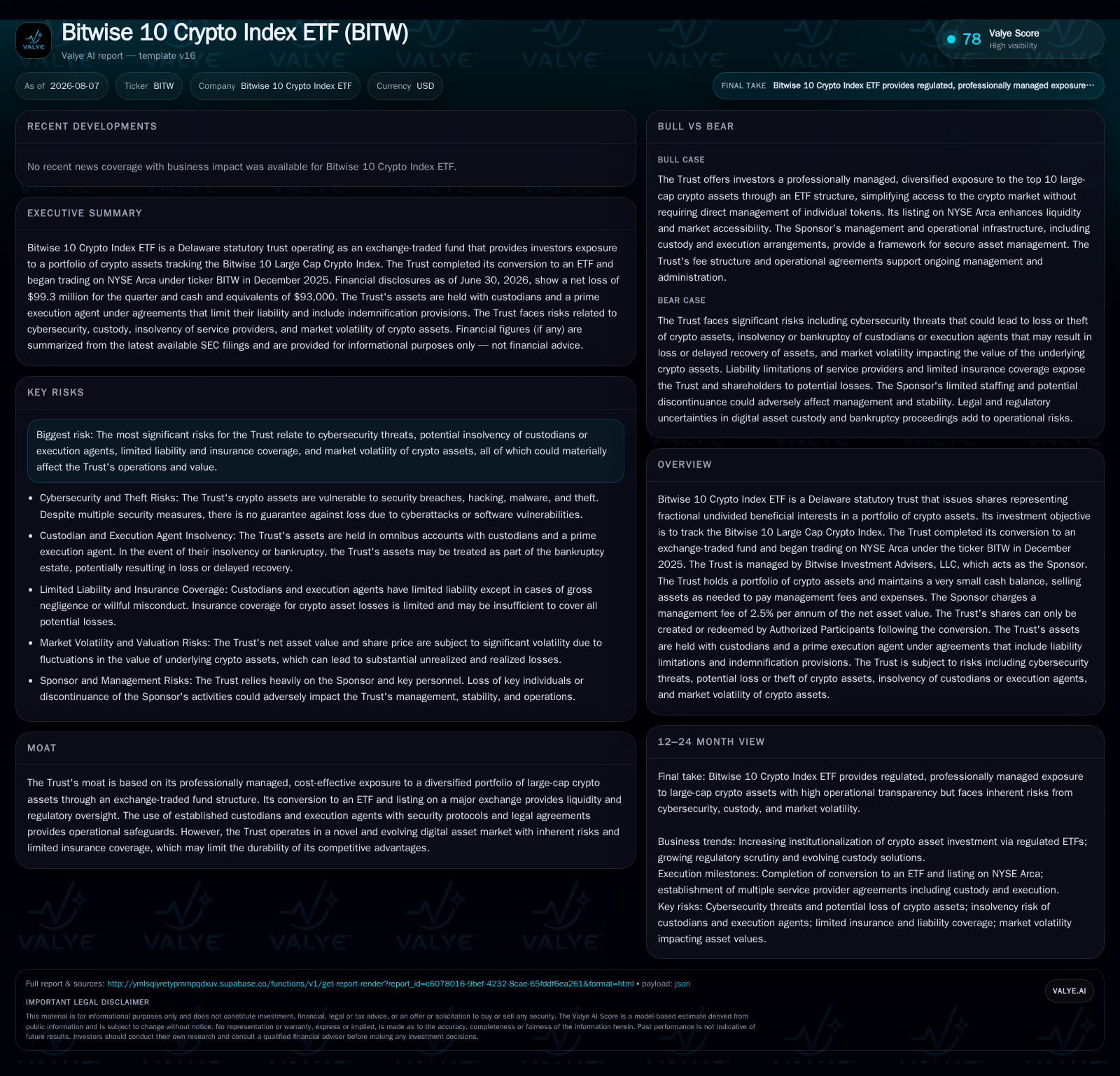
The Bitwise 10 Crypto Index ETF (BITW) completed its conversion to a fully regulated ETF structure in late 2025, positioning itself as a transparent, exchange-listed vehicle for investors seeking broad exposure to large-cap cryptocurrencies. Its business model hinges on tracking the Bitwise 10 Large Cap Crypto Index and earning management fees from assets under management (AUM). The latest quarterly filing reiterates ongoing cybersecurity risks inherent in digital asset custody despite robust security protocols. Market volatility and evolving regulation continue to shape the operational landscape. Authorized participants’ role in share creation/redemption underpins liquidity, while custodians and prime execution agents remain critical yet potential points of failure requiring active risk management. Growth opportunities depend on expanding institutional adoption and regulatory clarity accelerating crypto ETF demand.
Recent Operating Update Highlights
Bitwise 10 Crypto Index ETF marked a significant structural milestone by completing its transition into an exchange-traded fund listed on NYSE Arca under the ticker BITW in December 2025. This conversion from a Delaware statutory trust to an ETF structure provides investors with enhanced transparency, real-time trading liquidity, and regulatory oversight absent in many crypto trusts [S1]. The latest quarterly filing dated August 7, 2026 reiterates ongoing risk factors primarily centered on cybersecurity threats that remain prevalent despite industry-leading protections implemented by custodians and execution agents responsible for securing the Trust’s digital assets [S2].
The report underscores that the nature of digital assets—with pseudonymous blockchain ledgers—renders theft traceability difficult and consequently raises attractiveness for malicious actors targeting custodial accounts or wallets [S2]. While Bitwise employs sophisticated safeguards such as cold storage offline vaults, hardware security modules integrating multi-shard encrypted private keys, residual risk remains non-negligible due to dependences on multiple third-party service providers beyond direct Sponsor control. As assets under management grow alongside rising crypto valuations or inflows, these threats likely escalate proportionally
Business Model Analysis
Bitwise’s offering rests on managing a portfolio designed to replicate the performance of the Bitwise 10 Large Cap Crypto Index composed primarily of leading cryptocurrencies by market capitalization. As an ETF issuer and portfolio manager, Bitwise Investment Advisers serves as Sponsor while relying on institutional custodians for secure digital asset custody and a prime execution agent facilitating timely trading executions necessary for index tracking.
Revenue generation flows principally from an annual management fee fixed at 2.5% of net asset value — considerably higher than traditional equity ETFs but consistent with the elevated operational complexity and security requirements intrinsic to cryptocurrency asset management [S1]. This fee rate suggests an important sensitivity of margins and profitability to AUM scale: higher fund size spreads fixed costs better yet exposes the Trust to amplified cyber risk given larger asset pools.
Share creation and redemption are exclusively handled by Authorized Participants—generally large broker-dealers or institutional market makers licensed to transact directly with the Trust at NAV pricing. This arrangement promotes efficient liquidity enabling investors—both retail and institutional—to trade BITW shares intraday with minimal tracking error relative to underlying crypto values. However, it also constitutes a concentration risk if participant engagement reduces or technical barriers emerge impeding smooth share flow.
Unlike direct cryptocurrency ownership where retail investors face custody responsibility, BITW simplifies exposure through diversification across multiple top-tier coins tracked via index methodology. Maintaining very low cash reserves relative to total NAV means active portfolio turnover is limited primarily to funding fee payments or complying with index rebalancing schedules—a tactical factor impacting both operational costs and taxable events within the Trust [S1]
Industry Structure and Competitive Position
Within the rapidly evolving digital asset ecosystem, BITW occupies a distinct position bridging decentralized crypto markets with centralized traditional capital markets via regulated ETF infrastructure. This intermediary role situates Bitwise among crypto asset managers offering index-based investment vehicles while competing indirectly against other public trusts like Grayscale Bitcoin Trust (GBTC) known for single-asset focus but lacking true ETF status.
BITW’s competitive advantages stem from its cream-of-the-crop portfolio diversification combined with regulated exchange listing enabling transparent pricing discovery and shareholder accessibility. Custody arrangements with recognized institutional-grade providers fortify operational credibility amidst a backdrop of high-profile incidents involving thefts or platform insolvencies in less-regulated arenas.
However, persistent concerns around cybersecurity vulnerabilities inherent in blockchain custody technologies prevent realization of fully secure investment status comparable to conventional ETFs tracking equities or bonds. Potential regulatory uncertainty around crypto product classification further clouds durability of moats within this segment.
Peer institutions like CoinShares or Galaxy Digital offer active crypto management strategies contrasting BITW’s passive index approach; meanwhile global ETF titans BlackRock or Vanguard serve as structural benchmarks particularly regarding fee compression potential absent specialized crypto handling costs.
Growth Drivers
Demand for regulated crypto exposure is buoyed by several intersecting trends:
- Growing Institutional Adoption: More hedge funds, family offices, insurers seek compliant vehicles offering broad cryptocurrency access without direct ownership custody risks.
- Retail Investor Interest: Increasing awareness coupled with easier access via brokerage platforms listing ETFs underpins progressive inflows.
- Expansion of Crypto Indexes: Development of refined indices supporting diversified holdings beyond Bitcoin/Ethereum drives appetite for multi-asset crypto funds.
- Advances in Custody Technology: Improvements in cold storage solutions, multi-sig procedures enhance trustworthiness supporting further inflows.
- Regulatory Clarity: Incremental guidance fostering safer product registrations motivates new launches utilizing similar governance models as BITW.
- Rising Market Capitalization: Overall growth in aggregate value of cryptocurrencies amplifies potential AUM growth if captured effectively.
Monitoring these vectors alongside indicators such as fund flows measured through AUM changes or retail trading volumes will illuminate sustained structural growth prospects beyond transient market cycles.
Risks and Watchpoints
Cybersecurity remains paramount among risks given history of thefts in digital asset space—even best-in-class technical procedures cannot provide full immunity. Failures could trigger financial losses directly reducing NAV while damaging reputation possibly depressing share price materially.
Operational dependence on third-party custodians introduces counterparty risk; insolvency events or tech failures within those agents could compromise operations irreparably. Likewise, Prime Execution Agents face systemic technology or market disruptions affecting trade executions necessary for maintaining close tracking error versus benchmark index.
Fluctuating volatility inherent to cryptocurrencies induces valuation swings far exceeding classic assets thereby exacerbating investor sentiment swings potentially amplifying redemption pressures impacting liquidity dynamics handled by Authorized Participants.
Regulatory environments remain fluid internationally; adverse rules curtailing crypto fund offerings—or onerous compliance mandates—may restrict product marketing scope or increase operating expenditures unfavorably altering economics.
Finally, limited insurance coverage for digital assets imposes residual loss exposure beyond traditional insurable events creating tail-risk scenarios uncommon in established asset classes.
What To Watch Next
Investors monitoring BITW should focus on:
- Asset Under Management Trends: Persistent net inflows validate expanding investor acceptance; volatile withdrawals may signal shifts in market confidence.
- Security Incident Reporting: Any disclosed breaches or near-miss remediation efforts materially impact trust perception and operational resilience assessments.
- Authorized Participant Engagement: Changes in number or volume handled influence share liquidity robustness critical for seamless market-making.
- Tracking Error Metrics: Continued alignment between NAV performance versus underlying index affirms index replication quality essential for passive strategy appeal.
- Regulatory Developments: Updates from SEC or global regulators regarding cryptocurrency ETFs will materially affect future product evolution possibilities.
Ongoing quarterly filings will be key sources updating risk factor status alongside underlying business fundamentals largely derived from AUM trajectories tied directly to nascent but volatile cryptocurrency markets.
This analysis profiles BITW based on publicly filed information through August 2026 without research view or investment advice. Coverage emphasizes business model characteristics unique to emerging cryptocurrency ETF structures and inherent operational constraints within a dynamically evolving industry ecosystem.
Disclaimer: This is research-only, informational analysis and not investment advice. It may include AI-generated interpretation and general industry context. Always verify important details using primary sources.

Comments