
L.B. Foster Advances Infrastructure Products and Rail Technology Amid Supply Chain and Regulatory Challenges
L.B. Foster's latest quarterly results reflect resilience in its dual-segment industrial solutions strategy focused on rail technologies and infrastructure.
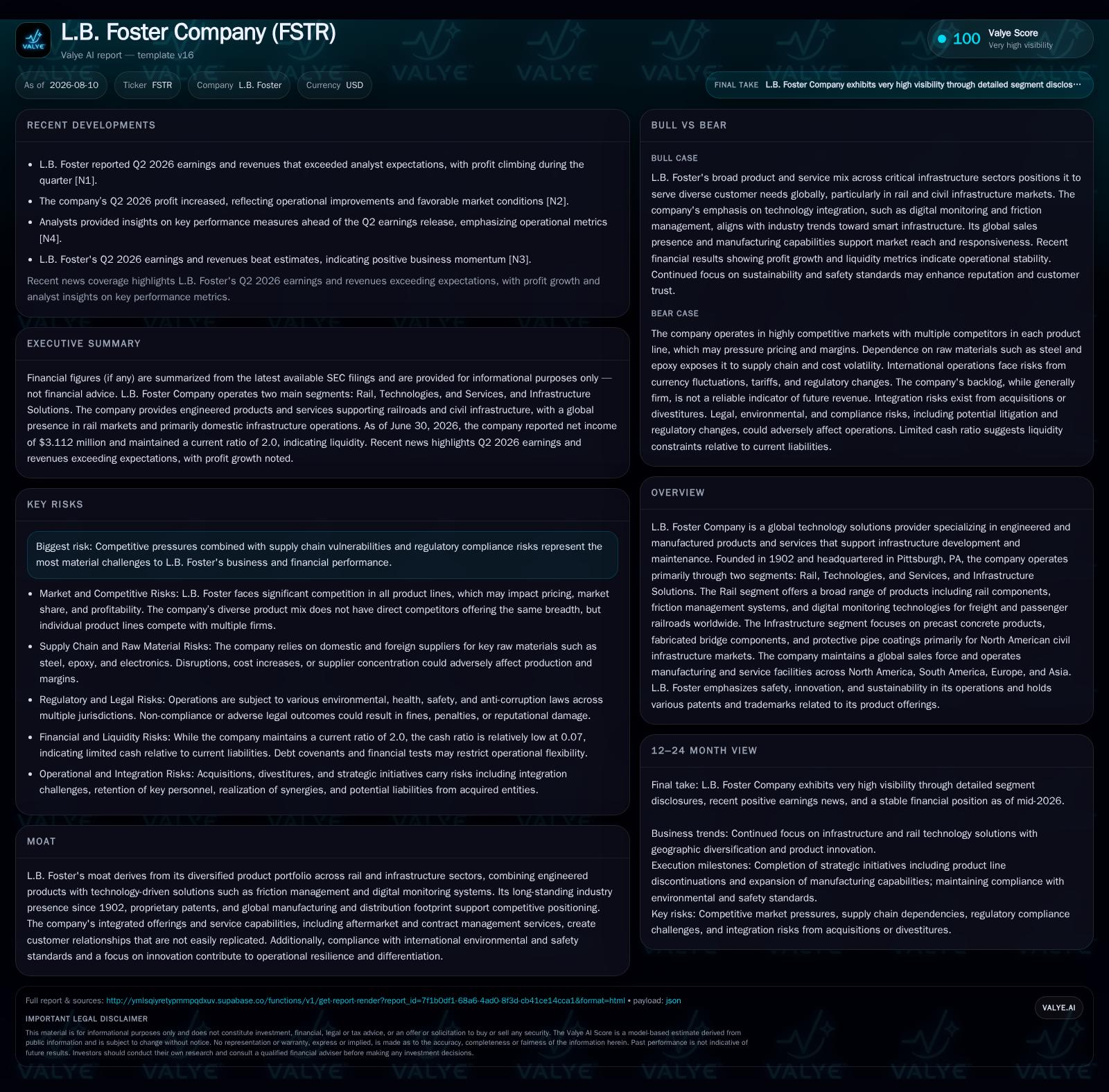
In its Q2 2026 filing, L.B. Foster Company reported operational progress driven by growth in its Infrastructure Solutions segment alongside stable performance in Rail, Technologies, and Services. The company’s diversified portfolio—spanning engineered rail components, friction management systems, precast concrete products, and digital monitoring technologies—positions it well amid infrastructure modernization trends. However, ongoing supply chain constraints and regulatory compliance remain challenges that may impact execution. Key growth drivers include demand for smart rail solutions and expanded civil infrastructure projects in North America. The company’s financial position shows manageable leverage with a current ratio of 2.0, supporting near-term operational funding requirements.
Recent Operating Update
This backlog—the contracted but not yet recognized revenue—remains a critical operating metric given the extended project timelines typical in infrastructure and rail sectors [S11]. L.B. Foster's approach of blending product sales with contract project management and aftermarket service arrangements helps smooth revenue recognition across quarters.
Business Model Overview
L.B. Foster is principally a global technology solutions provider specializing in engineered products and services tailored for infrastructure development across rail transportation and civil construction markets [S1]. Its two reporting segments illustrate a strategic alignment to serve complementary markets:
Rail, Technologies, and Services provides engineered components such as rail track hardware, friction management systems designed to optimize wheel-to-rail interface performance, along with condition monitoring digital solutions like Total Track Monitoring systems deployed globally [S1], [S7]. This segment addresses freight and passenger rail operators worldwide through a combination of direct manufacturing facilities and supply partnerships.
Infrastructure Solutions serves primarily North American clients with precast concrete products (e.g., restrooms under the CXT® brand), fabricated bridge components, protective pipe coatings for oil & gas pipelines, among other civil infrastructure-related engineered goods [S1], [S7]. This segment operates multiple specialized facilities domestically focusing on modular construction elements designed to meet stringent engineering standards.
Revenue generation hinges on both product sales—often tendered or awarded by public or private infrastructure contractors—and longer-term service agreements providing aftermarket maintenance or digital monitoring support [S1]. Customer segmentation spans government agencies, transit authorities, railway operators, energy pipeline companies, and commercial construction firms.
Integration of proprietary technology into traditional engineered products offers L.B. Foster a competitive edge facilitated by patented friction modifier delivery systems and digital condition sensing platforms that address evolving requirements for reliability and safety in rail operations.
Industry Structure & Competitive Position
The sector is characterized by long order-to-cash cycles frequently extended by regulatory reviews, permitting delays, and the complexity inherent in large infrastructure projects. Competition arises from manufacturers specializing solely in materials supply or narrowly focused rail component producers lacking integrated service capabilities.
Peers vary from specialized rail component manufacturers to larger civil infrastructure suppliers offering precast concrete or bridge fabrication; L.B. Foster differentiates itself through cross-segment capabilities combining physical products with embedded digital technologies. This integration allows it to capture more comprehensive share-of-wallet opportunities with clients seeking turnkey or modular solutions that ease maintenance burdens over asset lifecycles.
Global reach also strengthens L.B. Foster's position relative to regionally focused competitors. The company’s manufacturing plants spread across North America support resilience against localized supply disruptions while maintaining alignment with regional customer requirements concerning environmental regulations or safety certifications like ISO 14001:2015 [S22]
Growth Drivers
Several macro-level trends underpin demand:
Continued investment in freight and passenger rail modernization globally fuels the need for advanced friction management products aimed at reducing fuel consumption cost-effectively while extending track asset life.
Increasing adoption of digital monitoring systems for condition assessment improves network safety and operational efficiency; L.B. Foster’s technology services harness this demand via Total Track Monitoring offerings that detect wheel impacts or structural risks early [S1].
On the civil infrastructure side, government stimulus packages targeting roads, bridges, pipelines, parks, and municipal utilities drive orders for high-end precast concrete buildings under brands like CXT®, facilitating faster project timelines compared to traditional cast-in-place methods.
Environmental regulation mandates push clients towards more sustainable building materials and protective coatings compliant with evolving emission or waste disposal standards, areas where L.B. Foster has focused technological improvements.
Aftermarket services related to contract project management provide recurring revenue streams offering margin stability amid cyclicality inherent in construction spending patterns.
Risks & Watchpoints
Operating risks stem notably from supply chain volatility affecting steel inputs or specialty chemicals used in coating formulations; extended lead times can delay shipments impacting recognized revenue timing [S2], [S5]. Moreover, competition exerts pressure on pricing especially in commoditized product lines without significant patent protection.
Regulatory compliance represents an ongoing cost factor; failure to maintain certifications or mishandling environmental liabilities (e.g., historic contamination sites) could result in fines or remediation expenses affecting profitability [S29]. The company also highlights complexities integrating acquired businesses or disposing non-core assets as strategic initiatives unfold [S23].
Execution risk is inherent given the nature of large infrastructure projects involving multiple contractors where delays can cascade through order flow impacting backlog conversion rates; close contract management remains critical.
What to Watch Next
Key milestones include order intake cadence data for upcoming quarters which will clarify backlog durability amid variable government infrastructure funding cycles. Management's ability to contain supply chain costs without eroding margins will also be pivotal as raw material price inflation fluctuates.
Monitoring contract renewal rates for aftermarket technological services will indicate how well L.B. Foster can capitalize on installed base expansion—a crucial growth vector beyond initial product deployments.
Further updates on any acquisitions or divestitures expected during rest of 2026 should shed light on strategic portfolio realignment efforts aimed at boosting market exposure or operational efficiencies.
Financial Profile Discussion
As of June 30, 2026, L.B. Foster reports cash & equivalents of approximately $5.8 million against total debt near $47.9 million resulting in net debt around $42.1 million [F1], reflecting moderate leverage aligned with capital intensity associated with manufacturing operations. The current ratio stands near 2.0 indicating sufficient short-term liquidity coverage relative to current liabilities (~$81.9 million) providing operational flexibility [F1].
Capital expenditures focus primarily on maintaining manufacturing capacity enhancements aligned with new product installations especially within Technology Services units adding digital monitoring capabilities.
Overall financial positioning supports continued investment in R&D initiatives necessary to sustain technology differentiation whilst managing debt repayment schedules within existing credit covenant frameworks noted previously as material risk factors if breached under adverse economic conditions [S4], [S6].
Disclaimer: This analysis is based solely on publicly available information including recent SEC filings and industry knowledge frameworks; it does not constitute investment advice nor an endorsement of securities mentioned herein.
Disclaimer: This is research-only, informational analysis and not investment advice. It may include AI-generated interpretation and general industry context. Always verify important details using primary sources.

Comments