
XBiotech Advances Vilamakitug Phase 2 Program with Strong Q2 Liquidity Amid Leadership Transition
Following FDA clearance to initiate Phase 2 trials for Vilamakitug, XBiotech leverages robust cash reserves and internal scientific leadership to navigate clinical development risks and position its proprietary antibody platform within competitive autoimmune therapy markets.
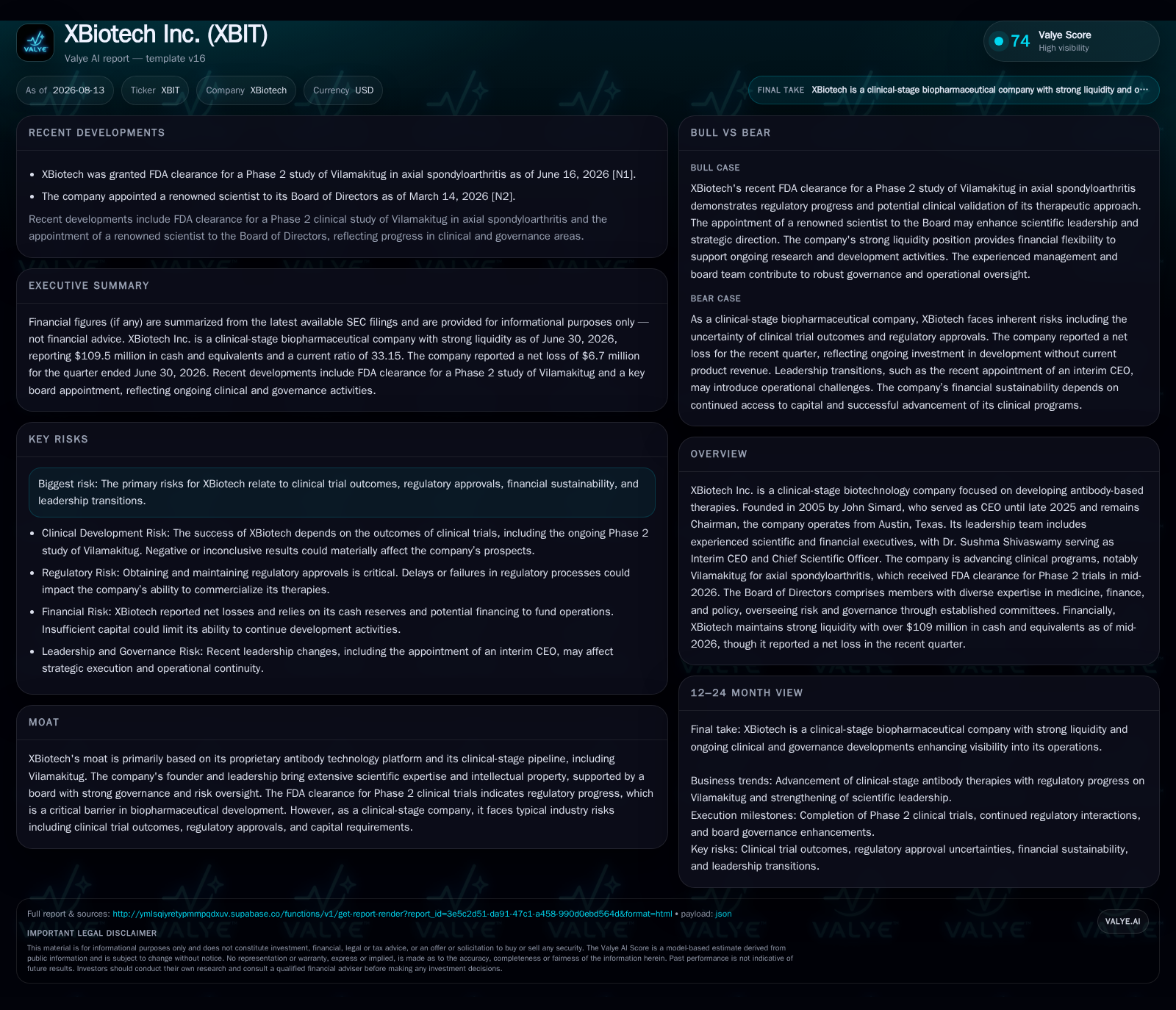
XBiotech Inc. achieved a pivotal operational milestone in mid-2026 with FDA clearance to commence Phase 2 clinical trials of its lead antibody candidate Vilamakitug for axial spondyloarthritis, advancing beyond early safety assessments toward efficacy evaluation. The company reported a strong liquidity position of $109.5 million in cash and equivalents as of June 30, 2026, supporting ongoing R&D and enrollment activities. Interim CEO Dr. Sushma Shivaswamy’s dual role as Chief Scientific Officer underpins continuity amid executive transition following founder John Simard’s retirement. While the proprietary antibody platform forms a strategic moat in a competitive autoimmune indication landscape, watchpoints include enrollment pace, trial outcome uncertainties, regulatory interactions, and sustaining capital through development phases.
Recent Operating Update: FDA Clearance Spurs Phase 2 Trial Initiation
In the second quarter of 2026, XBiotech secured FDA authorization to begin Phase 2 clinical trials for its lead antibody candidate Vilamakitug targeting axial spondyloarthritis, a chronic autoimmune disease affecting the spine [S1][S2]. This clearance marks an important operational inflection as the company moves beyond initial human dosing (Phase 1) into more rigorous efficacy and dose-optimization studies involving patient populations. The FDA’s green light reflects confidence in the drug candidate’s safety profile established during earlier phases and validates its underlying mechanism of action.
Phase 2 studies are crucial for demonstrating preliminary efficacy signals and refining safety/tolerability data that inform larger pivotal trials. For XBiotech, efficient patient enrollment is paramount; delays or slow recruitment could extend timelines and increase cash burn given the high costs associated with clinical operations. Additionally, axial spondyloarthritis is a competitive therapeutic area with evolving standards of care, necessitating clear differentiation by Vilamakitug to justify continued investment.
Leadership Continuity during Transition: Scientific Expertise Anchoring Strategy
Following founder John Simard’s retirement as CEO in late 2025, Dr. Sushma Shivaswamy assumed the Interim CEO role while maintaining her position as Chief Scientific Officer [S1][S13]. This integration of executive management with deep scientific expertise aims to preserve strategic focus on pipeline advancement through this critical clinical juncture.
Leadership changes in clinical-stage biotech often introduce execution risks such as shifts in R&D priorities or operational disruptions. However, appointing an internal scientific leader mitigates these risks by ensuring continuity of institutional knowledge and technical direction. The board’s governance framework supports this approach by linking executive incentives primarily to pipeline progress rather than short-term financial metrics.
Proprietary Antibody Platform: Competitive Positioning in Autoimmune Therapeutics
XBiotech’s business model centers on a proprietary antibody platform designed to develop biologic therapies addressing unmet needs in autoimmune diseases like axial spondyloarthritis [S1]. This platform underpins the company’s value creation strategy typical of clinical-stage biotechs reliant on progressing drug candidates through phased clinical development toward regulatory approval.
Within the broader industry context — including peers such as Moderna with mRNA-enabled antibody innovations and Regeneron with established fully-human antibody platforms — XBiotech’s moat derives from its novel discovery methods coupled with advancing pipeline assets through regulated milestones. Intellectual property protections provide barriers to entry; however, competition remains intense due to multiple biologics targeting overlapping inflammatory pathways.
Focused R&D Investment Linked to Clinical Progression Risks
The company concentrates research and development expenditures on advancing Vilamakitug through mid-stage clinical programs following FDA clearance [S1]. This capital allocation aligns with sector norms where spending escalates upon entering patient trials.
Key operating risks include potential slow enrollment driven by stringent inclusion criteria or competing studies within rare disease populations. Furthermore, any emergence of adverse safety signals could necessitate costly protocol amendments or trial suspension. These factors underscore the importance of monitoring enrollment rates and tolerability outcomes as leading indicators of program viability.
Industry Context: Regulatory Milestones Define Value Inflections
The clinical-stage biotechnology sector is characterized by sequential regulatory milestones acting as binary value events — from investigational new drug filings through late-stage pivotal trials. Achieving FDA clearance for Phase 2 differentiates companies that have successfully navigated early toxicology and safety hurdles.
Manufacturing scale-up readiness remains a critical challenge given biologics’ complexity relative to small molecules. Successful navigation of these operational domains often predicates partner interest or licensing agreements that can provide additional capital and commercial expertise.
Growth Drivers: Indication Expansion and Strategic Partnerships
Beyond axial spondyloarthritis, XBiotech may explore extending Vilamakitug into related autoimmune or inflammatory conditions leveraging shared mechanistic pathways [S1]. Such diversification would mitigate single-indication dependency while enlarging market opportunity.
Partnerships or licensing arrangements constitute vital growth avenues by offsetting capital intensity inherent in late-stage development and commercialization phases. External validation via collaborations would also reinforce confidence in the platform's robustness.
Watchpoints: Clinical Execution Risks, Cash Management, Leadership Stability
Critical risks revolve around potential delays or unfavorable outcomes within ongoing trials that could materially impact valuation given the absence of commercial revenues at this stage [S2]. Enrollment variability directly affects operating expense duration; thus managing burn rate against cash runway is essential.
As of June 30, 2026, XBiotech held approximately $109.5 million in cash equivalents against nominal current liabilities (~$3.35 million), yielding a current ratio above 33x—indicative of strong short-term financial flexibility supporting active development programs [F1]
Nevertheless, sustaining funding beyond mid-stage development will require continued access to public markets or partnership capital.
Leadership transitions introduce uncertainty regarding strategic consistency; however, internal appointments combining executive management with scientific leadership suggest effective risk mitigation [S13]. Maintaining stable oversight will be key to advancing complex clinical protocols efficiently.
Forward-Looking Indicators: Enrollment Metrics, Regulatory Engagements & Capital Strategy
Upcoming milestones include enrollment velocity updates for Vilamakitug's Phase 2 study which will influence timing for interim efficacy/safety data releases. Ongoing regulatory dialogue post-clearance remains critical especially if adaptive trial designs are employed based on emerging results.
The company’s ability to balance burn rate against robust cash reserves while progressing multiple immuno-inflammatory candidates will be closely watched by investors focused on durability through pivotal inflection points.
Potential announcements regarding strategic collaborations or licensing agreements would represent significant de-risking events broadening resource availability beyond organic financings.
Financial Profile Discussion: Solid Liquidity Underpinning Development Activities
XBiotech reported cash and cash equivalents totaling $109.5 million as of June 30, 2026 alongside modest current liabilities amounting to approximately $3.35 million—resulting in a current ratio exceeding 33x—reflecting strong near-term liquidity supportive of ongoing operations without immediate funding pressures [F1]
Operating losses persist due to elevated R&D investments customary among clinical-stage biotechs lacking commercial products [F1]. This underscores a capital-intensive business model focused on achieving regulatory milestones rather than near-term profitability.
Capital allocation prioritizes advancing Vilamakitug through clinical phases underpinning long-term value creation rather than short-term earnings generation [S1]. Maintaining financial discipline alongside securing future partnership funding will be critical for sustained operational resilience.
This analysis synthesizes information available as of August 13, 2026 primarily from XBiotech's latest quarterly report ([S2]), supplemented by annual disclosures ([S1]) and up-to-date financial snapshots ([F1]). It aims to provide informed context without constituting investment advice.
Disclaimer: This is research-only, informational analysis and not investment advice. It may include AI-generated interpretation and general industry context. Always verify important details using primary sources.

Comments