
QNB Corp. Expands Asset Base and Market Reach Following Victory Bancorp Acquisition
QNB Corp.’s recent merger with Victory Bancorp significantly reshaped its balance sheet and regional footprint, underscoring key growth vectors and integration challenges.
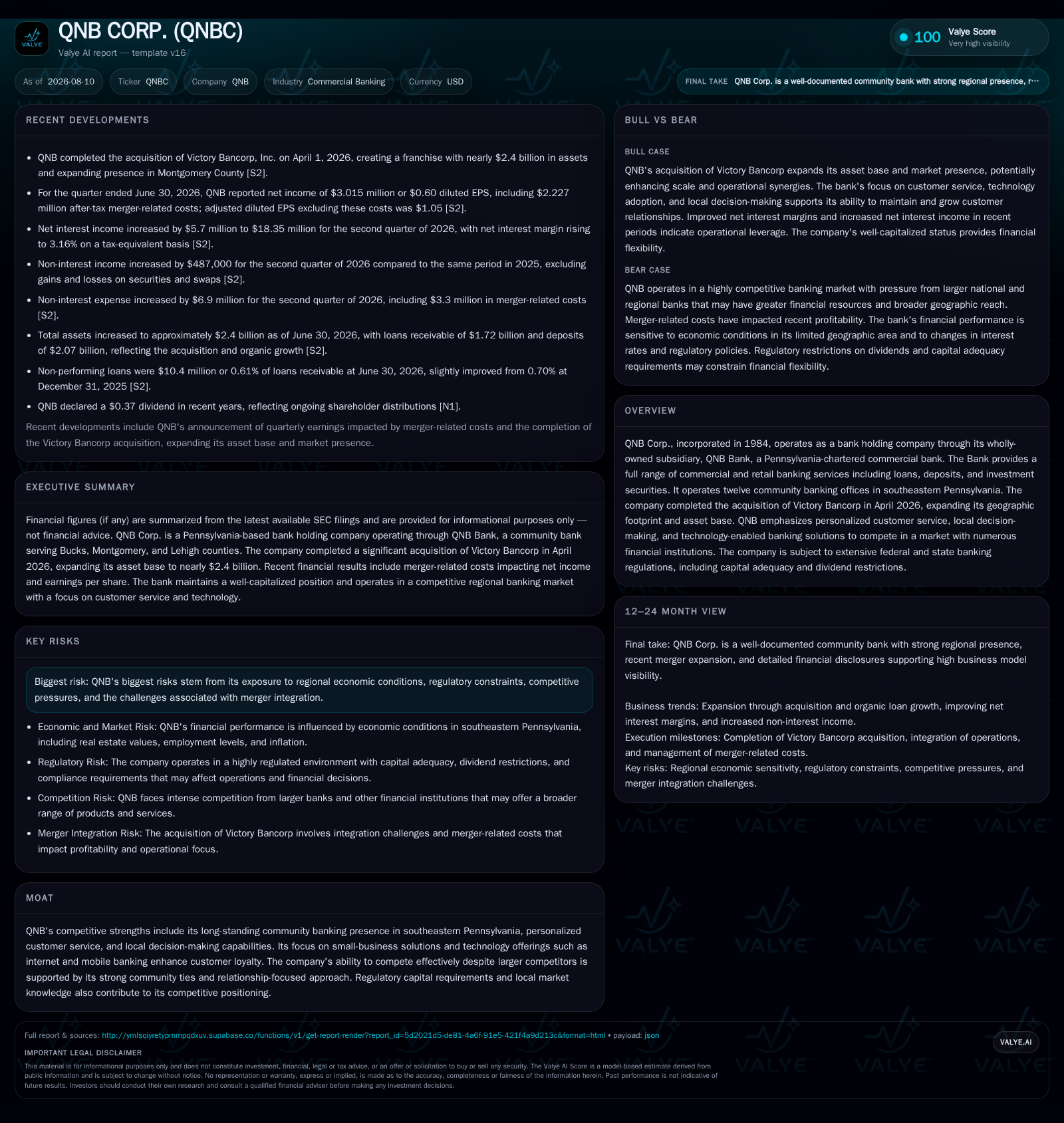
In Q2 2026, QNB Corp. reported notable asset, loan, and deposit growth driven primarily by the acquisition of Victory Bancorp in April 2026. This strategic move expanded QNB’s presence deeper into Montgomery County, Pennsylvania, creating a franchise with nearly $2.4 billion in assets. While merger-related costs weighed on short-term earnings, they are non-recurring and exclude ongoing operational results. The bank maintains a strong capital adequacy posture above regulatory requirements despite portfolio expansion. Key risk factors remain regional economic variability, regulatory constraints, and integration execution. QNB’s business model hinges on local relationship banking, supported by technology-enabled services that differentiate it within the competitive community banking landscape.
Recent Operating Update: Victory Bancorp Acquisition Reshapes Scale and Franchise
QNB Corp.'s latest quarter ending June 30, 2026 reflects a major inflection driven by the acquisition of Victory Bancorp on April 1, 2026 [S2][S3]. This all-stock transaction created a combined entity with nearly $2.4 billion in assets and broadened QNB’s footprint further into Montgomery County, Pennsylvania. Resulting figures for loans receivable surged to approximately $1.7 billion (up from $1.26 billion at year-end 2025), primarily fueled by the addition of $408 million in loans acquired from Victory [S2]. Commercial loans represent the bulk of this expansion, rising by over $423 million compared to $1.06 billion at December 31, 2025. Retail loans also grew modestly by about $31 million over the same period.
Deposits also expanded substantially by roughly $425 million following the merger, including an increase of over $76 million in non-interest-bearing demand deposits—a vital measure for maintaining low-cost core funding [S2]. This deposit growth strengthens liquidity flexibility crucial for balancing loan deployment against withdrawal risks.
Net income for Q2 declined to approximately $3 million from nearly $3.9 million in the prior-year quarter; however, this reduction was largely attributable to after-tax merger-related costs of about $2.2 million that are classified as non-recurring expenses [S2][S12]. Adjusted earnings per share excluding these expenses was reported at $1.05 versus GAAP diluted EPS of $0.60.
Operating expenses saw an uptick due chiefly to increased software maintenance fees ($664k higher over six months), augmented marketing spend ($161k increase), and elevated consulting outlays ($557k rise) associated with integration activities post-acquisition [S2]. Yet favorable FDIC insurance premium reductions partially mitigated expense pressures by about $49k.
Business Model: Relationship-Driven Community Banking Enhanced by Scale
QNB operates as a bank holding company through its wholly owned subsidiary QNB Bank—a Pennsylvania-chartered commercial bank with roots dating back to 1877—serving Bucks, Montgomery, and Lehigh counties with twelve community banking offices [S1]. Its primary revenue derives from net interest margin earned by accepting customer deposits (checking accounts, money market accounts including higher-yielding online options) and deploying these funds predominantly via commercial loans supplemented with residential mortgages and retail consumer loans.
The acquisition of Victory Bancorp aligns closely with QNB's relationship-focused ethos emphasizing personalized service delivered through local decision-making frameworks—an advantage against larger regional competitors that often rely on centralized underwriting [S1][S2]. Digital banking channels including internet/mobile platforms complement traditional offerings thus improving customer retention and operational efficiency.
Fee income contributes additional diversification through deposit-related charges, loan servicing fees, and brokerage services offered alongside core banking products.
Margins benefit from deposit mix improvements post-merger: the rise in non-interest-bearing demand accounts bolsters stable funding while allowing flexibility amid rate competition that remains intense for quality deposits locally [S2][S25]. Loan portfolio expansion is carefully managed under underwriting policies designed to mitigate credit risk concentration within regional sectors.
Industry Structure & Competitive Positioning
Community banks like QNB hold a niche as trusted financial intermediaries within localized markets where familiarity with client needs affords competitive moat advantages despite intense pressure from larger regional banks (e.g., Fulton Financial or WSFS Financial) or emerging fintech disruptors offering transactional convenience.
QNB’s consolidation strategy typifies industry trends where smaller community institutions scale via accretive mergers targeting complementary geographies—Victory Bancorp being a prime example—with culturally compatible operations facilitating smoother integration.
Operational efficiency remains critical given upward pressure on expenses related to technology infrastructure investments necessary to compete digitally while sustaining personalized service [S2]. Effective cost management amid bolt-on acquisitions can delineate winners versus laggards among peer community banks.
Growth Drivers
Post-acquisition growth prospects for QNB are multi-faceted:
- Loan book expansion: Primarily via small business commercial lending aligned with regional economic health metrics plus selective retail lending growth providing diversity [S2][S12].
- Deposit base growth: Increasing core low-cost deposits supports net interest margin expansion by reducing reliance on borrowings or costly wholesale funding [S2].
- M&A strategy: Completion of Victory merger creates platform for future targeted acquisitions enhancing scale synergy potential.
- Technology investments: Ongoing software upgrades improve customer experience and operational productivity mitigating competitive pressures from fintech entrants [S2].
- Economic environment: Favorable localized economic conditions drive credit demand; however cyclicality remains a watchpoint.
Risks / Watchpoints / Growth Constraints
Key risks include:
- Regional economic cyclicality: Exposure concentrated in southeastern Pennsylvania links credit quality tightly to local economic fluctuations impacting loan performance metrics like non-performing assets ratio.
- Interest rate volatility: The shape of the yield curve influences net interest margin dynamics; rate hikes can compress margins if deposit repricing outpaces loan yields [S12].
- Merger integration risks: Operational disruption during systems harmonization or client attrition poses execution hazards impacting projected synergies.
- Regulatory compliance burden: Capital adequacy rules including Basel III buffers necessitate capital planning prudence limiting aggressive growth tactics without capital raises.
- Competition: Larger regional banks’ scale advantages or fintech innovation could erode market share or pricing power unless QNB sustains differentiated relationship commitments.
- Expense inflation: Personnel costs alongside third-party consulting and software maintenance escalate baseline operating expense expectations affecting efficiency ratios.
What To Watch Next
Investors should monitor:
- Quarterly updates on earnings excluding merger expenses to track normalized profitability trends.
- Loan portfolio quality indicators such as charge-offs and delinquency rates demonstrating credit risk evolution amid geographic concentration.
- Deposit mix shifts toward non-interest-bearing categories signaling funding cost improvements or vulnerabilities from volatile balances.
- Success metrics related to integration milestones for Victory Bancorp including cost synergies realization rates.
- Regulatory capital ratios stability maintaining well-capitalized status permitting continued dividend payments without restrictions.
- Adoption rates of enhanced digital platforms evidencing improved customer engagement critical for retention amid shifting consumer banking behavior.
Financial Profile Discussion
As of June 30, 2026, total assets stood at approximately $2.4 billion up sharply from just under $1.9 billion at year-end reflecting the acquisition impact combined with organic growth trends [S2][F1]. Shareholders' equity rose to about $183.5 million representing a healthy 7.65% of total assets versus prior trailing figure of 6.8% on December 31, 2025 [S2]. The capital position reflects substantial net unrealized losses relating to available-for-sale investment securities—$43.8 million net of taxes—but remained robust with shareholders' equity supporting ongoing growth [S2].
Cash and cash equivalents totaled approximately $79.3 million at June 30, 2026, providing liquidity to support ongoing operations and asset-liability management [F1]. The company holds $3 million in subordinated notes issued by Victory Bancorp as part of the acquisition transaction [S2]. No other long-term debt was reported in the latest quarter filings, indicating a conservative leverage profile [F1][S2].
Operating expenses rose mostly on investments related to increased digital infrastructure maintenance fees plus marketing campaigns aimed at retaining client bases post-merger—areas often viewed as necessary cost centers during transformational phases but bear watching for normalization signals going forward [S2].
In summary, QNB Corp’s second quarter presents a transitional balance sheet profile marked by significant expansion effected through an M&A event balanced against one-time integration costs impacting near-term earnings comparability but positioning it for potential sustainable growth within its community banking niche.
This analysis is based exclusively on publicly available disclosures through August 10, 2026, including SEC filings and industry contextualization without any prediction or investment advice regarding QNB Corp.’s shares or performance.
Disclaimer: This is research-only, informational analysis and not investment advice. It may include AI-generated interpretation and general industry context. Always verify important details using primary sources.

Comments