
OptimumBank Advances Specialized Lending and Fee Income Growth Despite Regional and Rate Pressures
OptimumBank Holdings expands its South Florida loan portfolio and merchant cash advance services while investing in digital platforms to manage competition and interest rate volatility.
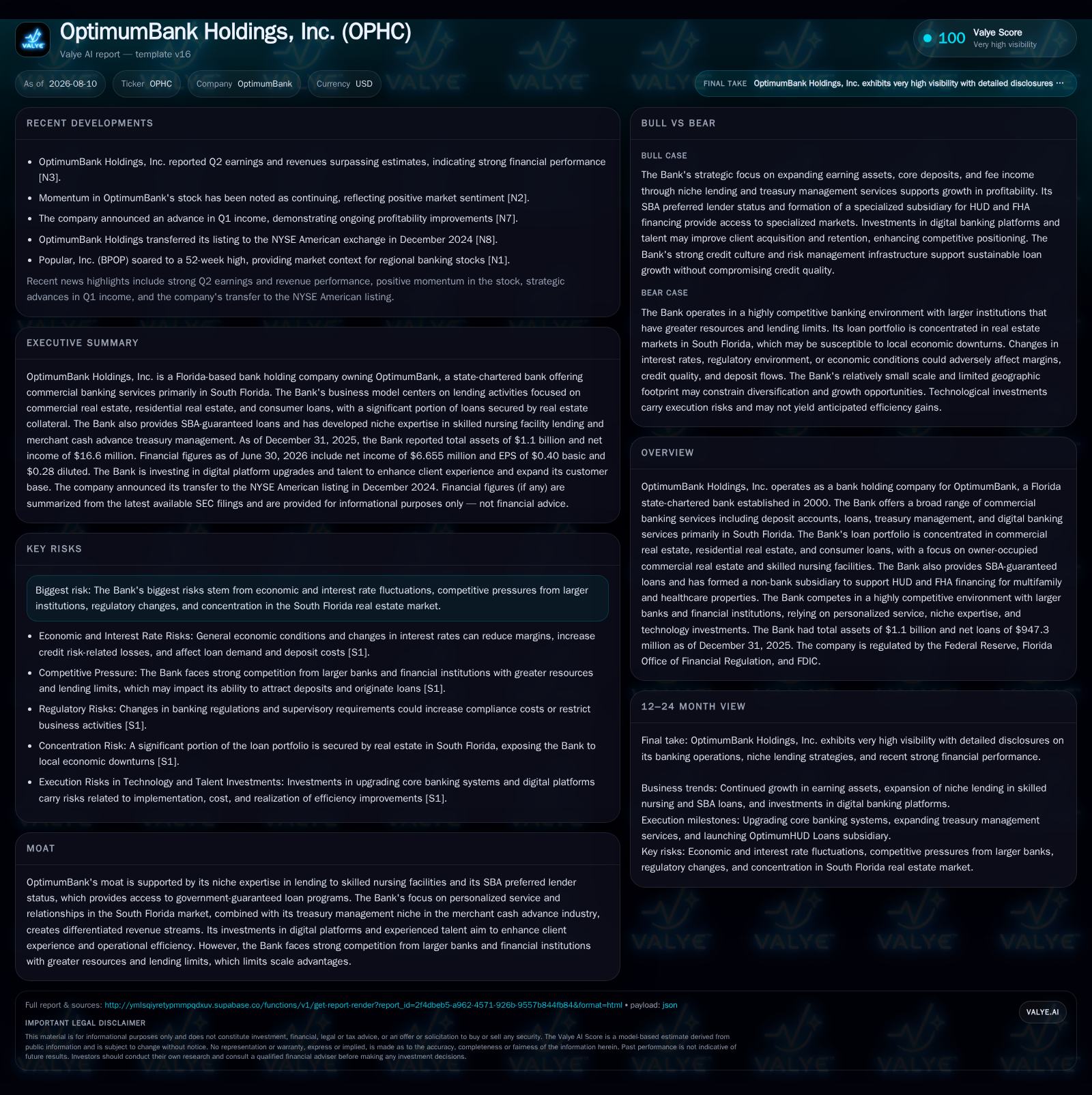
OptimumBank Holdings, Inc., operating primarily through its Florida-based OptimumBank, continues its focus on niche lending in commercial real estate and skilled nursing facilities alongside SBA-guaranteed loans. The company's latest quarterly disclosures show stable asset growth supported by personalized client service, a focused treasury management niche in the merchant cash advance sector, and investments in digital banking technologies. However, it faces structural challenges including competition from larger institutions with broader resources and exposure to regional economic conditions and interest rate fluctuations. Maintaining credit quality amid these pressures remains critical to sustaining profitability.
Recent Operating Update
OptimumBank Holdings’ most recent quarterly filing dated August 10, 2026, confirms ongoing strategic execution emphasizing loan portfolio growth, deposit base expansion, and enhancing fee income streams [S2]. The Q2 results align with prior communications that the bank is focusing on core lending sectors—commercial real estate (CRE), owner-occupied properties, skilled nursing facilities (SNFs), and SBA-guaranteed loans—which remain key contributors to asset quality and revenue generation. A July 24 event filing further detailed operational enhancements including treasury management initiatives within the merchant cash advance (MCA) industry niche that underpin both low-cost funding accumulation and noninterest income generation [S3].
Business Model Overview
OptimumBank operates as a Florida state-chartered bank primarily serving South Florida through focused commercial banking offerings encompassing deposit accounts, various loan products including CRE, residential real estate, consumer loans, SBA-guaranteed loans, treasury management services, and digital banking platforms [S1]. Its revenue model relies predominantly on net interest income derived from lending activities supported by deposits – its principal funding source – but importantly is complemented by noninterest fee income generated from treasury management services especially geared towards high-volume ACH transactions servicing MCA providers [S5].
The bank’s niche expertise lies in two overlapping areas: proprietary knowledge of lending to skilled nursing facilities coupled with SBA Preferred Lender status obtained in Q1 2025 which broadens its capacity to extend government-backed loans secured by accounts receivable, equipment or real estate assets [S1]. This specialization supports higher-quality relationship banking aimed at owner-occupied CRE borrowers including multifamily housing and healthcare properties. To complement this strategy, OptimumBank formed OptimumHUD Loans LLC as a wholly owned non-bank subsidiary in late 2025 intended to facilitate bridge-to-HUD/FHA financing solutions particularly relevant for borrower segments requiring long-term federally insured debt structures; this diversifies funding options while retaining sector expertise
This business concentration creates differentiated revenue streams but also exposes the company to regional economic dynamics including competitive supply-demand factors prevalent in South Florida’s real estate markets [S19]. Deposit gathering efforts extend beyond the immediate geography through reciprocal deposit networks like IntraFi to broaden the institution’s core transaction deposit base essential for stable low-cost funding required to support loan growth ambitions without resorting extensively to pricier brokered deposit sources
Industry Structure and Competitive Position
Within the regional commercial banking landscape characterized by intense competition from larger national banks as well as other community banks specializing in similar lending regions or niches, OptimumBank’s strategy hinges on leveraging unique sector insights—especially healthcare-related lending—and personalized client relationships. Unlike larger peers that may command scale advantages enabling greater lending limits and more extensive technology platforms, OptimumBank competes on depth of service within targeted verticals coupled with nimble digital adoption efforts to maintain operational efficiency [S1], [S5].
Peers such as Flagstar Bank have similarly capitalized on SBA lending credentials while others like FVCBankcorp operate with distinct treasury management focus areas; thus breadth of product offerings combined with localized market knowledge define competitive positioning metrics. The bank’s ability to maintain stringent underwriting standards despite growth initiatives is imperative given cyclical risks typical for CRE-heavy portfolios subject to regional economic cycles.
Growth Drivers
Key drivers include accelerating loan originations within CRE sub-sectors emphasizing owner-occupied premises alongside expanding SBA loan volumes facilitated by preferred lender status achieved recently. The establishment of OptimumHUD Loans LLC also signals potential new revenue avenues tapping federally backed multifamily and healthcare financing markets that traditionally require specialized servicing capabilities [S1]
On the deposit side, increasing core transaction accounts via existing customer relationships plus new acquisitions underpins funding stability crucial for sustainable net interest margin performance amidst volatile interest rate environments [S5]. Treasury management services aimed at MCA providers represent an innovative channel providing steady fee income; ongoing investments in process automation aim to capitalize on high ACH volumes by reducing cost per transaction and scaling this niche effectively throughout 2026
Digital banking enhancements play a strategic role in improving client acquisition/retention cost dynamics while underpinning operational scalability.
Risks and Constraints
Critical vulnerabilities include concentration risk stemming from localized South Florida economic downturns which could impair asset quality notably in CRE exposures vulnerable to property market corrections or regulatory shifts affecting healthcare operators reliant on SNF financing. Intense competition from larger banks possessing deeper capital bases imposes pricing pressure on deposit rates and underwriting terms limiting the bank’s margin expansion potential.
Interest rate fluctuations remain an overarching risk impacting net interest margin through both asset yield compression during rate cuts or heightened funding costs during hikes; effective asset-liability management will be crucial for preserving profitability. Regulatory changes around government-backed loan programs (e.g., SBA or HUD/FHA) could materially affect origination volumes or program economics. Lastly, technology adoption introduces operational risks including cybersecurity vulnerabilities or failed automation initiatives which could disrupt client experience or increase operating expenses if not executed prudently.
What To Watch Next
Upcoming milestones include monitoring the operational ramp of OptimumHUD Loans LLC subsidy activities reflecting success entering new federal financing markets. Loan portfolio growth rates especially in SBA 7A loans will signal traction against diversification goals while asset quality metrics such as nonperforming loans or provision levels will reveal credit risk trends under evolving economic conditions.
Deposit base growth pacing relative to regional market trends merits close observation as does progress toward treasury management automation targets anticipated through year-end 2026. Quarterly net interest margin development will be a key profitability indicator given current financial market uncertainties.
Finally, any substantive regulatory developments relating specifically to SBA program eligibility or FDIC policies would be material catalysts.
Financial Profile Discussion
Financial expenses principally comprise interest paid on deposits which fluctuate according to competitive dynamics impacting deposit cost of funds; noninterest expenses reflect operating costs related to personnel investments critical for talent acquisition necessary for maintaining full-service relationship banking capabilities alongside technology modernization projects [S1]. Loan loss provisions are calibrated prudently with emphasis on maintaining asset quality integrity given regional sector exposures.
Overall efficiency ratios indicative of cost-to-revenue trends should improve if digital platform investments yield anticipated operational leverage benefits while return on equity performance will depend on balancing asset yield management amidst external interest rate volatility risks.
This analysis is based solely on publicly available filings and sector knowledge provided without investment research views.
Disclaimer: This is research-only, informational analysis and not investment advice. It may include AI-generated interpretation and general industry context. Always verify important details using primary sources.

Comments